

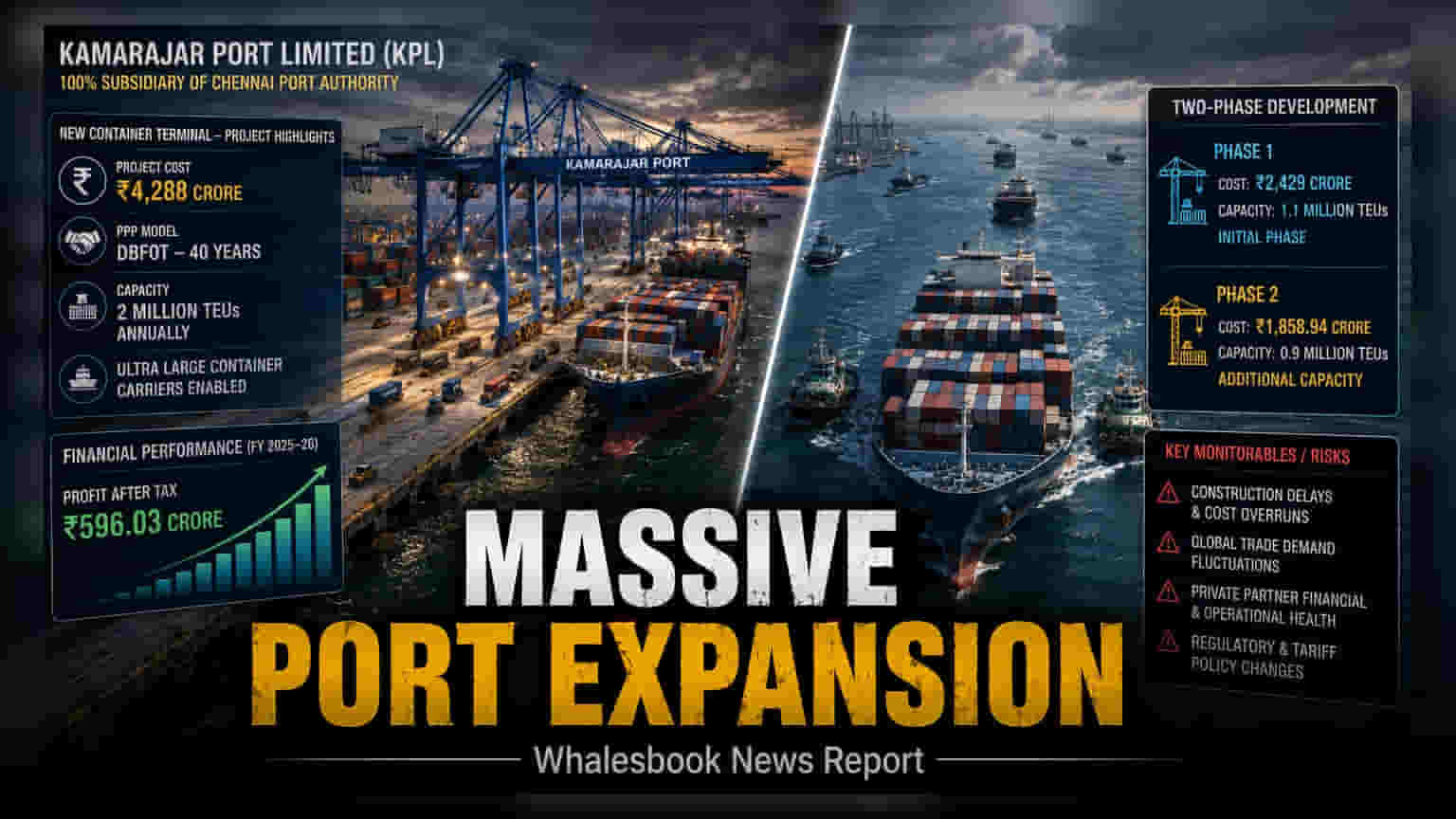
State-owned Kamarajar Port Limited has invited bids to build a new container terminal worth ₹4,288 crore under a public-private partnership. This expansion aims to boost cargo capacity by 2 million TEUs annually, signaling significant growth plans ahead of the port's expected IPO in FY2027.
Kamarajar Port Limited (KPL), a 100% subsidiary of the Chennai Port Authority, has formally invited bids to develop its second container terminal. The project is estimated at ₹4,288 crore and will be executed under a Public-Private Partnership (PPP) model on a Design, Build, Finance, Operate, and Transfer (DBFOT) basis. Under this arrangement, the chosen private partner will manage the terminal for 40 years before transferring it back to the port authority.
The project is a significant infrastructure push as KPL prepares for its anticipated public listing. The company, which is currently an unlisted state-owned entity, has reported solid financial performance, with a Profit After Tax of ₹596.03 crore for the 2025-26 fiscal year. With government plans for an IPO in FY2027, the success of this major expansion project will be a key area for potential future investors to track, as it aims to scale up operational capacity ahead of the public issue.
The expansion is designed to handle 2 million Twenty-Foot Equivalent Units (TEUs) annually and will be rolled out in two phases. The first phase, with an estimated cost of ₹2,429 crore, will establish an initial capacity of 1.1 million TEUs. The second phase, budgeted at approximately ₹1,858.94 crore, will contribute the remaining 0.9 million TEUs of capacity. The terminal is being designed to handle Ultra Large Container Carriers, a strategic move to attract larger vessels and increase the port's share of regional transshipment cargo.
While the project aims to improve throughput, it also carries typical infrastructure risks. Investors should keep in mind that large-scale port projects are sensitive to construction delays, cost increases, and fluctuations in global trade demand. Additionally, because the project relies on a private partner to finance and operate the facility, the financial and operational health of the selected partner remains a critical monitorable. If the private partner encounters liquidity issues or fails to meet performance targets, it could create operational hurdles for the port.
Furthermore, KPL operates within a regulated sector where changes in government tariff policies or shipping regulations can directly impact profitability. As the company moves toward a potential public listing, the ability to effectively manage the risks associated with this large debt-funded project and maintain steady margins will be important. The next step for the port is the partner selection process, followed by the start of construction, which will dictate the project's timeline and long-term financial impact.