

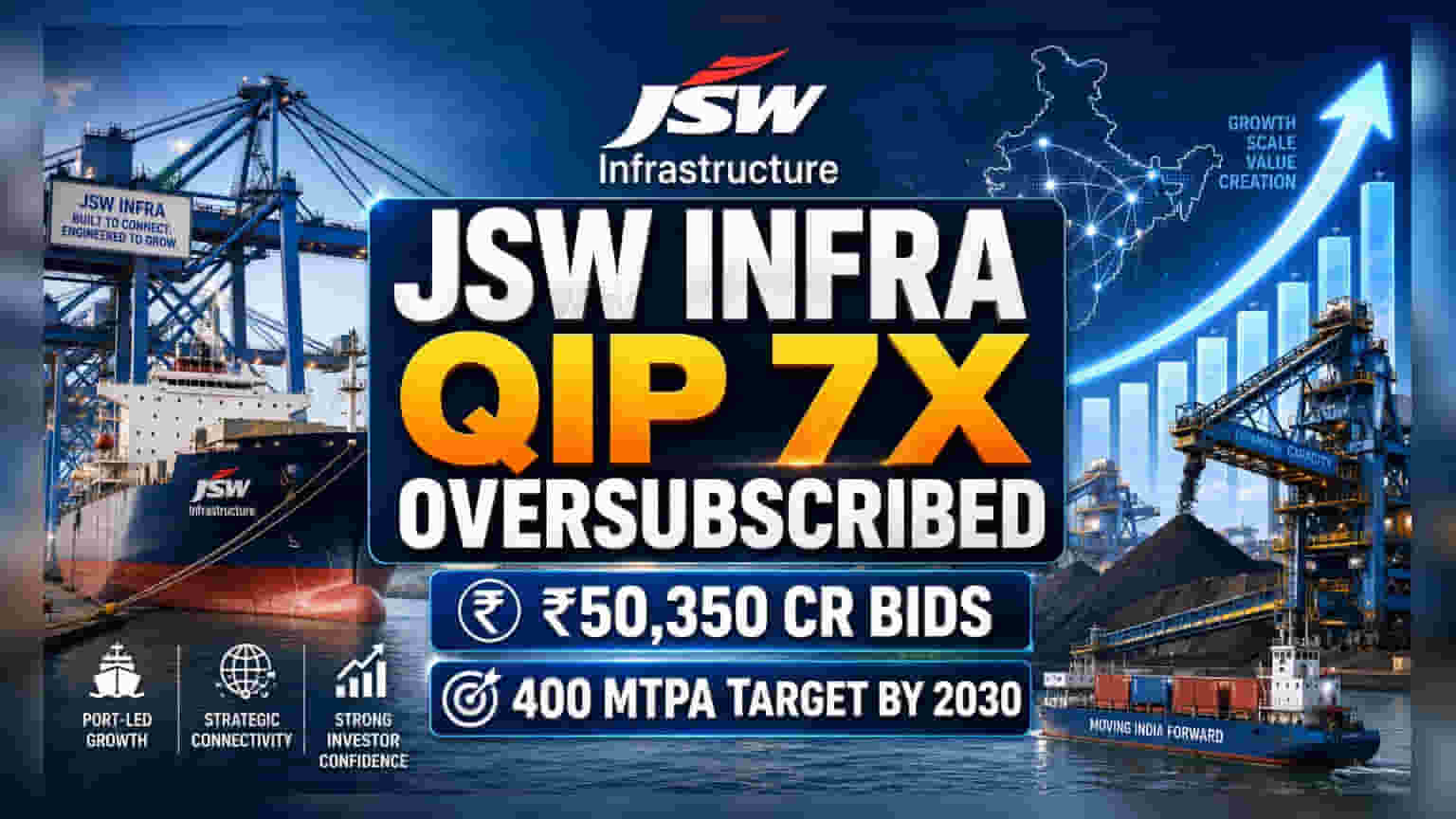
JSW Infrastructure’s share sale to institutional investors attracted bids worth over ₹50,350 crore, marking a seven-fold oversubscription. The strong demand signals investor interest in the company’s goal to expand port capacity to 400 million tonnes by 2030. The raised capital is earmarked for new projects, acquisitions, and debt reduction.
What Happened
JSW Infrastructure has successfully closed its Qualified Institutional Placement (QIP), a method where listed companies raise capital by issuing shares to large institutional investors. The company aimed to raise ₹7,503 crore, but the offering saw an overwhelming response, attracting bids totaling over ₹50,350 crore. This means demand from investors was seven times higher than the actual shares on offer. The floor price for this issue was set at ₹285 per share. The process, which concluded recently, included both the issuance of new shares and an offer for sale by the promoters.
The Growth Path To 400 MTPA
The capital raised is a critical part of the company's broader expansion strategy. JSW Infrastructure, which is the second-largest private port operator in India, is aiming to increase its cargo handling capacity to 400 million tonnes per annum (MTPA) by the fiscal year 2030. To reach this, the company is shifting from being a simple port operator to an integrated logistics provider. This involves moving money into rail connectivity, inland container depots, and multimodal logistics parks. By expanding into these areas, the company hopes to capture more value from the goods moving through its ports rather than just charging for the port services themselves.
How It Compares With Sector Leaders
The Indian port sector is dominated by a few large players, with Adani Ports and Special Economic Zone (APSEZ) being the primary competitor in the private space. Compared to some peers, JSW Infrastructure maintains a specific focus on handling bulk commodities like coal, iron ore, and limestone, which are essential for industrial activities. While Adani Ports has a more diverse geographic presence and a larger container handling business, JSW Infrastructure is leveraging its connection to the wider JSW Group's industrial needs to drive volume. Investors often view this group-led demand as a stable base for the business, though it also means the company’s performance is tied closely to the health of the steel and cement industries.
Key Risks To Watch
While the high demand for the QIP shows investor confidence, the business model carries inherent risks. Port development is highly capital-intensive, meaning it requires massive spending on expansion before revenue starts flowing in. This puts pressure on the balance sheet. Although the company plans to use part of the funds to lower its debt, rapid expansion projects can lead to unexpected cost increases or delays in commissioning. Furthermore, because port revenues depend heavily on global commodity trade volumes, any major slowdown in industrial production or a drop in raw material demand can directly impact the company's profit margins.
What Investors Should Track Next
The immediate monitorable for shareholders is the pace of execution for the projects planned between now and 2030. Investors will be watching for the commissioning timeline of the new port assets. Additionally, tracking the debt-to-equity ratio in the coming quarters will be important to see if the company is successfully managing its leverage while pursuing this ambitious growth. Finally, management commentary on the actual progress of the integrated logistics network and the ability to win third-party cargo—outside of the JSW Group—will provide clues on how successfully the company is diversifying its revenue base.