

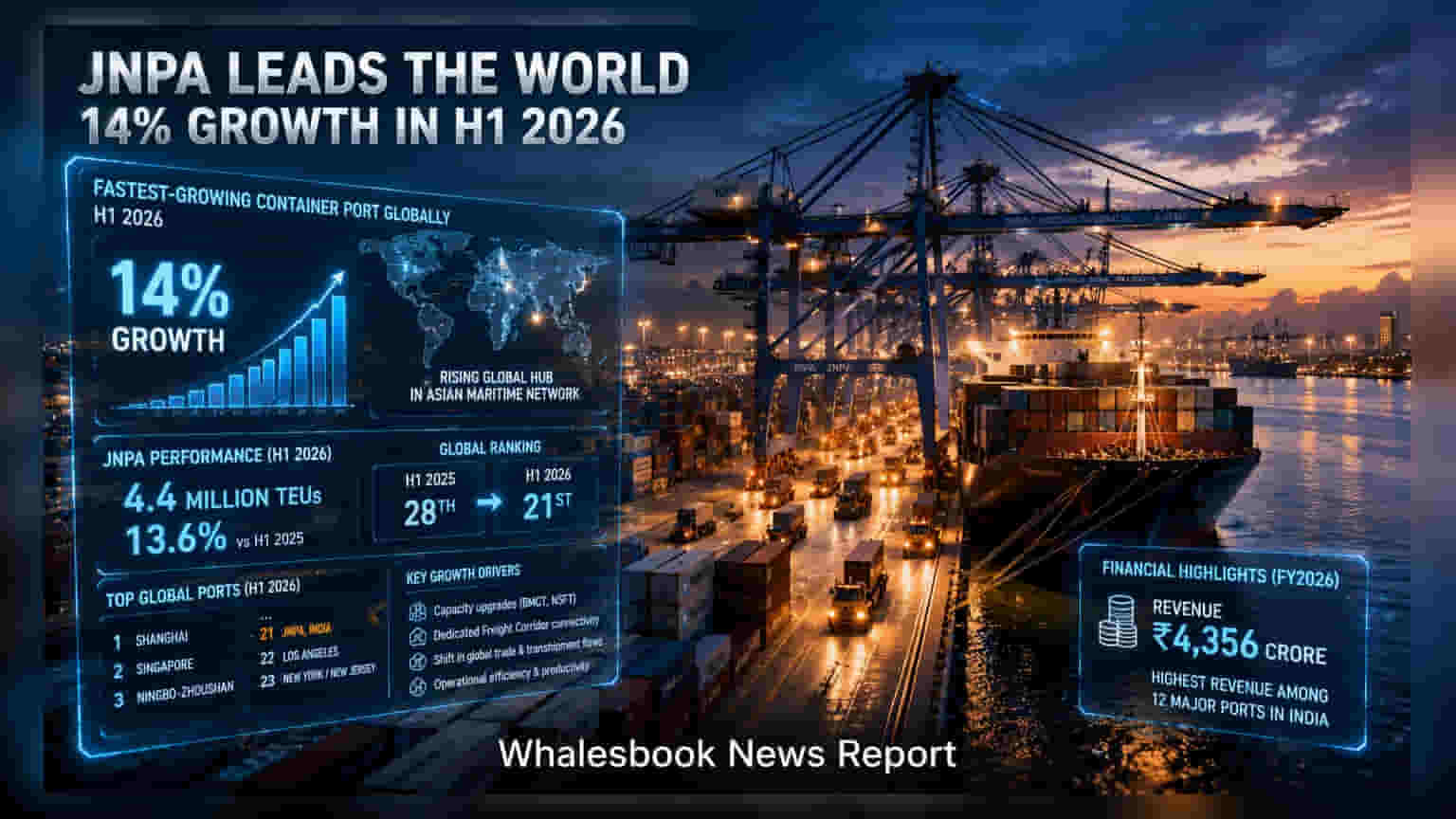
The Jawaharlal Nehru Port Authority (JNPA) recorded 13.6% growth in container volume during the first half of 2026, reaching 4.4 million standard shipping containers. Driven by geopolitical trade shifts and infrastructure efficiency, the port is now ranked 21st globally. While JNPA is a government-owned entity and not a publicly traded stock, this growth highlights India's strengthening position in maritime logistics, though investors in related sectors should monitor ongoing geopolitical and competition risks.
The Jawaharlal Nehru Port Authority (JNPA) has emerged as the fastest-growing container port globally for the first half of 2026. According to data from the shipping research firm Alphaliner, the Mumbai-based port handled 4.4 million twenty-foot equivalent units (TEUs)—the industry standard for measuring container capacity—marking a 13.6% increase compared to the same period in 2025. This performance has elevated the port to the 21st position in global rankings, a significant improvement from its 28th place standing the previous year.
Drivers of Operational Growth
This growth is largely credited to a combination of operational efficiency and shifting global trade routes. JNPA has successfully leveraged its capacity upgrades at terminals such as the Bharat Mumbai Container Terminals (BMCT) and the Nhava Sheva Free Port Terminals (NSFT). These infrastructure improvements have allowed the port to handle higher volumes with greater speed. Furthermore, the operationalization of long-haul double-stack rake services on the Dedicated Freight Corridor (DFC) has improved connectivity, making the port a more attractive option for exporters and importers.
Geopolitical developments have also played a role. Regional supply chain disruptions have led to a structural shift in maritime cargo movement. Cargo that was previously routed through other major regional hubs, such as Jebel Ali in Dubai, has been redirected toward Indian ports. This shift has allowed JNPA to capture additional transshipment volumes, effectively moving the port from a local import-export node to a more central transit point in the Asian maritime network.
Financial Context and Investor Monitorables
For market participants, it is important to note that the Jawaharlal Nehru Port Authority is a government-owned entity and is not a publicly traded company on the NSE or BSE. Therefore, investors cannot purchase equity shares in the port authority. However, JNPA has previously issued non-convertible debentures (NCDs) that are listed on Indian exchanges. The port reported revenue of ₹4,356 crore in the 2026 fiscal year, maintaining its position as the highest-revenue generator among India’s 12 major ports.
While the current growth numbers are positive, investors in the logistics and maritime infrastructure space should maintain a balanced view. The reliance on redirected cargo due to geopolitical instability is a double-edged sword; if transit routes stabilize, traffic patterns could revert. Additionally, the port faces ongoing competition from other domestic facilities, such as the Adani-operated Mundra Port, which is the only other Indian port currently in the global top 30.
Capital spending (capex) remains a key factor for the port’s long-term financial health. Large infrastructure projects, while necessary for capacity, can place pressure on liquidity and debt servicing capabilities. Investors tracking the broader port and logistics sector should focus on the sustainability of this volume growth as global trade conditions evolve, as well as the port's ability to maintain its efficiency advantage against regional competitors.