 Whalesbook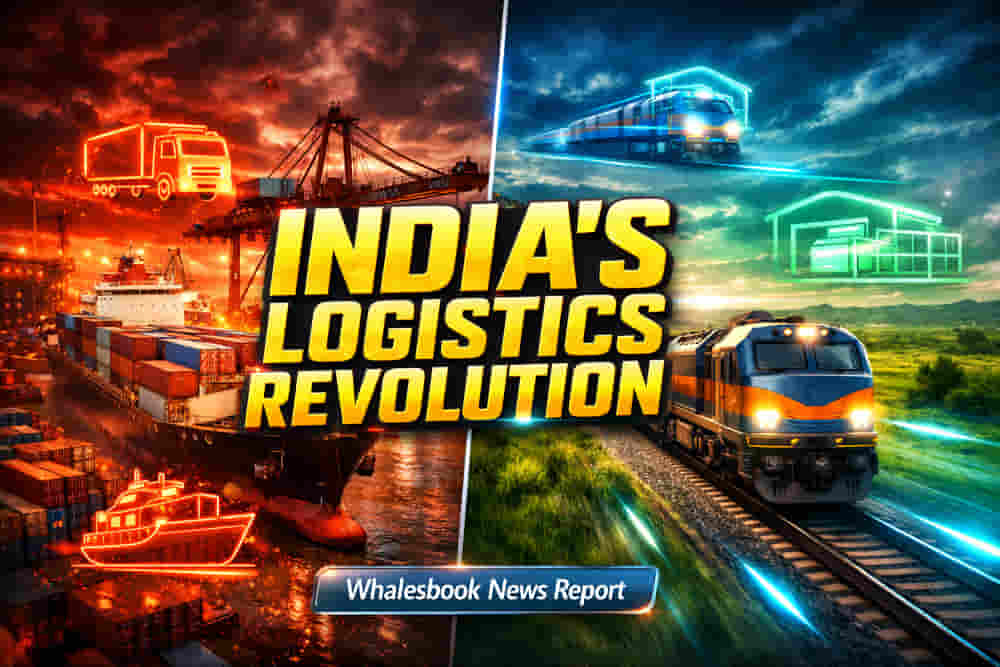
India's Multimodal Logistics Transformation
India is actively promoting multimodal transport, a strategy that utilizes various modes of transport like road, rail, and sea to move goods, aiming to reduce reliance on single modes and enhance efficiency. This shift is significantly propelled by the government's PM Gati Shakti plan, which integrates planning and execution across railways, roads, and ports to create cohesive infrastructure networks. The initiative focuses on developing dedicated freight corridors, rail-linked cargo terminals, and improving port connectivity, with the overarching goal of shortening transit times and lowering overall logistics expenses. This policy framework is encouraging a gradual migration of freight towards more organized and integrated transportation routes, opening avenues for companies operating in this space. The development of such infrastructure is a capital-intensive, long-term endeavor, with benefits often realized as networks and terminals become operational and see increasing utilization. Companies involved in rail evacuation, port operations, and integrated freight movement are positioned to benefit from improved operational efficiency and volume growth, with policy support mitigating some execution risks.
Company Performance Snapshots
Transport Corporation of India (TCI): For the second quarter of fiscal year 2026 (Q2 FY26), Transport Corporation of India reported consolidated revenue growth of 7.6% year-on-year, reaching ₹1,205 crore. Net profit for the same period increased by 6.5% to ₹114 crore. Growth drivers included the supply chain segment, which saw its revenue increase by 17.8% for the quarter, and rail operations, which handled over 1,400 rakes in the first half of FY26. The company is undertaking capital expenditure of approximately ₹170 crore in the first half of FY26, funded through internal accruals, to support network expansion and capacity additions. Management indicated that while freight demand remains varied, there are signs of stabilization, with gradual volume growth anticipated. However, margin recovery is expected to be slow due to ongoing competitive pressures. TCI has yet to report its results for Q3 FY26.
JSW Infrastructure: JSW Infrastructure reported revenue growth of 14% year-on-year to ₹1,350 crore for the December quarter of FY26, with net profit rising 9% to ₹365 crore. For the nine-month period ended December, revenue stood at ₹3,839 crore, a 20% increase year-on-year, and profit grew 12% to ₹1,123 crore. Cargo volumes for the quarter increased by 8% to 31.7 million tonnes, supported by new operations in Tuticorin and JNPA, though this was partly offset by reduced iron ore movement at Paradip. The company continues to focus on capacity expansion, with ongoing projects at Tuticorin and Mangalore, and a significant greenfield port development in Oman scheduled for commissioning by the first half of 2029. Leverage remained at a comfortable level of 0.76 times EBITDA.
Adani Ports and Special Economic Zone (APSEZ): Adani Ports & Special Economic Zone announced Q2 FY26 consolidated revenue growth of 19% year-on-year to ₹9,167 crore, with net profit surging 42% to ₹3,120 crore, supported by improved operating performance and reduced interest expenses. Cargo handled across its ports reached 104 million tonnes, a 7% increase from the prior year, primarily driven by domestic container volumes. Expansion initiatives, including progress at the Vizhinjam port and capacity enhancements at Ennore and Krishnapatnam, are continuing. Operations at Haifa Port in Israel proceeded without significant disruptions. The company maintained a net leverage of 2.3 times EBITDA. APSEZ has not yet declared its results for Q3 FY26.
Valuation and Financial Health
Analyzing the valuations using the Enterprise Value to EBITDA (EV/EBITDA) multiple, Transport Corporation of India is trading at 12.2 times, which is below its five-year median of 13.2 times, and reports a Return on Capital Employed (ROCE) of 20.5%, the highest among the companies discussed. JSW Infrastructure is valued at an EV/EBITDA of 21.2, trading below its five-year median of 25.3, with a ROCE of 13.9%, suggesting that significant growth potential may not yet be fully reflected in its current market pricing. Adani Ports and Special Economic Zone trades at an EV/EBITDA of 16.3, close to its five-year median of 16.5, with a ROCE of 13.8%, indicating stable valuations and returns.
As of January 22, 2026, Transport Corporation of India's market capitalization is approximately ₹25,500 crore, with a P/E ratio around 35x. JSW Infrastructure has a market capitalization of about ₹55,500 crore and a P/E ratio near 45x. Adani Ports and Special Economic Zone holds a market capitalization of approximately ₹1,85,000 crore, with a P/E ratio around 40x. These valuation metrics suggest that while some companies trade below their historical averages, the overall sector's pricing reflects a cautious outlook on rapid re-ratings, contingent on volumes exceeding current expectations.
Market Movement and Outlook
As of January 22, 2026, Transport Corporation of India's share price is trading around ₹720. JSW Infrastructure's stock is priced near ₹210. Adani Ports and Special Economic Zone's shares are trading at approximately ₹1350. The transition to multimodal freight in India is considered an early-stage, structural play. Progress is anticipated to be gradual, with volumes building incrementally. Success in this domain is expected to depend more on effective execution and capital discipline rather than rapid expansion. Valuations across the sector generally align with historical trends, offering limited scope for substantial upward re-ratings unless cargo volumes grow at a faster pace than projected. For investors, this theme represents a long-term opportunity, where progress is likely to unfold in stages, emphasizing the importance of patience and a focus on steady volume growth and efficient utilization of existing capacity.