

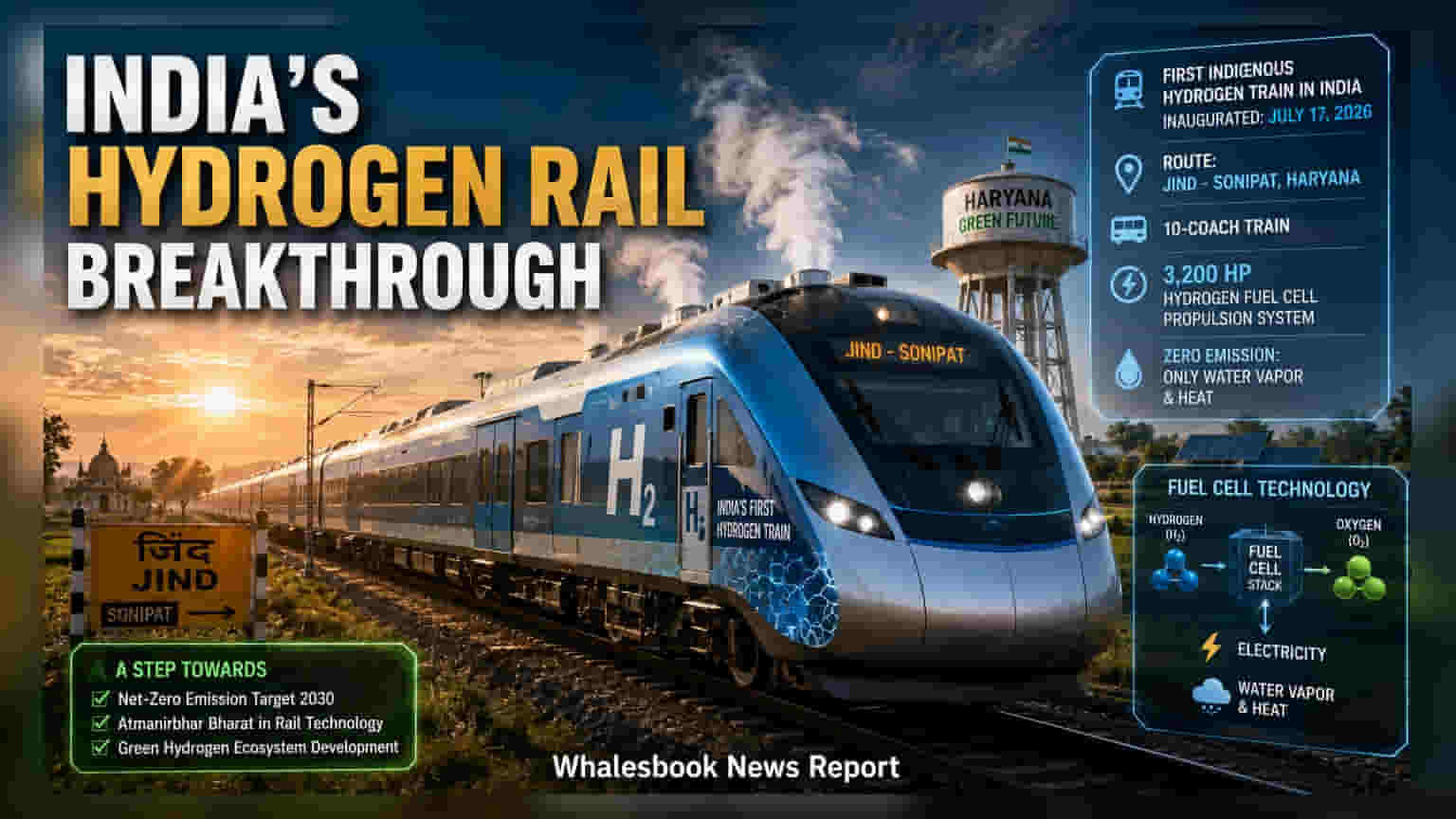
India has launched its first indigenous hydrogen-powered passenger train on the Jind-Sonipat route. Developed by Indian Railways and private partner Medha Servo Drives, the project marks a significant step in rail decarbonization. Investors should note the pilot's high capital intensity and the long-term challenges of scaling green hydrogen infrastructure across the national network.
India has officially commenced operations of its first indigenous hydrogen-powered passenger train. The train, which was inaugurated on July 17, 2026, is currently running on the Jind-Sonipat section in Haryana. This 10-coach train utilizes hydrogen fuel cell technology, which generates electricity by combining hydrogen and oxygen, with water vapor and heat as the only byproducts. This move is part of the broader 'Atmanirbhar Bharat' initiative aimed at modernizing the national rail network and moving toward 2030 net-zero emission targets.
The Role of Technology Partners
The project involves a collaboration between Indian Railways, the Integral Coach Factory (ICF), and Medha Servo Drives. Medha Servo Drives Pvt. Ltd., the private partner, was responsible for integrating the fuel cell-based propulsion system. For investors, it is important to note that Medha Servo Drives is an unlisted private limited company. Consequently, there is no direct public equity exposure to the specific company manufacturing these propulsion units. However, the project highlights the increasing role of private engineering and technology firms in complex government infrastructure projects.
Investor Perspective: Opportunity and Challenges
While the launch represents a significant milestone in engineering, the sector presents distinct considerations for investors monitoring the energy and rail transition. The primary opportunity lies in the potential for large-scale infrastructure spending. Scaling this technology requires significant capital expenditure, not just for the trains themselves but for the supporting hydrogen ecosystem, including specialized refueling stations and production facilities. The project at Jind, developed in partnership with GreenH Electrolysis, serves as a test case for whether such technology can be economically viable across India's vast and varied rail network.
Risks and Monitorables
Investors tracking the green mobility space should consider several operational and financial risks. First, the reliability of fuel cell technology in India’s diverse climatic conditions is still being tested. Second, the cost of hydrogen is a major factor. The economic benefit depends heavily on whether the hydrogen is produced using renewable energy, known as green hydrogen, or fossil fuels, known as grey hydrogen. Green hydrogen is currently expensive to produce, and until production costs drop, profitability and scalability will remain under pressure. Additionally, supply chain dependency is a concern, as critical components like high-performance fuel cell stacks have historically been sourced from international suppliers, although the project aims to push domestic manufacturing.
Moving forward, the key monitorable for the industry is the government's long-term policy support and budgetary allocation for hydrogen rail infrastructure. While the Jind-Sonipat pilot provides proof of concept, the transition from pilot project to national adoption will depend on sustained cost reduction, technological maturity, and the availability of affordable hydrogen fuel. Investors may look to follow updates on policy frameworks regarding green hydrogen and upcoming infrastructure tenders in the rail sector.