

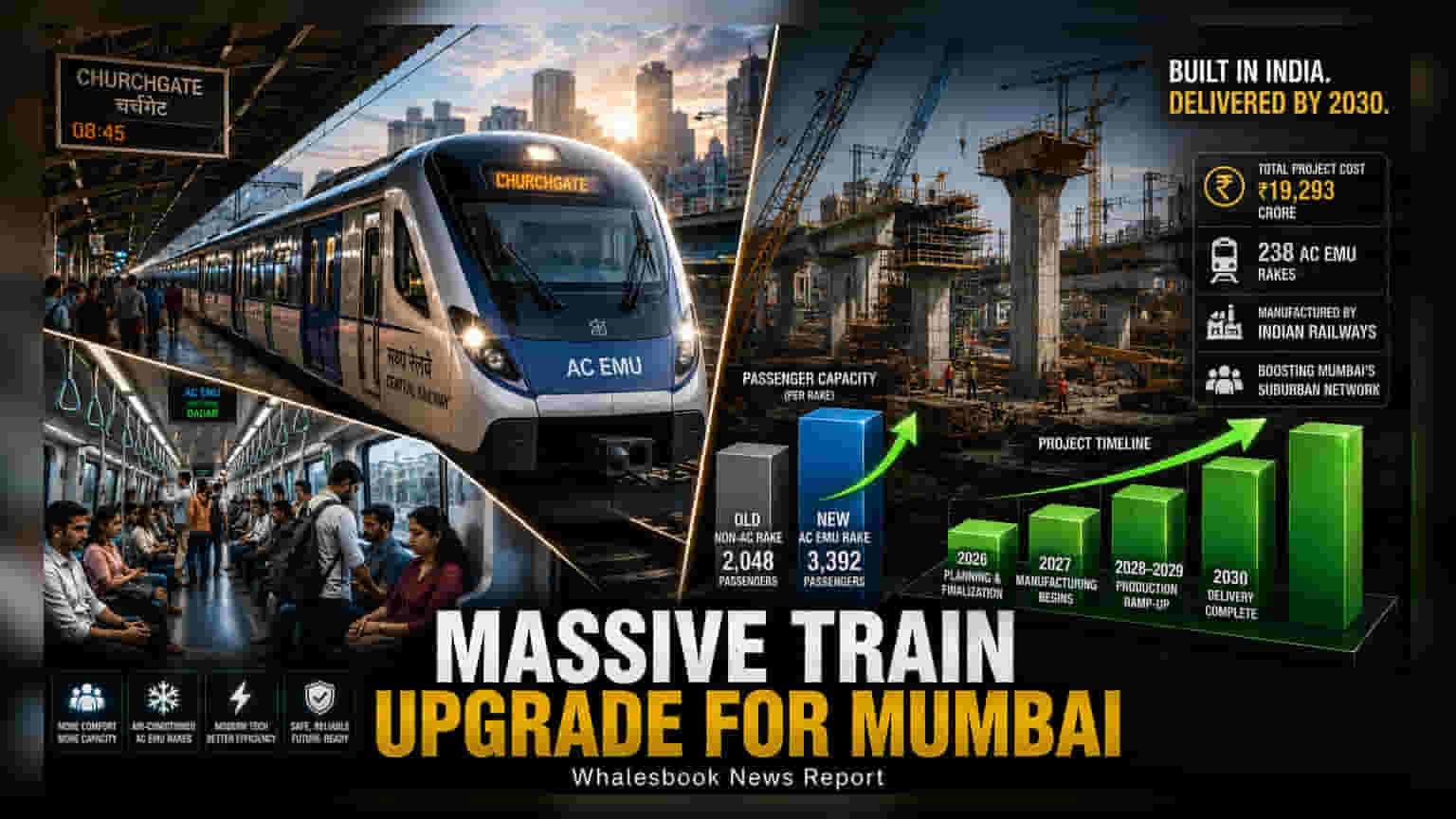
Indian Railways has finalized plans to manufacture 238 AC EMU rakes internally for Mumbai’s suburban network by 2030, with an estimated investment of ₹19,293 crore. This move replaces a delayed international tender and seeks to align rolling stock delivery with infrastructure expansion. Investors may track the potential impact on the broader railway supply chain, including companies that provide electrical components, braking systems, and interior materials.
The Ministry of Railways has decided to take charge of manufacturing 238 air-conditioned Electric Multiple Unit (EMU) rakes for the Mumbai suburban rail network. The project, which involves an estimated capital outlay of ₹19,293 crore, is designed to ensure that rolling stock is ready by 2030. This decision comes after the cancellation of an international tender process that was deemed too slow, with potential delivery timelines stretching into 2034. By keeping the manufacturing in-house, the ministry aims to synchronize the delivery of trains with the ongoing expansion under the Mumbai Urban Transport Project (MUTP).
Manufacturing Hubs and Production Strategy
The responsibility for this massive order has been split across three of the Indian Railways' own manufacturing facilities. The Integral Coach Factory (ICF) in Chennai is set to lead the project, with a target to produce 120 rakes. The Rail Coach Factory (RCF) in Kapurthala has been assigned 71 rakes, and the Modern Coach Factory (MCF) in Raebareli will handle the remaining 47. This distribution strategy is intended to utilize existing capacity across these plants to ensure the 2030 deadline is met. The project will rely on technical specifications already established by the Research Designs and Standards Organisation (RDSO).
Investor Angle: Supply Chain Impact
While the primary manufacturing is handled by government units, this large-scale project creates significant opportunities for private companies in the railway ancillary sector. For investors, the focus remains on the supply chain ecosystem. Since these are air-conditioned rakes, there will be substantial demand for high-end electrical components, HVAC systems, and advanced braking technology. Additionally, companies specializing in train interiors, specialized steel, propulsion systems, and traction motors are likely to see increased order flow as the manufacturing tempo ramps up starting in 2027.
Execution and Delivery Risks
Manufacturing 238 trainsets over a few years is a significant operational task. The primary risk for the project is execution efficiency. Maintaining high production standards while scaling up across three different facilities simultaneously can lead to supply chain bottlenecks or cost overruns. Furthermore, the synchronization with the MUTP infrastructure is critical. If the broader infrastructure work, such as station upgrades or track capacity expansion, faces delays, the new rakes could remain underutilized, affecting the overall return on this massive investment.
Investors should monitor upcoming contract awards related to the supply of components for these trainsets. Tracking production milestones at ICF, RCF, and MCF will also provide clarity on whether the project is moving according to the 2030 schedule.