 Whalesbook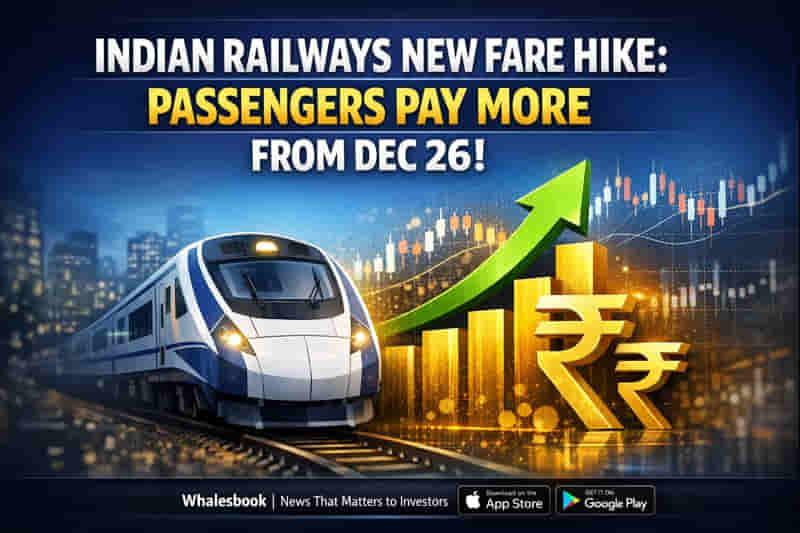
The Fare Adjustment
Indian Railways has announced a significant update to its fare structure, set to take effect on December 26, 2025. This strategic change is projected to generate an estimated additional revenue of ₹600 crore for the national transporter.
The revised pricing model introduces a modest increase for most long-distance passengers. Those undertaking journeys exceeding 215 kilometers will experience a fare adjustment of 1 paisa per kilometer for travel in Ordinary Class.
For passengers opting for Mail or Express trains, including both Non-AC and AC accommodations, the increase will be 2 paise per kilometer for distances beyond 215 kilometers.
Affordability Safeguards
Recognizing the importance of accessible travel for all sections of society, Indian Railways has explicitly stated that no fare hikes will be applied to passengers traveling routes shorter than 215 kilometers.
Furthermore, the pricing for suburban services and monthly season tickets, which are crucial for daily commuters, will remain unchanged. This ensures that the cost of daily travel for low and middle-income families remains stable.
Freight and Infrastructure Focus
In contrast to passenger fares, the Ministry of Railways highlighted that freight rates have not seen any revision since 2018. This is notable given the substantial increase in input costs the railway network has faced over the years.
The ministry also provided updates on major infrastructure projects. Construction on the flagship high-speed bullet train project has advanced significantly in Maharashtra, with 100% land acquisition now completed.
Between 2014 and 2025, Indian Railways has undertaken extensive procurement, adding approximately 2 lakh wagons and over 10,000 locomotives. This investment aims to bolster freight loading capacity and enhance overall mobility across the network.
Union Minister for Railways, Ashwini Vaishnaw, informed the Lok Sabha about the progress of the government's ‘Gati Shakti Multi-Modal Cargo Terminal (GCT)’ policy. To date, 118 new GCTs have been commissioned, collectively capable of handling an estimated 192 million tonnes per annum.
Significant strides have also been made in electrification. Indian Railways reports that approximately 99.1% of its Broad Gauge network has now been electrified, contributing to operational efficiency and environmental goals.
Impact
This fare adjustment is expected to have a direct impact on the travel expenses of millions of passengers undertaking long-distance journeys. The estimated ₹600 crore revenue gain could contribute to the operational finances of Indian Railways.
For businesses, the unchanged freight rates provide stability in logistics costs, although the overall impact on the Indian logistics sector remains tied to various other factors. The continued development of infrastructure like GCTs and electrification suggests a focus on improving efficiency and capacity.
Impact Rating: 6
Difficult Terms Explained
Ordinary Class: The basic, non-reserved class of travel on Indian trains.
Mail/Express: Faster trains that operate on scheduled routes, typically with higher fares than ordinary trains.
Non-AC: Train compartments that do not have air conditioning.
AC: Air-Conditioned, referring to train compartments equipped with air conditioning systems.
Freight Rates: The prices charged for transporting goods by train.
Input Cost: The expenses incurred by a business in the process of producing goods or services, such as fuel, labor, and materials.
Bullet Train Project: A high-speed railway line designed for faster passenger transportation, often involving advanced technology.
Gati Shakti Multi-Modal Cargo Terminal (GCT): Integrated logistics hubs that aim to connect various modes of transport for efficient cargo movement.
MTPA: Million Tonnes Per Annum, a unit used to measure the capacity of cargo handling.
Broad Gauge (BG): The standard track gauge used by Indian Railways, referring to the distance between the inner sides of the two parallel rail tracks.
Electrification: The process of equipping railway lines with overhead power lines to supply electricity to trains.