

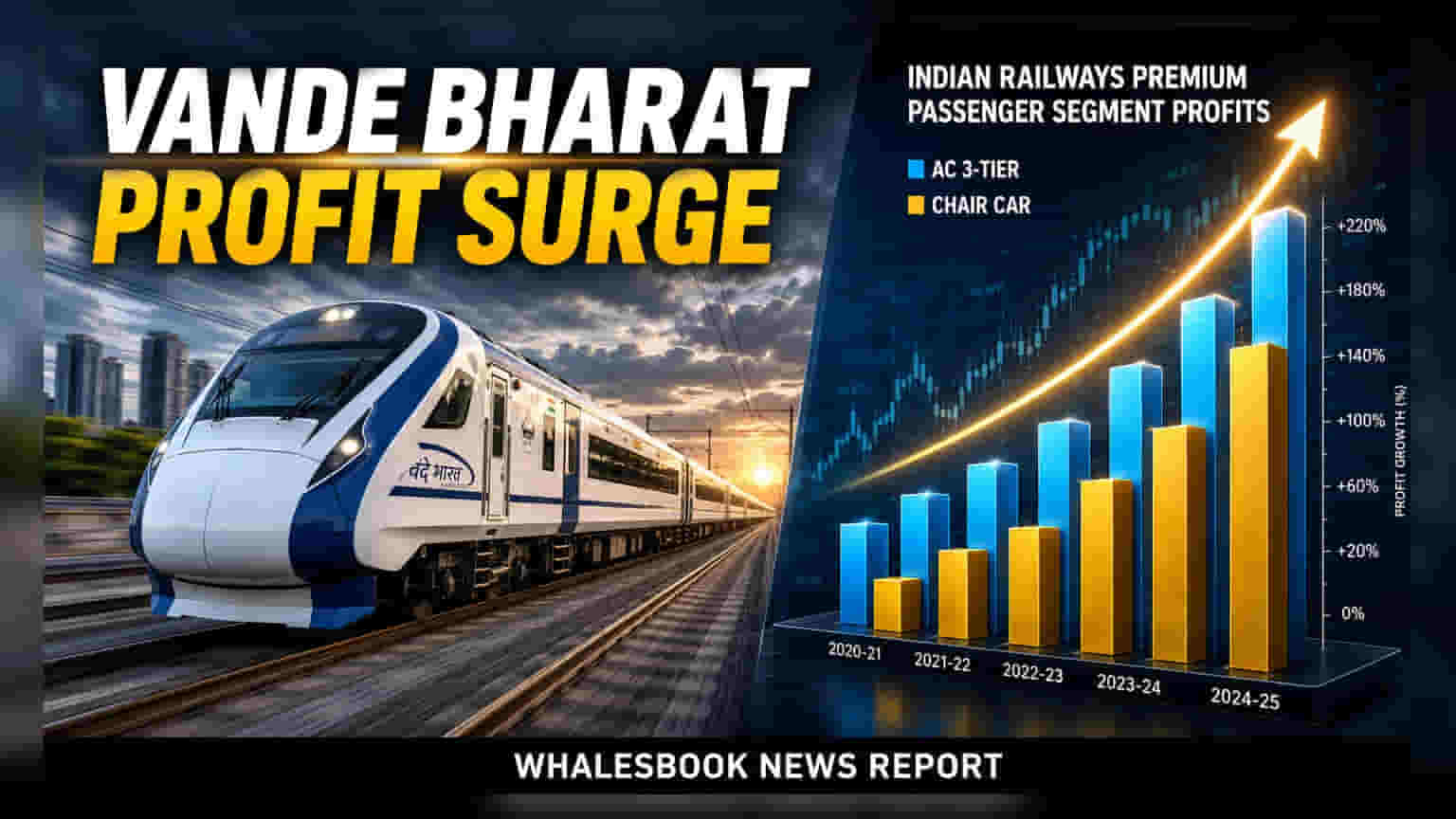
Indian Railways is scaling up its Vande Bharat network as AC 3-tier and Chair Car segments emerge as the only profitable passenger categories. With over 3.98 crore passengers in FY26, the strategy aims to improve the railway's thin operating margins. While premium travel demand remains high, the shift highlights a critical balancing act between high-visibility passenger projects and the essential freight capacity required for core railway economics.
Indian Railways is significantly increasing its focus on the Vande Bharat brand, shifting its operational strategy to prioritize premium passenger segments that consistently generate profit. This move comes as the national transporter grapples with a high operating ratio—estimated at around 98.8% for FY26—which leaves very little margin for error in its overall financial health.
The economic rationale for this expansion is found in the performance of AC 3-tier and AC Chair Car services. Data from FY25 shows that these two categories were the only passenger segments to remain profitable, with AC 3-tier reporting a profit of ₹3,645.44 crore and AC Chair Car contributing ₹376.77 crore. In contrast, many other passenger classes continue to operate at a loss, necessitating a heavy reliance on freight revenue to subsidize passenger operations.
Premium services like the Vande Bharat and the newly introduced Vande Bharat Sleeper are central to this revenue-generation model. The Vande Bharat network has seen rapid adoption, with ridership hitting approximately 3.98 crore passengers in FY26, a 34% increase over the previous year. The sleeper variant, launched in January 2026, has further validated this demand, with occupancy rates consistently exceeding 100% in its initial months. This success gives the Railways a clear incentive to deploy more high-speed, premium-fare trains to improve the yield per passenger.
While the expansion of premium trains is a visible success, it creates a complex trade-off for the broader railway system. Indian Railways must balance these high-visibility passenger projects with the need for infrastructure upgrades like track doubling and the expansion of dedicated freight corridors. Freight movement typically provides the bulk of the Railways' revenue, and analysts often point out that any diversion of capital or track capacity toward passenger expansion could create long-term bottlenecks for the country’s logistics sector.
Furthermore, the Railways face the constant challenge of pricing sensitivity. While premium segments are currently profitable, the ability to increase fares remains tied to political and social factors, which limits the organization's pricing power. For companies within the railway supply chain—such as rolling stock manufacturers, signaling providers, and track equipment suppliers—the key monitorable is the sustainability of this capital-intensive expansion. The pace of infrastructure commissioning, the actual utilization rates of new sleeper services, and the ability of the Railways to maintain this premium pivot without compromising on essential freight logistics will define the financial performance of the sector in the coming years.