 Whalesbook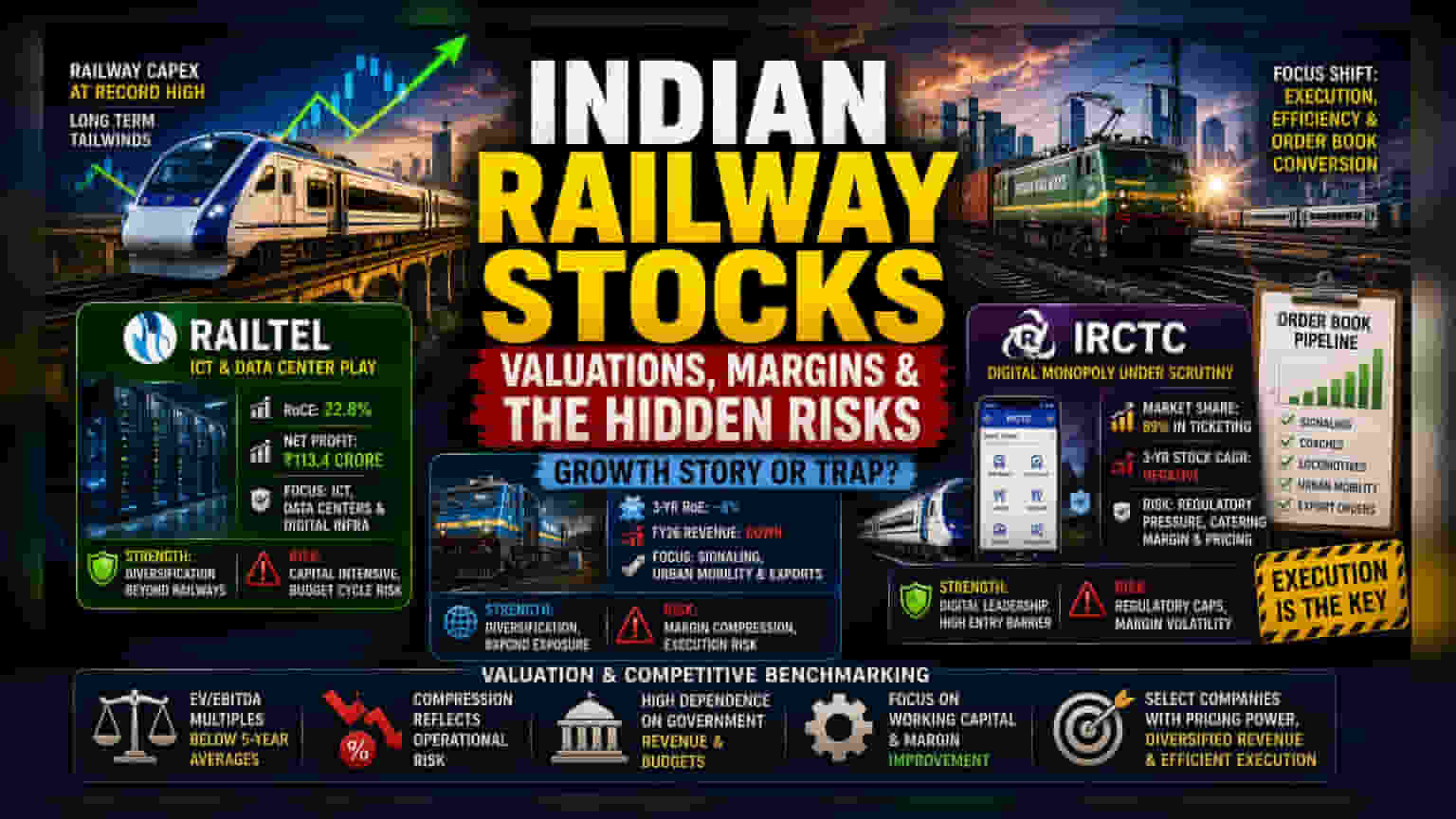


The Valuation Decoupling
The narrative of sustained government capital expenditure in Indian railways has driven significant interest in infrastructure-linked equities. However, current market pricing suggests a divergence between long-term macro potential and near-term fiscal realities. Investors are observing a transition from high-multiple excitement to a more nuanced focus on operational efficiency and order book conversion. As the sector matures beyond the initial post-pandemic recovery, the focus shifts to how these companies manage high entry barriers against margin pressures in a competitive bidding environment.
Operational Realities and Margin Constraints
Railtel’s pivot toward data center infrastructure represents a strategic hedge against pure-play railway dependency. By targeting the ICT space, the company aims to improve its RoCE, which sits at 22.8%. Yet, the challenge remains in scaling these capital-intensive projects without triggering debt-equity imbalances. Unlike its peers, Railtel’s reliance on government-mandated infrastructure projects makes it vulnerable to shifting budgetary cycles. The recent surge in net profit to ₹113.4 crore masks the underlying pressure on operational costs as the company competes for larger, more complex IT integration contracts.
Texmaco faces a different obstacle. While its aggressive diversification into signaling and urban mobility is meant to mitigate the cyclical nature of wagon manufacturing, the revenue contraction in FY26 illustrates the difficulty of executing this transition. With an average three-year RoE near 8%, the company has yet to translate its top-line growth into consistent shareholder value. The focus on export markets like South Africa serves as a necessary buffer, but margin compression persists due to rising raw material costs and stiff competition in public tender bidding.
The Forensic Bear Case
IRCTC presents a case of a digital monopoly grappling with regulatory ceiling effects. Despite a dominant market share of 89% in reserved ticketing, the company’s negative three-year stock price CAGR highlights a market recalibration of its growth prospects. Regulatory scrutiny over convenience fees and pricing power remains a persistent risk, limiting the upside of its digital footprint. Furthermore, IRCTC’s reliance on catering margins—which are notoriously difficult to control in an inflationary environment—creates a structural vulnerability. Investors should note that when a high-RoE entity like IRCTC experiences stagnant stock performance during a bull market, it typically signals that the market has fully priced in the core revenue drivers and is now discounting the potential for future regulatory interventions.
Competitive Benchmarking
The sector currently trades at valuations that reflect a hybrid of utility-like stability and high-growth industrial potential. While the EV/EBITDA multiples for Railtel and Texmaco remain below their five-year averages, this compression is not necessarily an entry signal; it represents a discount for operational risk. Compared to private infrastructure counterparts that possess greater pricing flexibility, these PSU-adjacent entities are constrained by rigid institutional mandates. Future performance will likely hinge on the ability to improve working capital cycles and reduce reliance on single-source government revenue streams.