

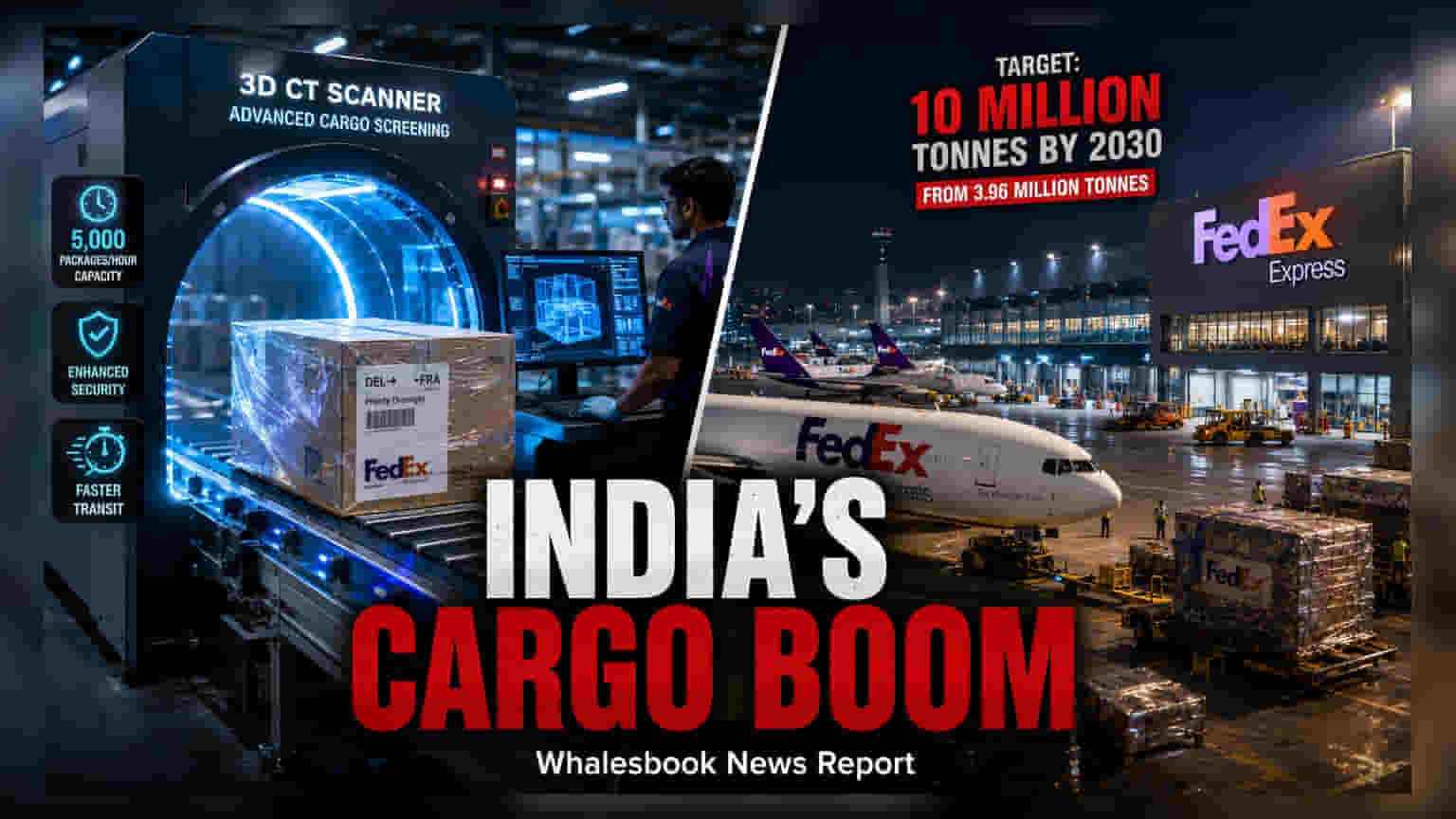
India aims to increase its annual air cargo capacity to 10 million metric tonnes by 2030, a nearly threefold rise from current levels. Supporting this, FedEx has inaugurated a new $150 million integrated hub at Delhi’s Indira Gandhi International Airport. The expansion focuses on boosting trans-shipment efficiency and reducing transit times to strengthen India's position in global logistics.
India is aggressively pursuing a target of 10 million metric tonnes of air cargo by 2030, moving up from the current handling capacity of approximately 3.96 million tonnes. This push is part of a broader strategy by the Civil Aviation Ministry to transform the nation into a global air freight hub. As part of this expansion, FedEx Corporation has inaugurated a major $150 million integrated air cargo hub at Delhi’s Indira Gandhi International Airport, operated by the GMR Group.
Scaling Logistics Infrastructure
The new FedEx facility covers approximately 230,000 square feet and is designed to significantly improve operational efficiency. Once fully operational, the hub is expected to increase package processing capacity from 600 to 5,000 packages per hour. For investors and industry observers, this represents a shift toward dedicated infrastructure, which is essential to handle higher volumes and complex supply chain requirements.
The government is focusing on unlocking the potential of trans-shipment—the process of moving goods through an intermediate hub before reaching the final destination. Currently, India’s trans-shipment share is below 5%, far behind international logistics hubs like Singapore and Hong Kong. Officials estimate that raising this share to 20% could unlock up to $5 billion in potential revenue. To facilitate this, the Ministry has revised security protocols, allowing certain routes to bypass mandatory re-screening. A successful proof of concept on the Chennai-Delhi-Frankfurt route has already reduced transit times from nearly 60 hours to approximately 17 hours, demonstrating the impact of these policy tweaks.
Sector Challenges and Outlook
While the expansion of infrastructure is positive for logistics, the sector faces specific hurdles. A significant portion of India's current air cargo capacity—roughly 70%—relies on 'belly-hold' cargo, which is the space available in passenger aircraft. This limits flexibility because cargo capacity is tied to passenger flight schedules rather than demand for freight.
Another challenge is concentration risk. Currently, the top 10 airports in India handle roughly 94% of the total air cargo traffic. Broadening this reach to smaller cities will require sustained investment and better coordination between airlines, airport operators, and logistics firms. Furthermore, dedicated cargo airlines often face regulatory complexities, including high crew costs and Flight Duty Time Limitations (FDTL), which can impact operational profitability.
For investors monitoring the sector, the key developments to track will be the continued commissioning of Air Freight Stations at off-airport locations and the success of digital customs modernization. Success will depend on whether infrastructure can keep pace with the aggressive 2030 volume targets without incurring excessive cost or debt pressure.