

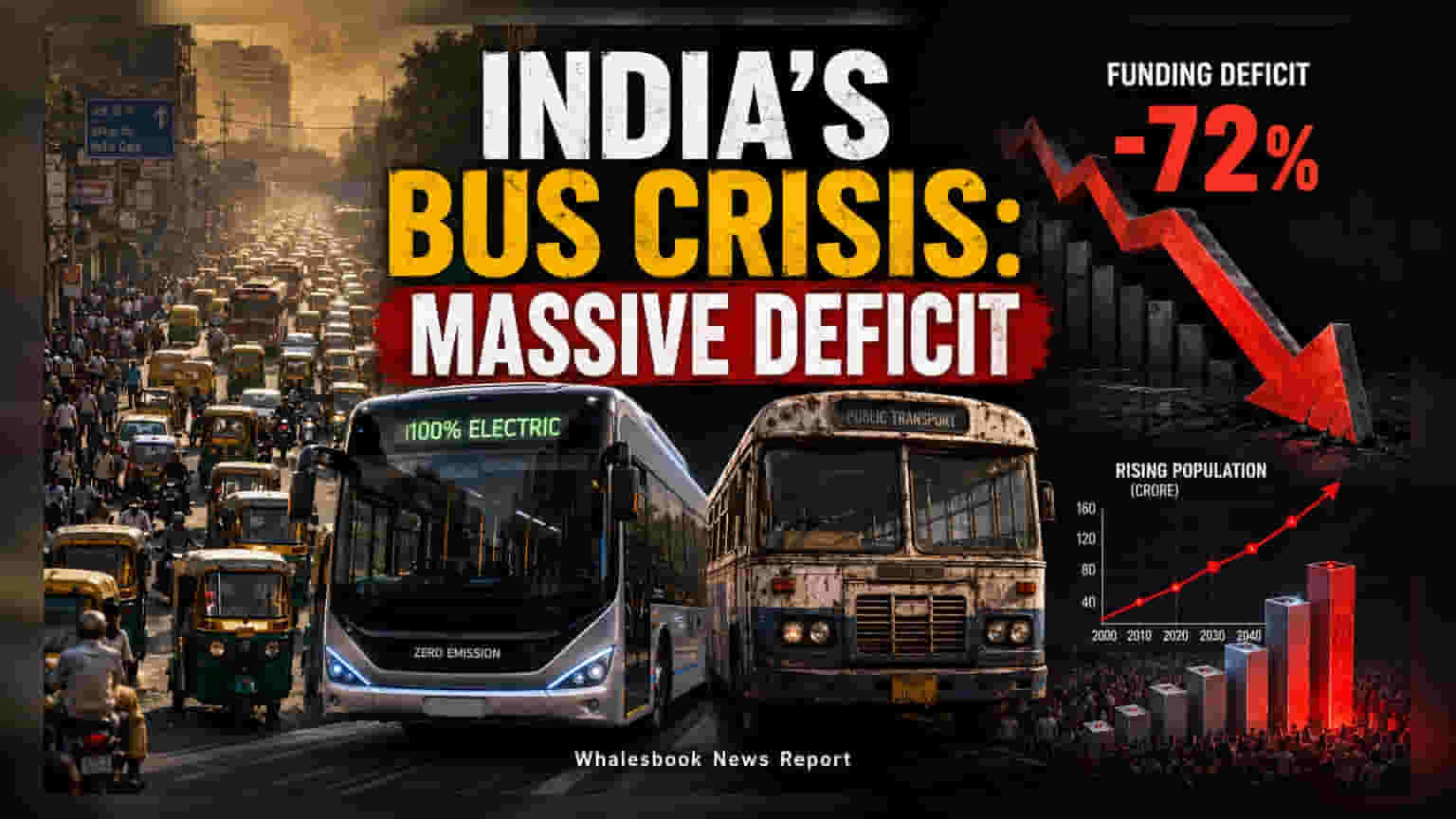
A report by the Centre for Science and Environment reveals a 70% deficit in India’s urban bus transit, requiring the fleet to grow to 671,000 vehicles by 2047. This massive expansion demands a ₹14.2 lakh crore investment, with a heavy emphasis on electric vehicles. Investors should track how funding models and infrastructure constraints shape this long-term growth opportunity.
A new study by the Centre for Science and Environment and the CITIES Forum has brought the scale of India’s urban transport challenges into sharp focus. The report highlights that over 400 Indian cities currently lack organized bus services, contributing to a 70% deficit in urban transit. With the urban population projected to reach 763 million by 2047, the demand for public transport is set for a significant long-term increase.
To bridge this gap, India needs to expand its urban bus fleet tenfold, moving from the current 65,000 buses to 671,000 vehicles over the next two decades. This requirement translates to an ambitious procurement target of roughly 41,500 buses annually—a 17-fold increase from current purchasing levels. Achieving this will require a cumulative investment of ₹14.2 lakh crore, covering not just the buses themselves, but the necessary depots, power grids, and charging infrastructure.
The Shift Toward Electric Mobility
A critical part of this expansion is the push toward cleaner energy, with the report aiming for 90% of the new fleet to be electric by 2047. This transition represents a major industrial shift for bus manufacturers and the power sector. Scaling up to this level would require an estimated 121 gigawatt-hours of battery capacity annually and a massive increase in electricity supply. For the automotive and infrastructure industries, this signals a long-term demand cycle for electric vehicle (EV) technology, charging stations, and grid management services.
Financial and Operational Risks
While the growth potential is high, the execution path faces distinct challenges. A major hurdle is the financial health of State Transport Undertakings, many of which struggle with low creditworthiness. Without sustainable subsidy models, green bonds, or concessional financing, state-run bodies may find it difficult to fund such massive fleet upgrades.
Furthermore, the high upfront cost of electric buses—which can be significantly more expensive than diesel counterparts—puts pressure on project viability. Infrastructure readiness is another critical monitorable. Simply buying more buses will not solve the transit deficit if there is no corresponding development of depots, electricity grid capacity, and fast-charging networks.
What Investors Should Monitor
As this sector evolves, investors may look for updates on the proposed National Urban Bus Mission, which aims to provide structured support and dedicated funding for this transition. The speed of fleet procurement, the stability of government EV subsidy schemes, and the ability of power utilities to meet increased electricity demand will be key indicators. Additionally, tracking how companies manage the shift from diesel to electric manufacturing and their ability to secure large-scale government contracts will be important for assessing the long-term impact on their profit margins and market share.