 Whalesbook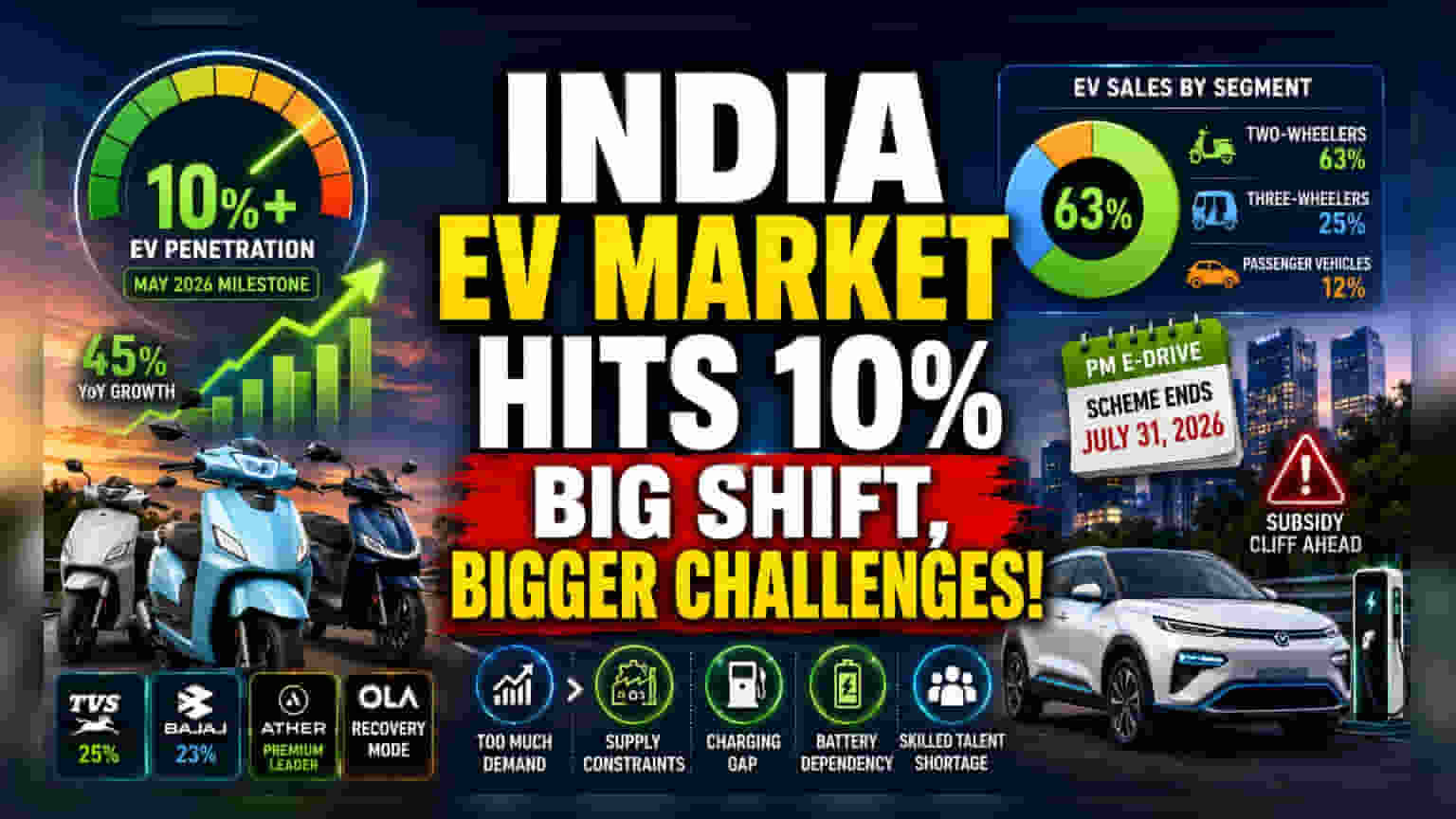


The Shift from Demand to Supply Constraints
The historic breach of the 10% electric vehicle penetration barrier in May 2026 masks a fundamental pivot in the underlying mechanics of the Indian automotive sector. While headline growth of 45% year-on-year signals robust consumer appetite, the market has transitioned from a demand-side narrative to a battle of supply-chain efficiency. Leading manufacturers are no longer fighting for customers; they are racing to manage production capacity and waiting periods in a volatile macro environment. The spike in EV registrations was heavily concentrated in the latter half of May, largely triggered by sharp upward adjustments in retail petrol prices, which compressed the total cost of ownership gap and accelerated purchase decisions.
The Two-Wheeler Concentration
Electric two-wheelers remain the undisputed engine of this transition, accounting for nearly 63% of all EV sales. Market dynamics within this segment have become hyper-competitive. TVS Motor Company continues to hold the top spot with a 25% market share, but the gap with Bajaj Auto—which captured roughly 23% in May—is narrowing aggressively. Ather Energy retains its foothold in the premium segment, while Ola Electric has demonstrated a recent, if volatile, recovery. This concentration highlights a critical vulnerability: the entire EV milestone is disproportionately reliant on the two-wheeler category’s sensitivity to fuel inflation and government subsidies. With the PM E-DRIVE scheme set to expire on July 31, 2026, the industry faces an imminent cliff where the effective price of entry-level scooters could climb by thousands of rupees overnight, potentially stalling the current trajectory.
Infrastructure and Segmental Gaps
While two-wheelers and three-wheelers demonstrate high adoption, the passenger vehicle (PV) segment remains in a nascent, albeit growing, phase. Despite robust total automotive sales driven by traditional internal combustion engines (ICE) and hybrid vehicles, EV penetration in the passenger segment struggles against significant structural friction. Public charging infrastructure remains sparse, particularly outside Tier-1 metros, and the lack of standardization in battery technology and charging connectors fosters persistent range anxiety. Furthermore, the reliance on imported lithium-ion cells exposes domestic OEMs to global price fluctuations and supply-chain fragilities that could delay mass-market affordability for years.
The Structural Bear Case
Beyond the celebratory metrics, institutional investors remain wary of several underlying risks. The sector is currently navigating a period of financial recalibration, shifting focus from aggressive market-share acquisition to profitability and operational discipline. Companies that fail to optimize manufacturing costs or manage margin compression will find it difficult to survive the next phase of consolidation. Moreover, the shortage of highly skilled human capital—specifically in battery chemistry and power electronics—poses a long-term bottleneck to domestic scaling. Without meaningful breakthroughs in localizing the EV supply chain and a consistent, long-term policy framework beyond the current subsidy windows, the 10% threshold may prove to be a fleeting peak rather than a sustainable floor for permanent adoption.