

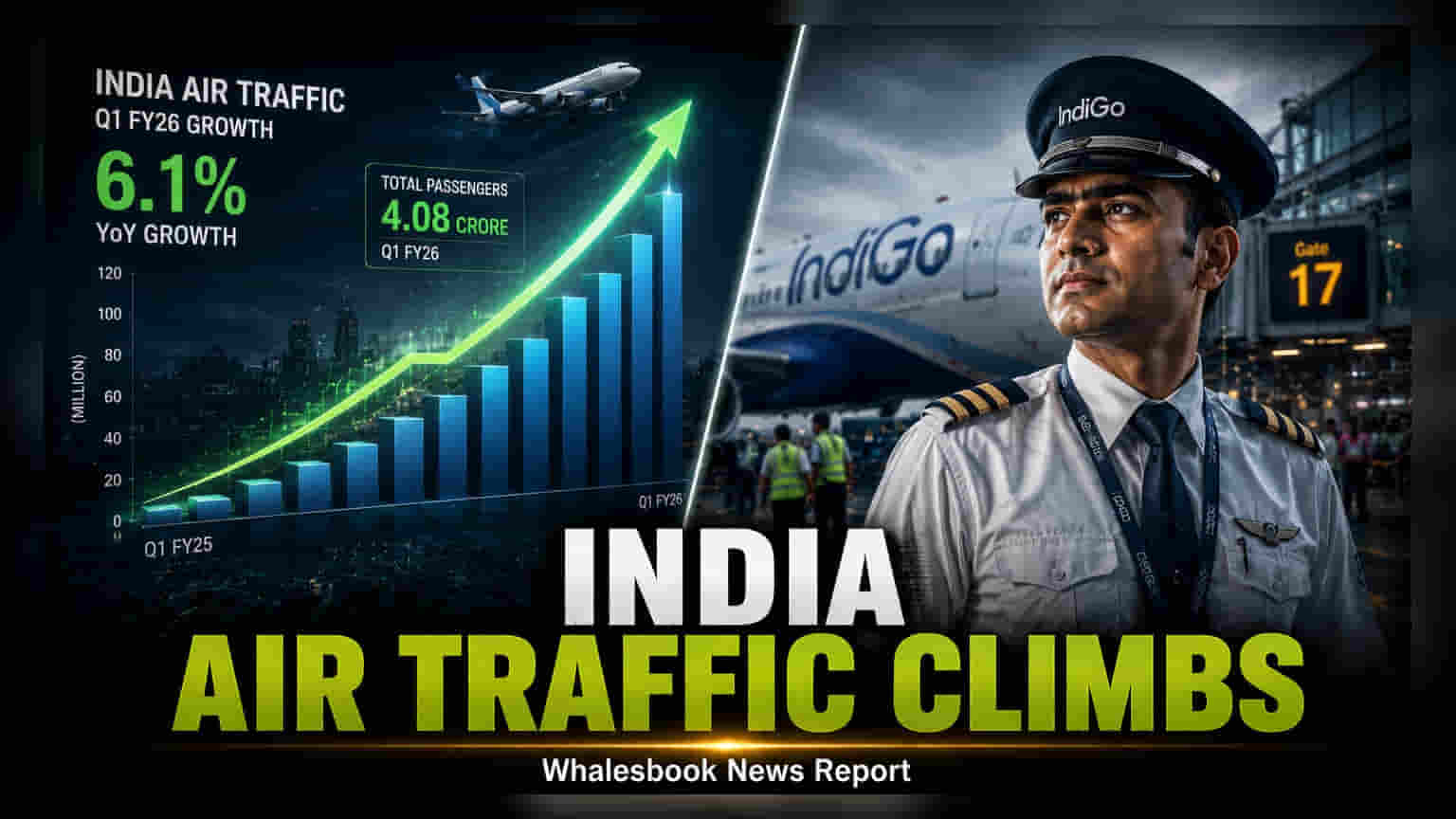
India’s domestic air passenger traffic grew by a marginal 1.44% in the first half of 2026, totaling 864.04 lakh travelers. While IndiGo expanded its market lead to 66.3% in June, the Air India Group saw its share decline to 23.9%. Investors may track how softening passenger demand in June affects airline pricing power and profitability in coming quarters.
Detailed Coverage
Domestic air travel in India saw steady but slow growth during the first half of 2026. Data from the Directorate General of Civil Aviation (DGCA) shows that airlines carried 864.04 lakh passengers between January and June, marking a 1.44% increase compared to the same period in 2025. Despite this half-yearly growth, June performance showed a slight cooling, with passenger numbers dropping 1.03% year-on-year to 134.64 lakh.
Airline Market Share Shifts
IndiGo, operated by InterGlobe Aviation, further strengthened its dominant position in the domestic skies. The airline captured 66.3% of the market share in June, rising from 64.9% in May. This expansion highlights the company’s continued ability to scale operations amid sector-wide capacity additions. In contrast, the Air India Group, which includes Air India, AIX Connect, and Air India Express, experienced a decrease in market share to 23.9% in June from 25.6% in the previous month.
Akasa Air continues to emerge as a significant player, growing its market share to 6.4% in June from 5.8% in May. Meanwhile, SpiceJet saw its market share contract to 1.9%, reflecting ongoing challenges for the carrier. Smaller operators like Fly91 and Alliance Air maintained stable footprints at 0.4% each.
Operational Efficiency and Passenger Experience
Investor attention is often focused on the passenger load factor—a key metric measuring how much of an airline's seating capacity is actually sold. In June, Akasa Air maintained the highest load factor in the industry at 92.2%, despite a minor dip from 92.5% in May. SpiceJet saw an improvement in its load factor to 87.8%, while the Air India Group’s load factor rose to 85.5%. IndiGo reported a load factor of 85.1%.
Service reliability metrics also provide insight into operational stability. The industry-wide flight cancellation rate rose slightly to 0.63% in June from 0.55% in May. IndiaOne Air reported a significantly higher cancellation rate at 16.43%, primarily due to technical and operational constraints. Furthermore, airlines received 2,568 passenger complaints in June. On a normalized basis, this equates to 1.91 complaints for every 10,000 passengers, with Alliance Air recording the highest rate of customer grievances.
For investors, the key area to watch will be whether the June dip in passenger traffic is a temporary seasonal fluctuation or the beginning of a cooling trend in travel demand. Profitability in the Indian aviation sector remains highly sensitive to fluctuations in passenger volume, fuel costs, and competitive pricing strategies. Upcoming quarterly financial results and management commentary on demand outlook will be crucial for understanding how these traffic shifts translate into revenue and margin performance for listed players like InterGlobe Aviation.