

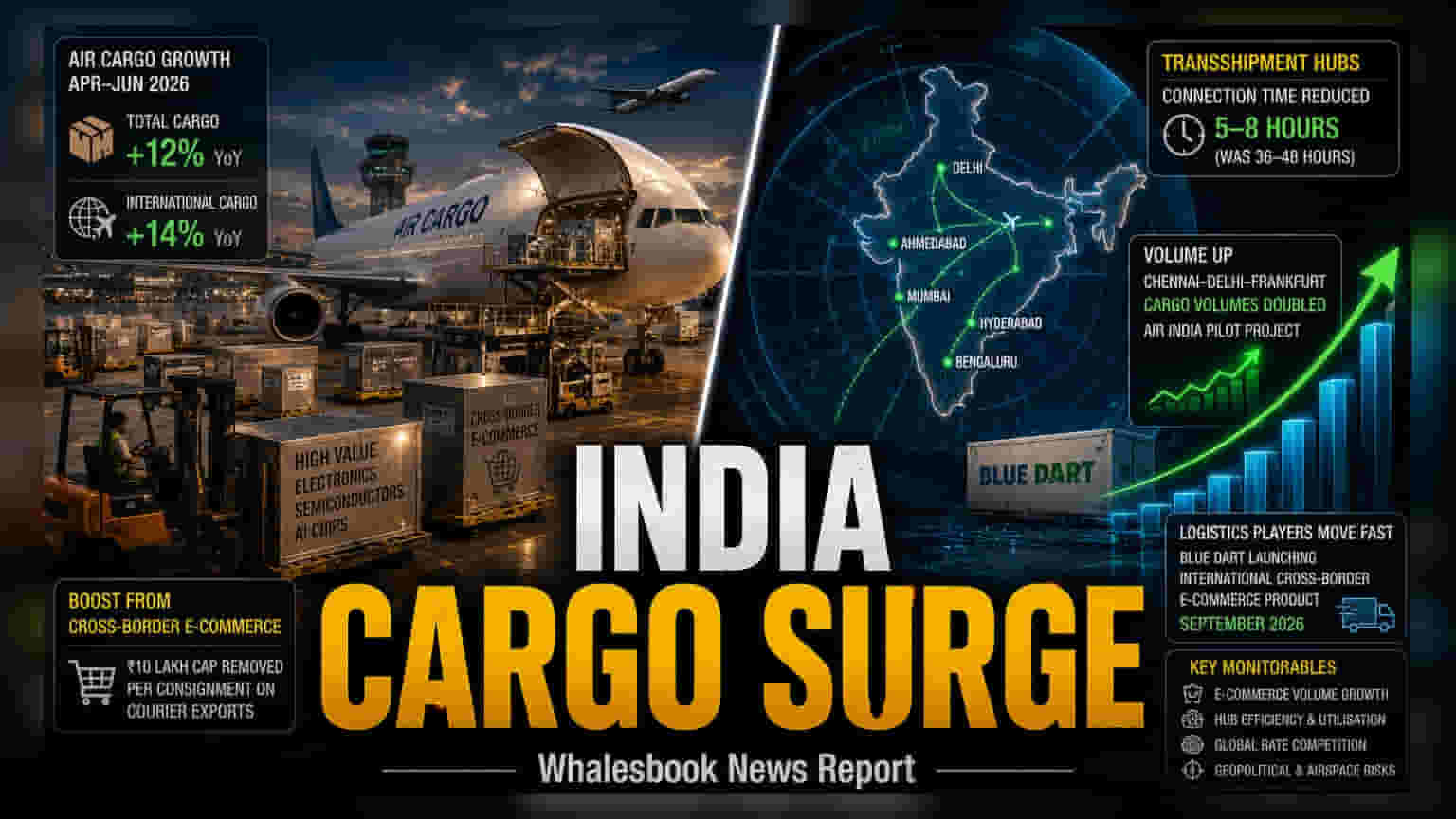
India’s air cargo market recorded a 12% growth in the April-June 2026 quarter, supported by the government’s removal of export value caps and new transshipment hubs. Logistics firms like Blue Dart Express are now shifting focus toward high-value international cross-border e-commerce to capitalize on these favorable trade policies.
The Indian air cargo sector is witnessing a structural shift, with airports reporting a 12% year-on-year increase in freight handling for the April-June 2026 quarter. International cargo, a key indicator of high-value trade, grew by 14% during the same period. This growth is being driven by the rapid rise of cross-border e-commerce and the increasing manufacturing of electronics and semiconductors within India.
A major factor supporting this expansion is the government’s recent regulatory changes. The Union Budget 2026 removed the ₹10 lakh value cap per consignment on courier exports, a move that significantly lowers barriers for e-commerce exporters. Additionally, the government has accelerated the development of air cargo transshipment hubs at major airports including Delhi, Bengaluru, Ahmedabad, Mumbai, and Hyderabad. These hubs have drastically reduced connection times for cargo, down to 5–8 hours from the previous 36–48 hours, making Indian airports more competitive gateways for global trade.
Logistics companies are moving quickly to capture this volume. Blue Dart Express, which reported a revenue of ₹6,141 crore for FY2025–26, is set to launch a dedicated international cross-border e-commerce delivery product in September 2026. This move highlights how domestic players are attempting to integrate into global supply chains, moving beyond simple domestic delivery to compete with large international integrators like FedEx and DHL.
The sector is also benefiting from the 'Make in India' push in electronics. As companies like Micron Technology and Kaynes Technology expand their local assembly capabilities, the demand for air-freighting high-value components such as AI chips and server racks has increased. Air India has already seen success in this area, with its pilot transshipment project doubling cargo volumes on key corridors like Chennai–Delhi–Frankfurt.
However, the sector faces specific risks that investors should monitor. Competition is intensifying as global logistics giants and local carriers like IndiGo and Air India expand their capacity to control freight rates and capture the high-yield, time-sensitive shipment market. Furthermore, the industry remains vulnerable to global geopolitical tensions, which can lead to air-space restrictions and sudden supply chain volatility. Investors should track the success of new international product launches, the sustained volume growth in the e-commerce segment, and the efficiency of the new transshipment hubs in handling larger cargo loads.