 Whalesbook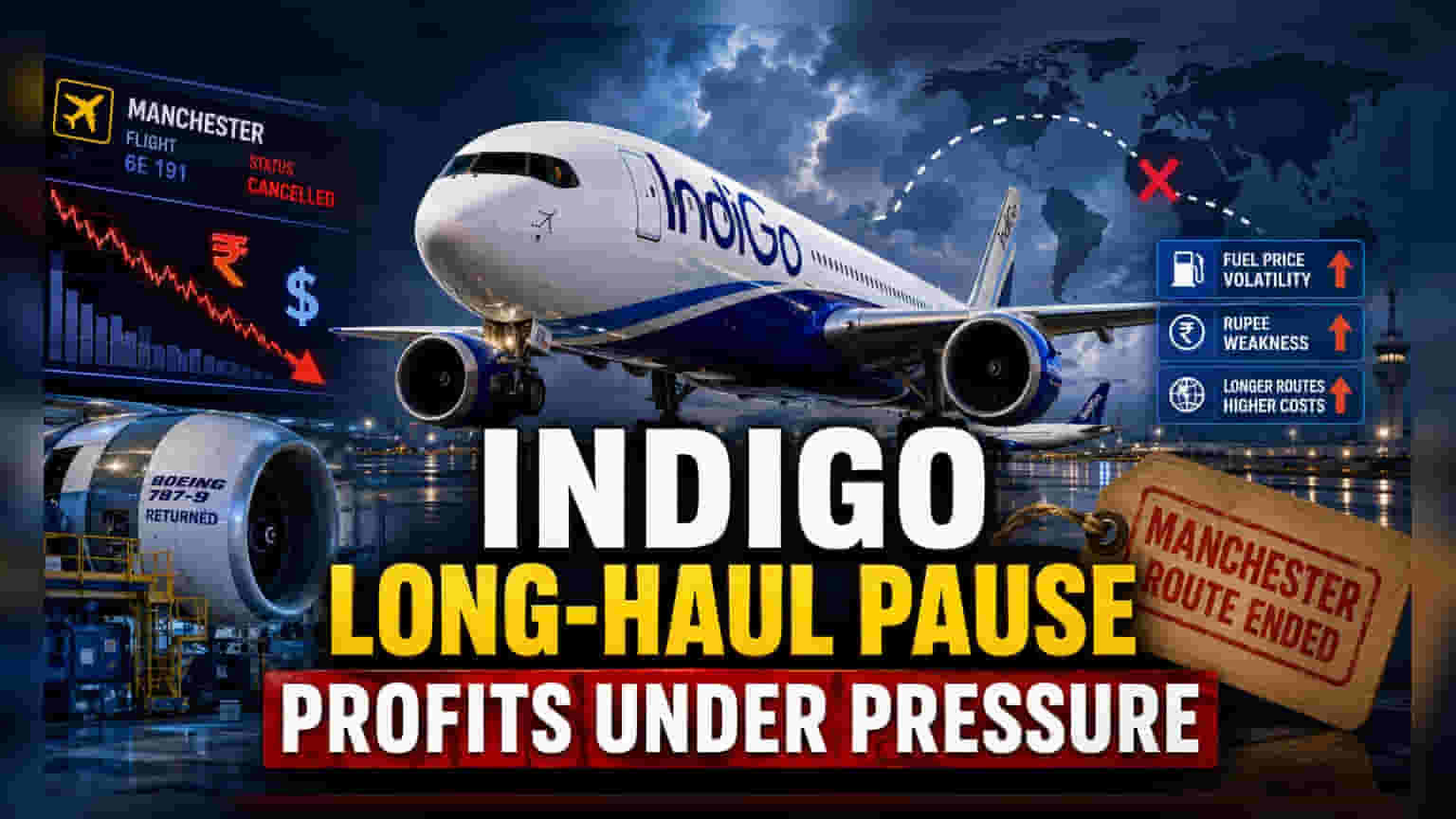


The Cost of Ambition
IndiGo’s decision to terminate its Manchester routes is less about a failure of demand and more about a brutal encounter with the realities of international long-haul economics. Despite management’s assertions of positive consumer response, the operational reality has become untenable. Persistent airspace closures, particularly those linked to Middle Eastern geopolitical instability, have forced longer flight paths. These extended routes, when paired with sustained aviation turbine fuel (ATF) price volatility and a weakening rupee, have compressed margins to the breaking point. The return of a Boeing 787-9 Dreamliner leased from Norse Atlantic Airways signals a cooling of the airline's aggressive, wide-body European expansion, an initiative that was meant to be a bridge until the arrival of its proprietary Airbus A350 fleet.
Financial Headwinds and Market Context
The structural challenges facing IndiGo are reflected in its recent fiscal performance. For the financial year ending March 2026, the carrier reported a net loss of approximately ₹23.94 billion, a stark departure from the profitability seen in the prior year. This financial erosion was exacerbated by massive foreign exchange losses as the rupee depreciated against the dollar—a particularly painful vulnerability for an airline with dollar-denominated leasing obligations. While operating profit, when stripped of non-recurring and forex-related charges, suggests a resilient core business, the market has taken a dim view of the carrier’s inability to scale its premium international aspirations profitably under current global conditions.
Risk Factors and The Bear Case
From a risk perspective, IndiGo faces a complex balancing act. The company’s heavy reliance on damp-leased wide-body aircraft exposes it to the financial health and operational decisions of its partners like Norse Atlantic Airways. Furthermore, the broader Indian aviation sector is currently experiencing its weakest passenger growth since the pandemic, with competitors such as Air India also struggling with massive losses. Investors should remain wary of the company’s high debt-to-equity profile and the potential for further margin compression if labor costs and fuel prices remain elevated. Past management turnover, including the recent transition following the departure of CEO Pieter Elbers, adds a layer of leadership uncertainty that could complicate execution in a recovery phase.
Future Outlook
Despite the retreat from Manchester and previous exits from routes like Copenhagen, brokerage sentiment remains cautious but observant. Institutions like Goldman Sachs have recently maintained a buy rating, pointing to a potential rebound in passenger revenue per available seat kilometer (PRASK) for the coming quarter. However, management’s ability to stabilize these long-haul operations depends entirely on external geopolitical factors that remain largely outside of their control. The focus for the remainder of the fiscal year will likely shift from aggressive network expansion to protecting operational reliability and restoring balance sheet health.