 Whalesbook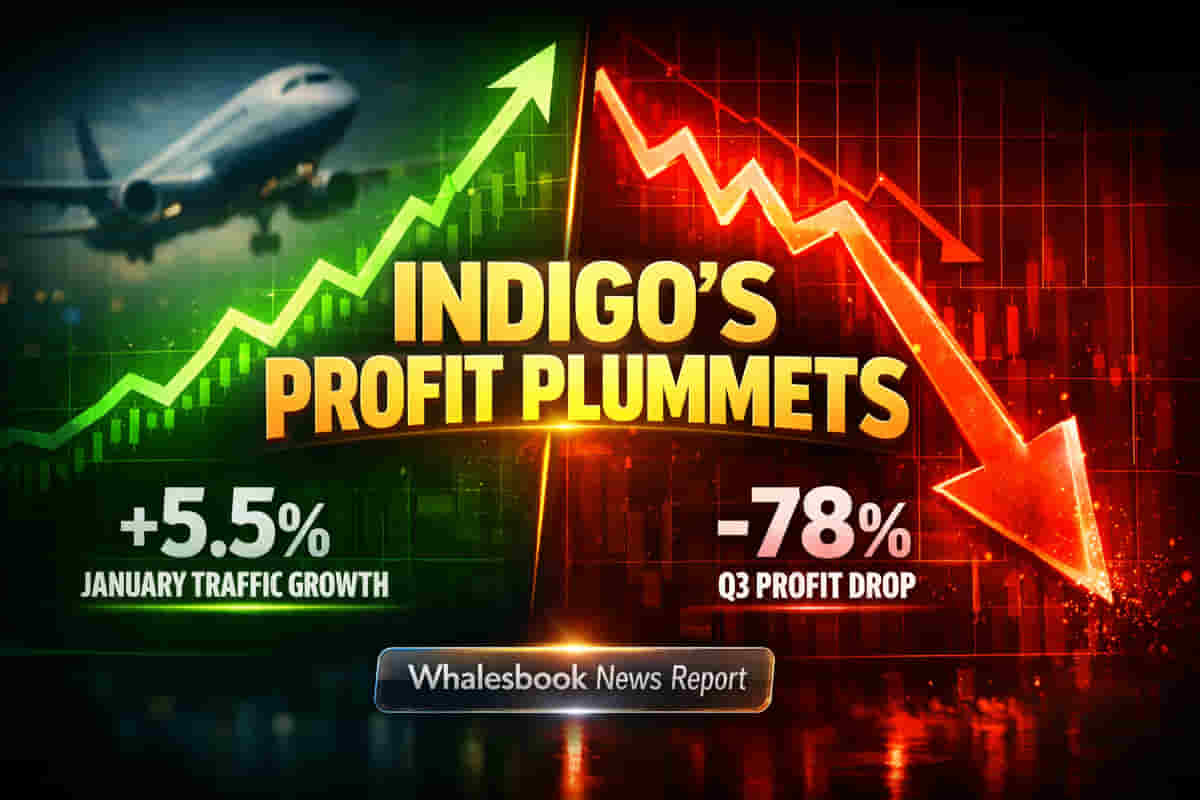
### Market Recovers on Value Buying; IndiGo Stock Gains
Indian equity markets, including the benchmark Nifty 50 which rose 0.42%, saw a rebound on Monday, February 2, 2026, driven by value-buying strategies. InterGlobe Aviation, the parent company of IndiGo, experienced a 1.82% increase in its share price, closing at Rs 4,658.80. This movement occurred despite the airline reporting a modest 5.5% year-over-year growth in air traffic for January 2026. The passenger load factor also dipped by 250 basis points year-on-year to 87.8%. Total traded volume for IndiGo was notably higher than its 30-day average, indicating increased investor interest.
### December Quarter Earnings Overshadowed by Costs
The recent operational update follows a challenging third quarter for IndiGo. The company announced a stark 78% year-on-year contraction in net profit for the December quarter, falling to ₹549.1 crore from ₹2,448.8 crore in the prior year period. This substantial decline was primarily due to extraordinary charges totaling ₹1,546.5 crore. Of this, ₹577.2 crore was attributed to significant flight disruptions experienced in early December, while an additional ₹969.3 crore stemmed from the implementation of new labor laws. The airline also incurred a ₹22.2 crore fine from authorities for these disruptions, which was accounted for as an exceptional item. Despite these profit headwinds, InterGlobe Aviation's total income for the quarter saw a slight increase, reaching ₹24,540.6 crore compared to ₹22,992.80 crore in the same period last year.
### Analyst Consensus Remains Bullish Amidst Expansion Ambitions
Despite the quarterly earnings dip and operational challenges, the analyst community largely maintains a positive outlook on IndiGo. According to Bloomberg data, out of 27 analysts tracking the company, 22 maintain a 'buy' recommendation, with three suggesting 'hold' and two advising 'sell' [cite: from prompt]. The average 12-month consensus price target stands at ₹5,703.65, implying a potential upside of 22.2% from the current trading price [cite: from prompt]. This confidence is buoyed by the airline's strategic vision, articulated by CEO Pieter Elbers. IndiGo aims for nearly 40% of its capacity to be deployed internationally by 2030, with a goal of operating over 4,000 daily flights and carrying 200 million passengers annually. The airline continues to expand its fleet, with approximately 900 aircraft on order, including new generation A321 XLRs [cite: from prompt, 12]. This aggressive expansion plans are supported by recent network additions, such as new non-stop services to Athens using the A321XLR aircraft.
### Sector Faces Headwinds Despite Growth Projections
The broader Indian aviation sector is poised for significant growth, with projections indicating a strong expansion trajectory and the potential to surpass China in passenger traffic growth by 2026. However, the industry is also facing considerable financial pressures. Credit rating agency ICRA forecasts substantial industry losses for FY2026, estimated between ₹17,000-18,000 crore, driven by moderating domestic traffic growth, elevated jet fuel prices, and a depreciating rupee. Additionally, the market is becoming more competitive with the planned entry of new airlines, including Shankh Air, Al Hind Air, and FlyExpress, in 2026, which will challenge IndiGo's dominant market position. Recent regulatory actions, including a substantial fine from the DGCA for operational disruptions, highlight the ongoing scrutiny of airline operations. The Union Budget 2026-27 includes measures like customs duty exemptions on aircraft components, which are expected to support domestic manufacturing and the sector's long-term outlook.