 Whalesbook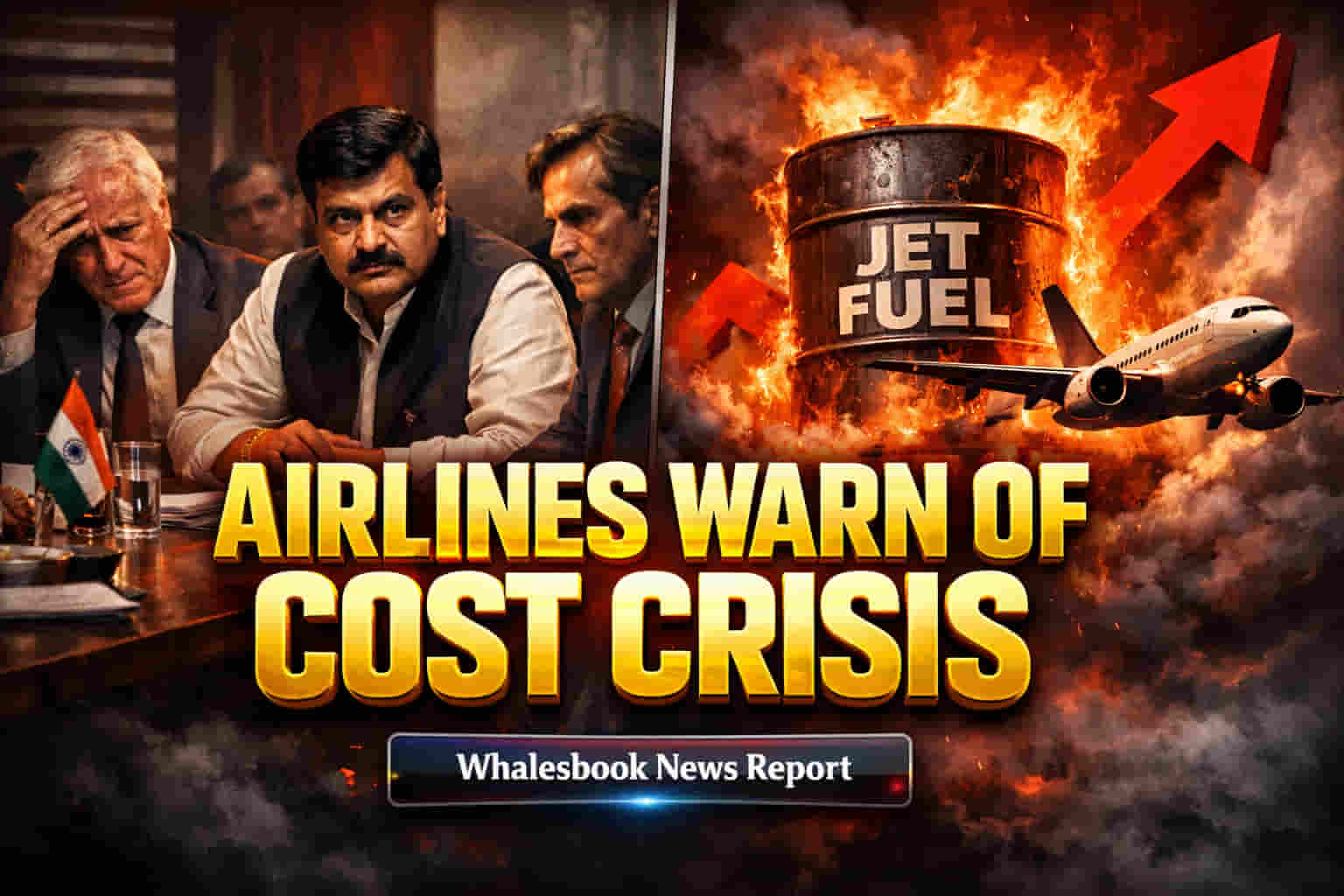


### The Seamless Link
The escalating conflict in West Asia has morphed from a regional crisis into a significant operational and financial challenge for Indian carriers, with InterGlobe Aviation (IndiGo) facing a confluence of severe pressures that extend beyond mere fuel price hikes. The disruption has exposed critical vulnerabilities in the airline's operational model and strategic choices, creating a complex risk environment.
### The Core Catalyst: A Multi-Pronged Assault on Operations
Jet fuel prices have surged dramatically, scaling a record $225.44 a barrel on Wednesday, March 5, 2026, a staggering 72% increase that directly inflates operating costs, which typically constitute 25-40% of an airline's expenses [cite: original news, 6, 20]. Analysts at Citi project Brent crude to remain elevated between $80 and $90 per barrel if hostilities persist [cite: original news]. This volatile energy market is further complicated by a depreciating Indian Rupee against the US Dollar, inflating costs for dollar-denominated expenditures like aircraft leases and maintenance.
As of March 6, 2026, InterGlobe Aviation's stock closed at ₹4,410.00, down 2.28%, reflecting cautious market sentiment and investor concerns over these mounting pressures. The airline's market capitalization stood around ₹1.7 trillion as of early March 2026. Its price-to-earnings (P/E) ratio, hovering near 53x for the trailing twelve months ending March 2026, suggests investors are pricing in significant future growth, a valuation that becomes increasingly precarious under sustained cost inflation.
### The Analytical Deep Dive
While fuel costs are a universal challenge, Indian carriers are uniquely disadvantaged. West Asia serves as a critical transit hub for flights between Europe and Asia, and its airspace closures necessitate longer, more fuel-intensive routes [cite: original news, 21]. Air India, for instance, has pushed for access to Chinese airspace to circumvent Pakistan's closure and mitigate extended flight times that can add up to 3 hours and increase fuel costs by up to 29%.
Globally, airlines employ varied strategies to navigate such volatility. Historically, fuel hedging has been a key tool for airlines like Southwest Airlines to stabilize costs. However, recent trends indicate a move away from this, with some US carriers stepping back from hedging, leaving them exposed to price surges. IndiGo has not immediately taken steps for oil price hedging, a decision that amplifies its vulnerability compared to airlines with more robust hedging programs.
Analysts at S&P have cautioned that the conflict's impact is disproportionately higher on Indian carriers due to their extensive capacity and route networks to West Asia, estimating that as much as 20% of IndiGo's capacity could be affected by these geopolitical events. HSBC analysts also point to this near-term pressure, noting around a 20% capacity impact for IndiGo from cancellations. The general analyst sentiment leans towards 'Buy' for IndiGo, but the sector's overvaluation risk is a persistent concern if geopolitical risks fully materialize into sustained cost increases and demand erosion.
### ⚠️ THE FORENSIC BEAR CASE
The most acute risk for InterGlobe Aviation stems from a specific regulatory entanglement. Its ambitious European expansion, utilizing six leased Boeing 787 Dreamliners from Norse Atlantic Airways, has been severely hampered. These Norse-registered aircraft are subject to European Union Aviation Safety Agency (EASA) directives. EASA has classified 11 West Asian airspaces as high-risk due to the conflict, prohibiting flights at any altitude. This ban uniquely impacts IndiGo's leased fleet, grounding its wide-body aircraft and forcing the cancellation of European services, a situation less severe for competitors operating Indian-registered aircraft that fall outside EASA's direct purview.
Furthermore, the airline's reliance on a high P/E ratio of approximately 53x as of March 2026 indicates that significant future growth is already priced into the stock. Any prolonged period of elevated costs, operational disruptions, or a slowdown in projected growth could lead to a sharp re-evaluation of this valuation. The absence of immediate fuel hedging strategies and the compounding effect of currency depreciation leave IndiGo with minimal buffer against these external shocks, especially when compared to competitors with stronger balance sheets or more diversified international operations.
### The Future Outlook
The Indian Civil Aviation Ministry is evaluating regulatory bottlenecks rather than immediate financial incentives for airlines, focusing on expediting permissions and exploring operational adjustments like extended watch hours at airports and pilot duty hour exemptions for rerouted flights [cite: original news]. However, the fundamental drivers of increased costs—geopolitical instability and currency weakness—remain largely outside the government's direct control. Analysts suggest the sector faces a sustained 'geopolitical risk premium' that will continue to affect profitability and market valuations, even as domestic passenger traffic growth offers some underlying support. The sustainability of IndiGo's current capacity deployment and its ability to pass on rising costs to consumers, particularly on international routes, will be critical determinants of its financial performance in the coming quarters.