

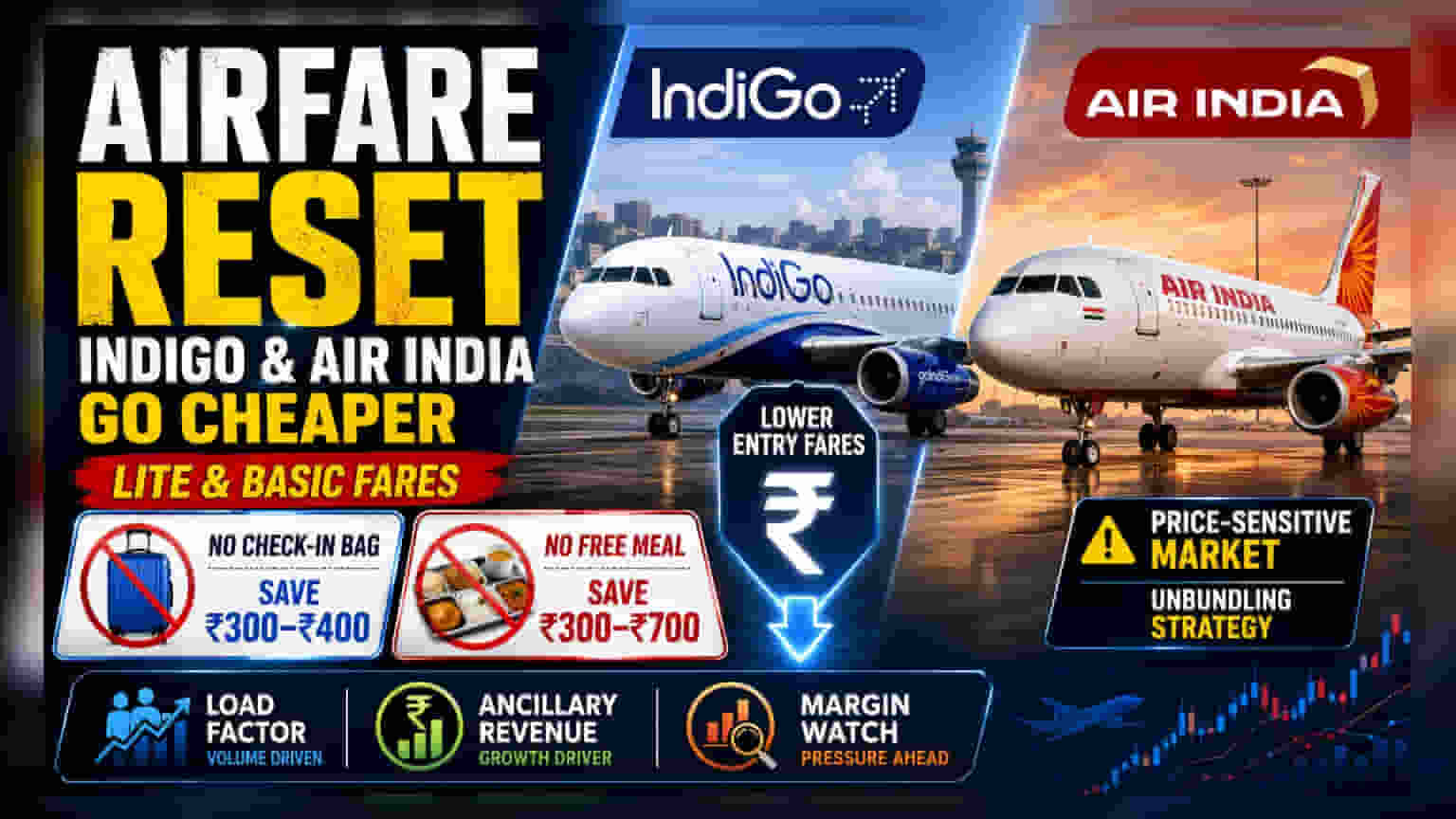
IndiGo and Air India are introducing 'Lite' and 'Basic' fare categories, stripping away perks like baggage or meals to lower ticket prices. This strategy aims to attract passengers who usually prefer trains or buses. Investors should monitor if these lower entry prices successfully drive higher passenger volume and manage margin pressure amid rising operational costs.
What Happened
India's two largest airlines, IndiGo and Air India, are recalibrating their pricing models to appeal to price-sensitive customers. Effective July 15, IndiGo is introducing a "Lite" fare option, which removes checked baggage for passengers, offering savings between Rs 300 and Rs 400. This follows a similar move by Air India, which has launched a "Basic" fare category that excludes complimentary in-flight meals, allowing customers to save between Rs 300 and Rs 700.
Both airlines are effectively "unbundling" their services. This means they are separating the base flight ticket from extras like baggage allowance or meals, allowing passengers to pay only for what they use. This move is a response to the intense competition in the Indian travel market, where rising operational costs often lead to higher ticket prices, making buses and trains more attractive options for travelers.
The Strategic Logic
For airlines, the primary goal of unbundling is to display a lower base fare on booking websites. In a market where travelers often sort options by price, a lower entry ticket increases the chances of a passenger choosing that airline over a competitor.
By offering a "Lite" or "Basic" option, airlines can attract cost-conscious travelers who would otherwise choose ground transport. If these passengers need extra services later, they can purchase them as add-ons. This approach helps the airline capture a wider customer base without necessarily slashing the overall revenue per passenger, as travelers who prioritize comfort can still opt for standard or premium fare bundles.
Financial Impact on Margins
For investors, the success of this strategy hinges on the trade-off between volume and profitability. On the positive side, lower fares can increase "load factors," which is a measure of how many seats on a plane are filled. Higher occupancy is crucial for airlines to cover fixed costs like aircraft leases, pilot salaries, and airport fees.
However, there is a risk that existing customers, who previously paid for full-service tickets, might switch to these cheaper "Lite" or "Basic" options. This behavior, known as revenue cannibalization, could potentially lower the average revenue per passenger if not managed correctly. Airlines must ensure that the increase in new passengers outweighs any loss in revenue from customers downgrading their ticket choices.
Sector Context
Operating an airline in India is expensive due to high costs like Aviation Turbine Fuel (ATF) and airport charges. Consequently, airlines operate on thin profit margins. To remain competitive, they must find ways to reduce costs or increase ancillary revenue—the money earned from services beyond the ticket price, such as baggage, seat selection, and food.
By moving toward an unbundled model, airlines are mimicking the strategy of successful global low-cost carriers. This model allows them to remain flexible, adjusting prices based on demand while maintaining their competitive edge against peers and alternative modes of transport like the Indian Railways.
What Investors Should Track
Going forward, investors should watch for a few key performance indicators:
- Yields and Load Factors: Watch whether the lower fares actually bring in more passengers or if they merely result in existing passengers paying less.
- Ancillary Revenue: Check if passengers are paying for the "unbundled" services (like buying a meal or baggage allowance) separately, which can sometimes be more profitable than including them in the base ticket.
- Competitive Reaction: Monitor how other smaller airlines respond to these fare changes and whether this leads to a price war that could hurt overall sector profitability.
- Operational Costs: Since the primary driver for these changes is high operating costs, monitor whether these measures successfully protect profit margins in upcoming quarterly financial reports.