 Whalesbook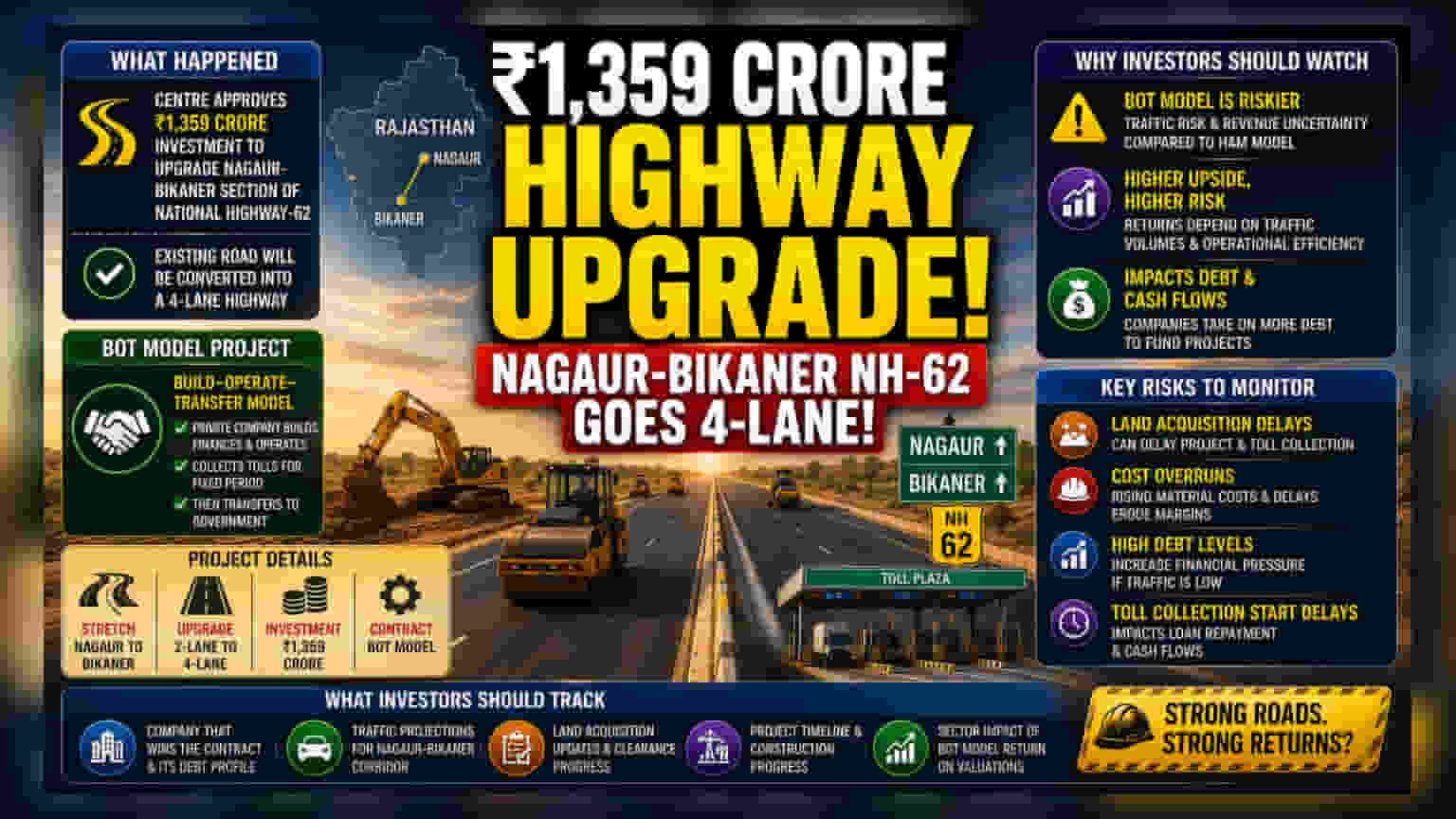


The government has approved a Rs 1,359 crore project to widen the Nagaur-Bikaner stretch of NH-62 to four lanes. The project will be built under the Build-Operate-Transfer model, shifting revenue and traffic risks to the private developer. This move highlights a renewed push for BOT projects in India’s road sector. Investors should focus on how companies handle the high capital needs and debt associated with this model compared to lower-risk contract structures.
What Happened
The central government has approved a Rs 1,359 crore investment to upgrade the Nagaur-Bikaner section of National Highway-62 in Rajasthan. This project involves turning the existing road into a four-lane highway. The contract will follow the Build-Operate-Transfer, or BOT, model. In this setup, the private company that wins the contract is responsible for building the road, paying for the construction, and then collecting tolls for a set number of years to recover its investment and earn a profit.
Why Investors Should Watch the BOT Model
For stock market investors, the return of the BOT model is significant. Over the last few years, the road sector in India mostly used the Hybrid Annuity Model, or HAM. Under HAM, the government pays a large portion of the construction cost, which makes it safer for companies. However, the BOT model is riskier. The company takes on the risk of whether the road will get enough traffic to pay back the loan taken for construction. If traffic is lower than expected, the company may face financial pressure. Investors should check which companies bid for these projects, as the contract terms will impact their debt levels and future cash flow.
Financial Risks and Debt Pressure
Projects under the BOT model require a large amount of upfront money. Companies often borrow heavily to fund this construction. This can increase their debt levels, which is a measure of how much a company relies on loans compared to its own money. If interest rates remain high or if construction gets delayed due to land issues, the company’s profit margins can come under pressure. Investors should track whether the company has the financial strength to handle this added debt without hurting its overall balance sheet.
Sector Context and Execution Challenges
The infrastructure sector is sensitive to external factors like land acquisition delays, environmental clearances, and raw material costs. Even with government backing, road projects often face timelines that stretch longer than planned. A delay in the project means the company cannot start collecting tolls on time, which disrupts its ability to pay back loans. When evaluating road construction stocks, investors often look at the order book and the historical ability of the company to finish projects on time without cost increases.
What Investors Should Track Next
Investors should monitor the specific company that wins this contract and its existing debt profile. It is also important to watch the overall traffic estimates for the Nagaur-Bikaner region, as this determines the long-term success of the project. Updates on land acquisition and any signs of construction delays will be key triggers. Finally, investors should observe how the broader road construction sector adapts to the return of the BOT model, as this will influence valuation trends for infrastructure stocks.