

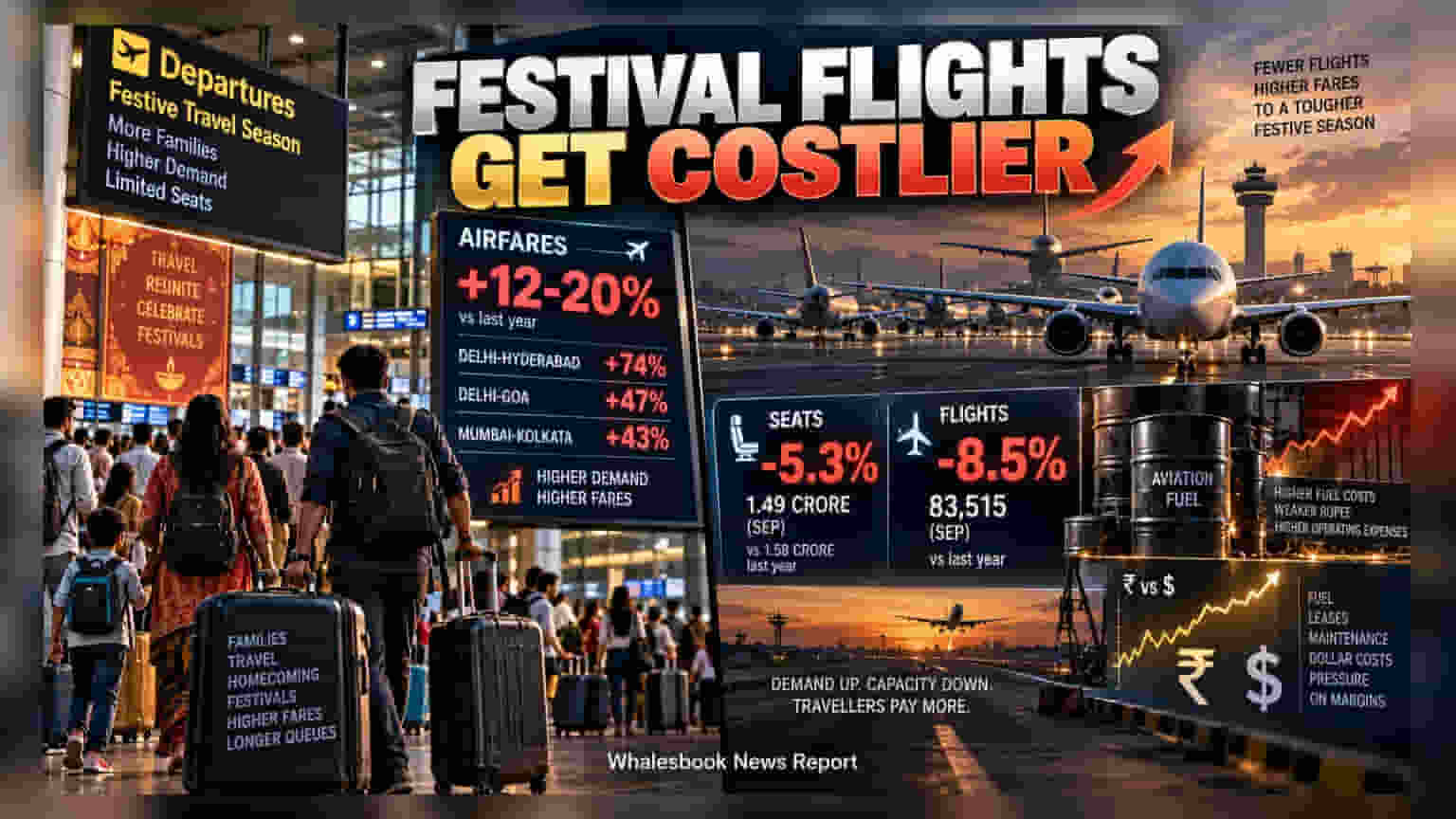
Domestic flight capacity for September has fallen 5.3% year-on-year, pushing airfares 12-20% higher than last year. While airlines are seeing increased revenue per ticket, rising costs linked to fuel prices and the US dollar may put pressure on overall profit margins.
The Indian aviation sector is experiencing a significant contraction in seat capacity just ahead of the peak festival season. Industry data for September shows that total scheduled domestic seat capacity has fallen to 1.49 crore, representing a 5.3% decline from the 1.58 crore seats available during the same period last year. The total count of scheduled domestic flights has seen an even steeper decline of 8.5%, falling to 83,515 flights.
This tightening of supply is directly influencing consumer ticket prices. Average domestic airfares for September are tracking 12-20% higher compared to the previous year. On several high-traffic routes, the price increases are even more pronounced. For instance, average one-way fares on the Delhi-Hyderabad route have jumped by 74%, while fares on the Delhi-Goa and Mumbai-Kolkata routes have increased by 47% and 43%, respectively.
While higher ticket prices generally improve revenue per seat, they do not necessarily translate to stronger profitability for airlines. Operational expenses remain high, driven by two major factors: aviation turbine fuel prices and the value of the rupee. Industry analysis indicates that approximately 70% of an airline's operating costs, including fuel, aircraft leases, and maintenance, are denominated in or linked to the US dollar. The persistent weakness in the rupee and high fuel costs, partly influenced by energy trends in West Asia, continue to exert pressure on bottom lines.
For investors, the current aviation environment presents a complex dynamic. Airlines are benefiting from higher yields due to limited capacity, but the risk remains that increased operational costs could offset these gains. If the seat supply remains constrained while festive demand continues to rise, travellers may face elevated fares for a prolonged period. However, this also limits the potential for volume growth, as higher costs for air travel can eventually impact passenger load factors.
The key monitorable for the coming months will be how individual carriers adjust their capacity. Investors should watch for announcements regarding future flight scheduling and any changes in fuel costs, as these will be critical in determining whether airlines can protect their profit margins in the second half of the year.