

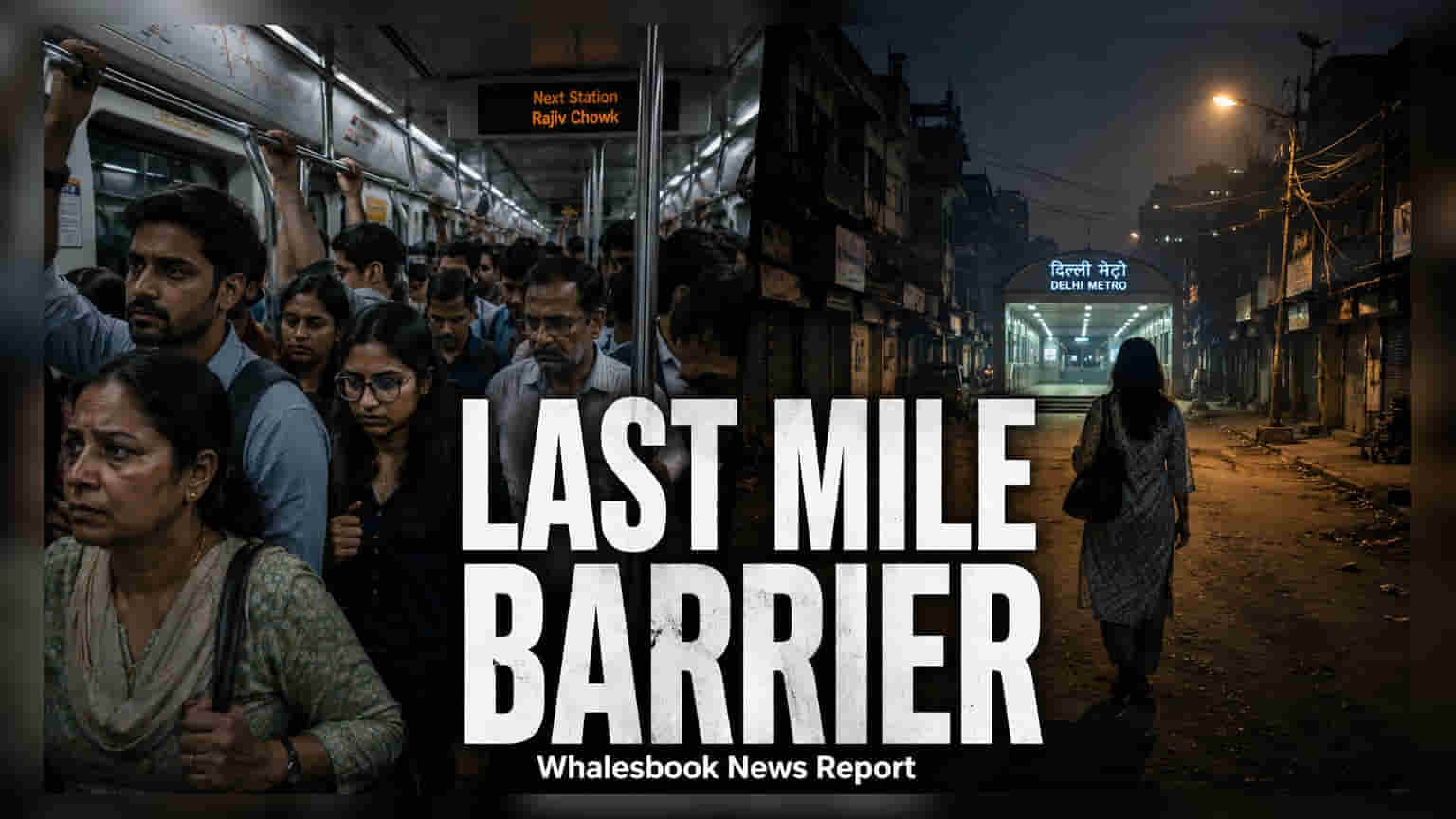
Despite serving over six million daily passengers with high punctuality, the Delhi Metro faces a persistent 'last-mile' connectivity challenge. Commuters spend nearly half their travel time and costs on the final leg, highlighting a critical infrastructure bottleneck and an emerging opportunity for integrated, electric-mobility solutions in urban transport.
The Delhi Metro is widely recognized as a success in mass urban transit, maintaining a punctuality rate of 99.95% and serving approximately 6.4 million passenger journeys daily across a 416.5 km network. However, a significant operational hurdle persists: the 'last-mile' connectivity gap. A recent study by the World Resources Institute (WRI) India shows that passengers spend about 40% of their total travel time and 48% of their commute costs simply moving between their final destination and the metro station. This effectively creates an 'accessibility tax' on public transport.
The Economic and Safety Impact
For investors and urban planners, this gap represents more than just a consumer inconvenience. It serves as a deterrent that limits the full utilization of the expensive, heavy infrastructure already built. When the final leg of a journey is expensive, time-consuming, or perceived as unsafe, commuters often default to private vehicles. This shift contributes to city-wide congestion and pollution, counteracting the environmental benefits of a robust metro system. The issue is particularly acute for women, who cite personal safety as a primary factor when choosing transport modes for this crucial final segment.
Emerging Opportunities in Mobility
As the government looks to integrate cleaner transit, the focus is shifting toward private mobility providers to bridge this gap. Private companies are stepping in with electric vehicle fleets, aiming to provide reliable, safe, and scheduled last-mile connectivity. For example, firms like Green SM India are actively positioning themselves to complement existing metro infrastructure by investing in safety technology and driver training.
These entities operate on the premise that reliable transport is a service that can be standardized. The goal is to create a seamless journey where the metro and the last-mile provider act as a single, unified system. While these companies are currently private and unlisted, their growth models reflect a broader trend in the urban mobility sector: the shift toward micro-mobility and electrification as a solution to dense city traffic.
Risks and Monitorables
Investors tracking the urban infrastructure and mobility space should watch for a few key developments. The primary risk remains execution; coordinating thousands of small, private trips with the high-frequency arrivals of a metro system is complex. Regulatory frameworks for these private operators in public spaces are still evolving. Additionally, the financial viability of these last-mile services depends heavily on high-volume ridership and the cost-efficiency of maintaining electric fleets.
The next major phase for the sector will be the successful integration of multi-modal transit systems—where metro schedules and last-mile vehicle availability are synchronized. The ultimate success of India’s expanding metro networks will likely depend not just on tracks and stations, but on how effectively policymakers and private mobility providers can solve the final few kilometers of the commuter’s journey.