

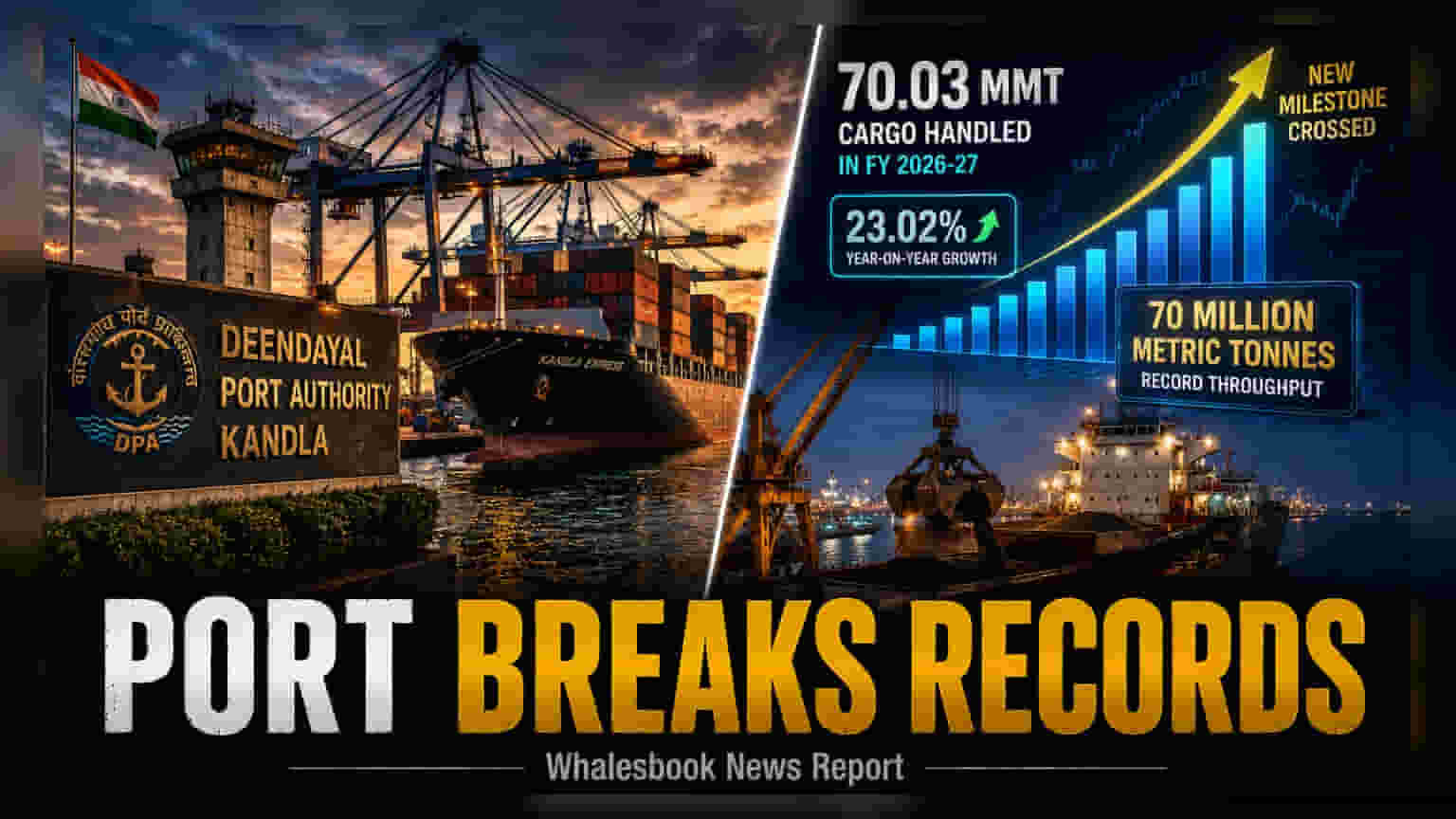
Deendayal Port Authority (DPA) has handled 70.03 million metric tonnes of cargo for the current financial year, achieving the target 32 days ahead of last year’s pace. This reflects strong activity in India's maritime logistics sector. While the port is a government entity and not listed, this operational momentum creates business opportunities for technology and infrastructure vendors in the logistics space.
The Deendayal Port Authority (DPA) at Kandla, Gujarat, has achieved a significant operational milestone by crossing 70 million metric tonnes (MMT) of cargo handling for the 2026-27 financial year. As of August 22, 2026, the port recorded a total throughput of 70.03 MMT, completing this performance 32 days ahead of its timeline from the previous year. This achievement underscores a 23.02% year-on-year growth, highlighting strong trade activity through the facility.
Operational Efficiency and Records
This growth in cargo handling is part of a broader trend of increased efficiency at the port. In July 2026, the port set a national benchmark for single-day operations, handling over 7,83,000 metric tonnes of cargo in 24 hours. The Offshore Oil Terminal at Vadinar also contributed to these metrics, setting new benchmarks for liquid cargo handling. These records reflect the port's ability to manage high volumes of essential commodities, including crude oil and other liquid products.
Impact on the Logistics Ecosystem
Although the Deendayal Port Authority is a government-owned statutory body and does not trade on the stock exchange, its operational performance is a relevant indicator for the Indian logistics and infrastructure sector. High throughput at major ports directly benefits listed companies that provide services such as terminal management, gate automation, and logistics technology. For instance, companies like RailTel Corporation of India recently secured contracts at this port for gate automation systems, demonstrating how DPA’s operational expansion creates business for private sector partners.
Operational Risks and Considerations
While the growth numbers are positive, large-scale port operations involve inherent complexities that stakeholders must monitor. The sector often deals with execution challenges related to infrastructure projects, including potential delays in capacity expansion or land acquisition. Additionally, maintaining such high levels of efficiency requires seamless coordination among multiple private terminal operators, customs authorities, and shipping lines. Environmental and regulatory requirements also remain a critical factor, as large ports must balance rapid expansion with sustainability norms, including planned investments in green energy hubs.
Investors monitoring this sector typically track the broader performance of logistics companies and infrastructure providers that supply the ports. The future performance of these vendors often correlates with the capacity utilization and cargo growth observed at major hubs like Kandla.