

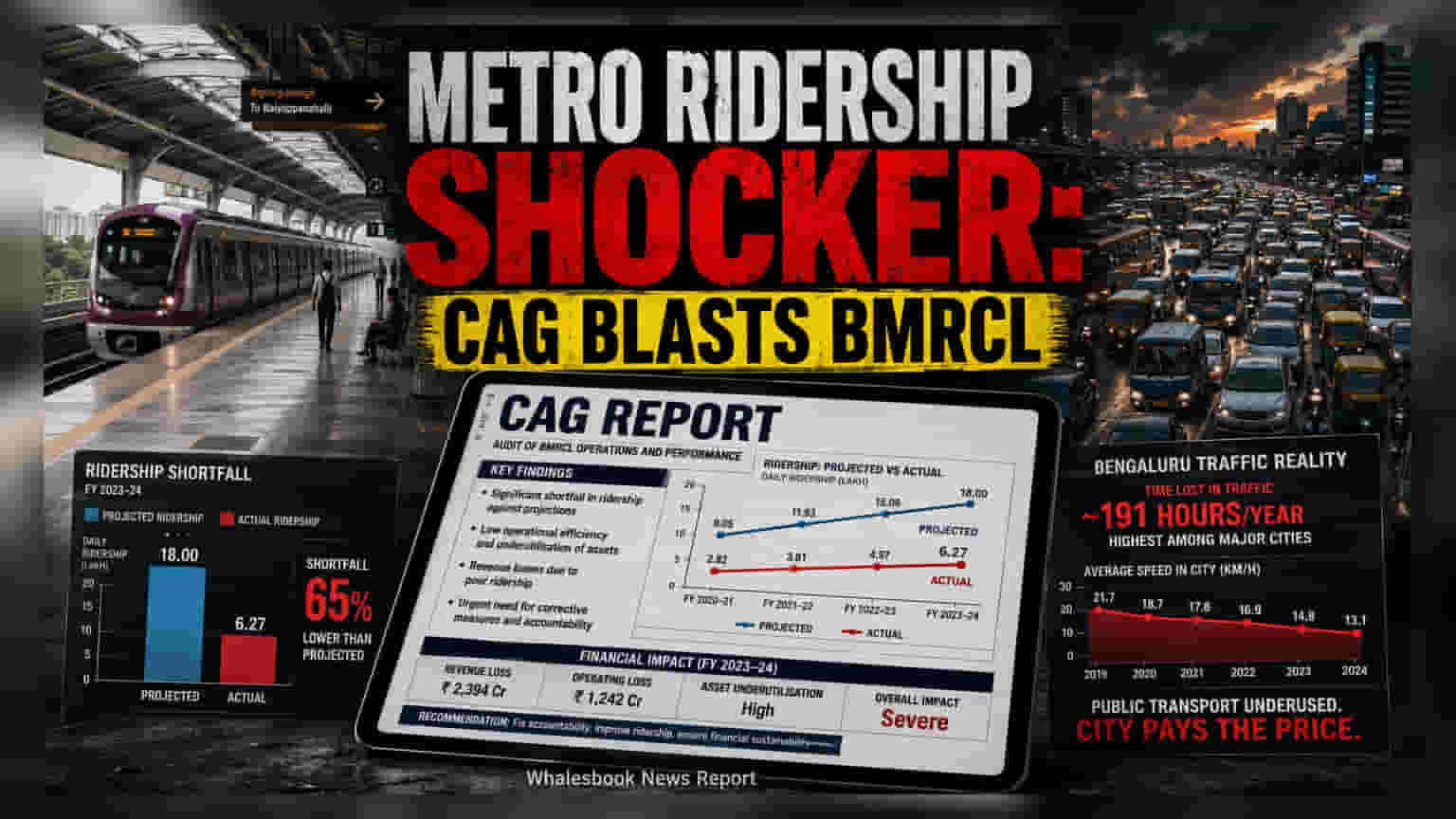
A Comptroller and Auditor General (CAG) report reveals that Bangalore Metro (BMRCL) has failed to meet long-term ridership projections set in 2007. The audit points to poor service integration and limited last-mile connectivity as key hurdles. While BMRCL operates with a surplus, it continues to face financial pressure from heavy foreign debt repayments and high infrastructure costs.
The Comptroller and Auditor General (CAG) has released a critical performance audit highlighting that the Bangalore Metro Rail Corporation Limited (BMRCL) has consistently fallen short of its ridership and peak traffic goals. The audit, tabled in Parliament, suggests that the Metro project has struggled to attract the expected number of passengers, even as public transport usage overall has seen shifts in the city.
Challenges in Connectivity and Integration
A primary concern raised by the audit is the lack of seamless integration between the Metro and the Bengaluru Metropolitan Transport Corporation (BMTC) bus services. The report indicates that the combined ridership of both systems is lower than what the bus network alone achieved before the Metro became operational. This suggests that the Metro system has not been successful in convincing a large portion of private vehicle users to switch to public transport. The CAG cited insufficient last-mile connectivity and inadequate parking facilities at stations as major reasons why commuters find it difficult to adopt the Metro.
Financial and Operational Health
It is important for stakeholders to note that BMRCL is an unlisted public sector entity and its shares are not traded on stock exchanges. Financially, the corporation is in a complex position. While BMRCL often generates an operating surplus—meaning it earns more from daily operations than it spends on running them—it continues to report net losses. These losses are largely driven by high interest payments on debt and the non-cash cost of asset depreciation.
Adding to the financial strain, BMRCL carries significant foreign currency debt. As of June 2026, the company began the repayment of a $500 million loan from the Asian Development Bank. The depreciation of the Indian Rupee against the US Dollar creates an additional financial burden, as the company must pay back more in local currency terms than originally planned. Furthermore, income from sources other than ticket sales, such as property development and leasing, has historically fallen short of projections, missing internal targets by significant margins.
Looking Ahead
The BMRCL, a joint venture between the Government of India and the Government of Karnataka, continues to work on expanding its network. While Phase 1 is fully operational, parts of Phase 2 are still under construction, with completion expected by the end of 2026. Given the ongoing operational and financial challenges, the key monitorables for the company will be its ability to improve ridership through better station access, the efficient completion of remaining corridors, and the management of its debt obligations. Recent scrutiny from government bodies, including safety audits regarding service reliability, also remains a focus area for the management.