 Whalesbook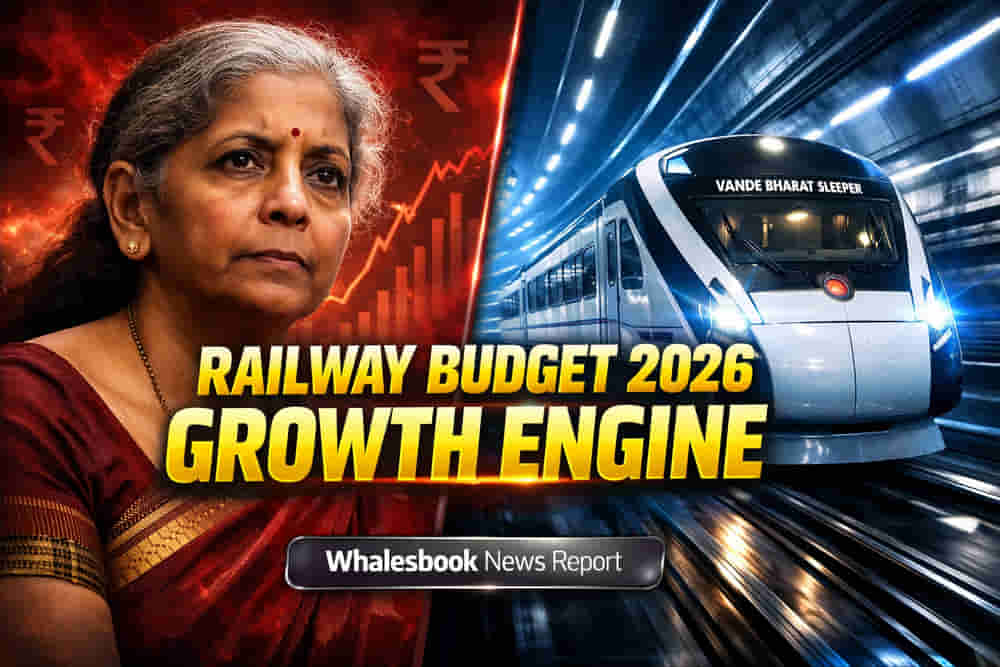
THE SEAMLESS LINK
The upcoming Union Budget 2026 is poised to reinforce India's infrastructure-led economic growth strategy, with Indian Railways expected to receive a substantial capital expenditure allocation, potentially setting a new record. This focus on infrastructure development is critical as the nation navigates global economic headwinds, with projections indicating continued robust GDP growth anchored by public investment [16, 34].
The Infrastructure Mandate
Finance Minister Nirmala Sitharaman's Budget 2026 is anticipated to signal a significant capital expenditure boost for Indian Railways. This allocation is expected to be a record, building on a sustained upward trajectory of investment in the sector over recent years [8, 14]. Analysts estimate the outlay could rise to approximately ₹2.7-2.75 lakh crore for FY27, from the current ₹2.52 lakh crore [38, 39]. This strategic investment is viewed as a cornerstone for national economic expansion, aligning with the government's broader push to enhance infrastructure and connectivity. Public capital expenditure is recognized as a primary driver, with the government's spending nearly doubling between FY22 and FY26, reaching an estimated ₹11.21 lakh crore in FY26 [24, 35]. The emphasis is shifting towards quality and efficient execution of projects, rather than solely scale, addressing historical challenges in project completion timelines [14, 35, 38].
Modernizing Passenger Services
The budget is likely to detail a significant expansion of modern train services. Plans for the rollout of Vande Bharat sleeper trains are expected to be a prominent feature, following the introduction of the first service earlier this year [Source A]. These advanced, semi-high-speed trains, capable of 160 kmph, aim to revolutionize overnight travel with enhanced comfort and amenities [10]. By December 2025, 164 Vande Bharat services were already operational across the network, demonstrating strong passenger demand [10, 22, 26]. The Integral Coach Factory (ICF) is set to manufacture 50 rakes of 24-coach Vande Bharat Sleeper trains [29]. Alongside this, the Amrit Bharat trains, designed for common passengers with sleeper and general class configurations, will see continued expansion; 30 such trains were operational by December 2025 [15].
Elevating Safety Standards
A critical focus for the upcoming budget will be the continued expansion of Kavach, India's indigenous automatic train protection system. This system is designed to automatically apply brakes in case of human error, significantly reducing the risk of collisions [12]. The recent commissioning of 472.3 route kilometers of Kavach Version 4.0 in a single day marks a significant acceleration in its deployment [1, 4, 7, 18]. The objective is to cover 18,000 km of high-density routes, with cumulative operational coverage exceeding 1,300 km [3, 7, 12]. The safety budget is also anticipated to see a substantial increase, potentially reaching ₹1.3 lakh crores, to support track renewal, bridge maintenance, and signaling systems [12].
Sectoral Context and Outlook
The practice of presenting a separate Railway Budget was discontinued in 2017, with allocations now integrated into the Union Budget speech, a format last seen when Suresh Prabhu presented the budget in 2016 [2, 9, 11]. Historically, railway allocations have seen significant increases, with the FY23-24 budget allocating ₹2.40 lakh crore and subsequent budgets maintaining high support [14]. Despite recent corrections in railway-focused mutual funds, with some experiencing losses of up to 8% since the last budget, analysts suggest maintaining investment in quality names for the medium term, citing strong underlying fundamentals and steady execution momentum [21, 38]. The market often exhibits a "buy the rumor, sell the news" trend around budget announcements for railway stocks [28]. The budget is expected to drive demand for wagons, signaling systems, and related services, benefiting railway-focused PSUs and manufacturers through steady order books and long execution cycles [33].