

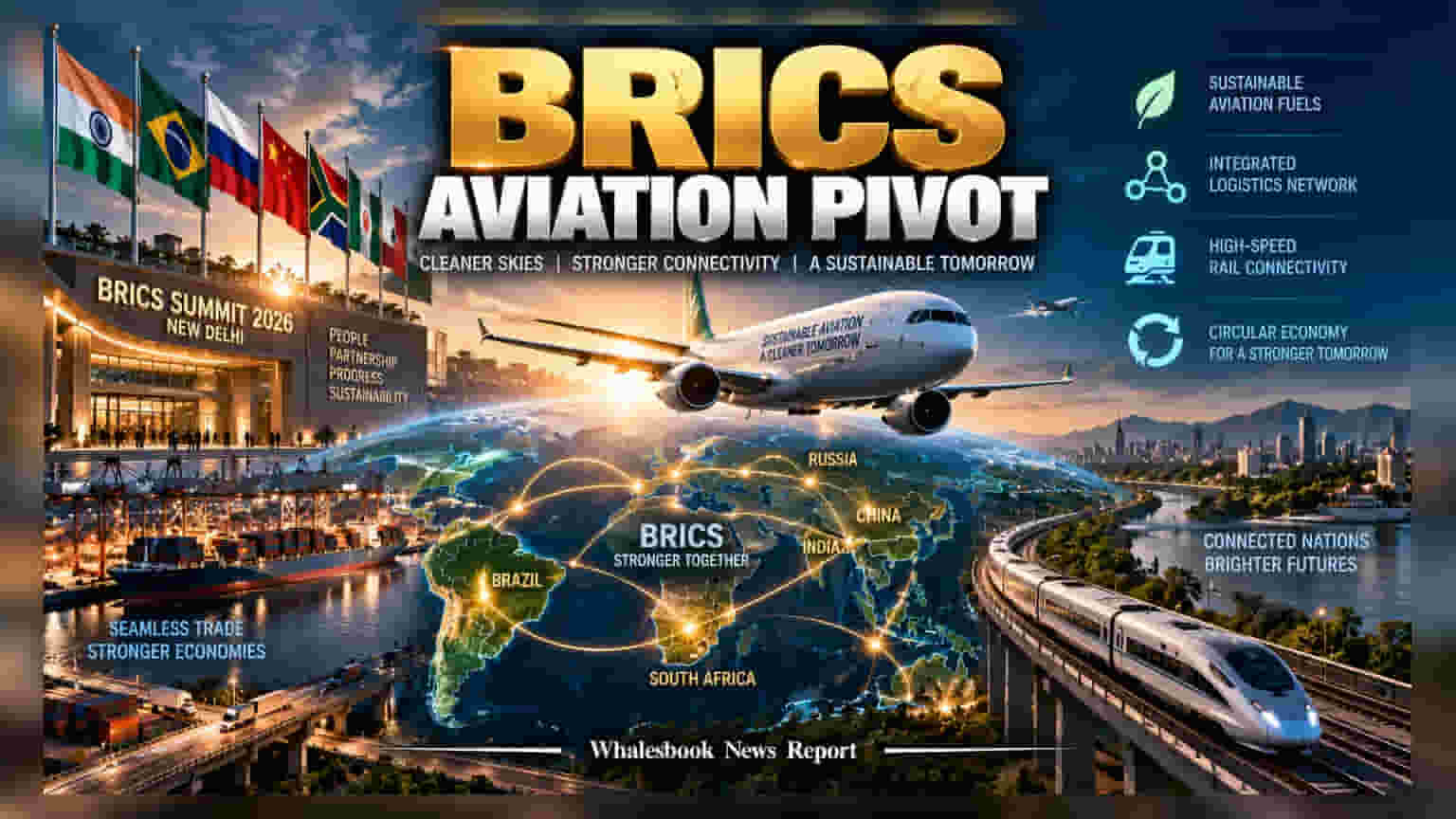
BRICS leaders have finalized an agreement to collaborate on Sustainable Aviation Fuels (SAF) and greener transport networks. The initiative, announced at the New Delhi Summit, targets logistics and urban mobility improvements. While this signals a move toward decarbonization, the feasibility of these plans depends on production costs and the varying economic health of the 11-member bloc.
During the 2026 BRICS Summit held in New Delhi, the 11-member bloc formalized a comprehensive agreement to overhaul transport infrastructure and adopt sustainable energy standards. The newly signed New Delhi Declaration prioritizes the development of Sustainable Aviation Fuels (SAF) and the integration of circular economy principles into the construction and maintenance of transport assets. This move follows initial discussions held at the 3rd BRICS Transport Ministers’ meeting in Nagpur earlier this year.
The agreement introduces structured frameworks to streamline cross-border trade and connectivity. Key initiatives include the establishment of the BRICS Urban Mobility Hub and a Logistics Supply-Chain Cooperation Framework. These entities are designed to facilitate knowledge sharing on smart, affordable transit solutions and to optimize freight movement across the member nations. Additionally, the bloc has expressed support for a BRICS Railway Research Network, which aims to drive innovation in high-speed and efficient rail connectivity.
For industrial stakeholders, the move toward SAF is the most significant development. The declaration includes commitments to align standards for feedstock mapping and carbon tracking, which are intended to facilitate smoother trade in sustainable fuels. By embedding circular economy principles—which focus on reducing, reusing, and recycling resources—into infrastructure projects, the member states hope to create more resilient and cost-effective transport networks over the long term.
However, there are structural and financial hurdles that investors should consider. The transition to SAF is capital-intensive, and the production costs currently remain high compared to conventional fuels. This poses a challenge for emerging economies within the bloc that are already navigating tight fiscal conditions. High debt levels in several member countries could constrain the funding available for large-scale, climate-resilient infrastructure projects, potentially delaying the execution of the proposed railway and logistics networks.
Furthermore, the logistics landscape is currently marked by fragmentation and disparities in industrial capacity among the 11 nations. While the framework aims to optimize supply chains, operationalizing these improvements will require sustained policy coordination and significant private and public investment. The success of these initiatives will depend on whether member nations can bridge the gap between policy goals and the practical reality of high implementation costs, existing geopolitical tensions, and global trade-restrictive measures such as carbon-border-adjustment mechanisms.
Going forward, stakeholders will track the progress of the newly created Urban Mobility Hub and the operational rollout of the logistics framework. The ability of the member states to standardize carbon tracking and secure affordable feedstock for SAF production will be primary factors in determining the commercial viability of these decarbonization efforts.