

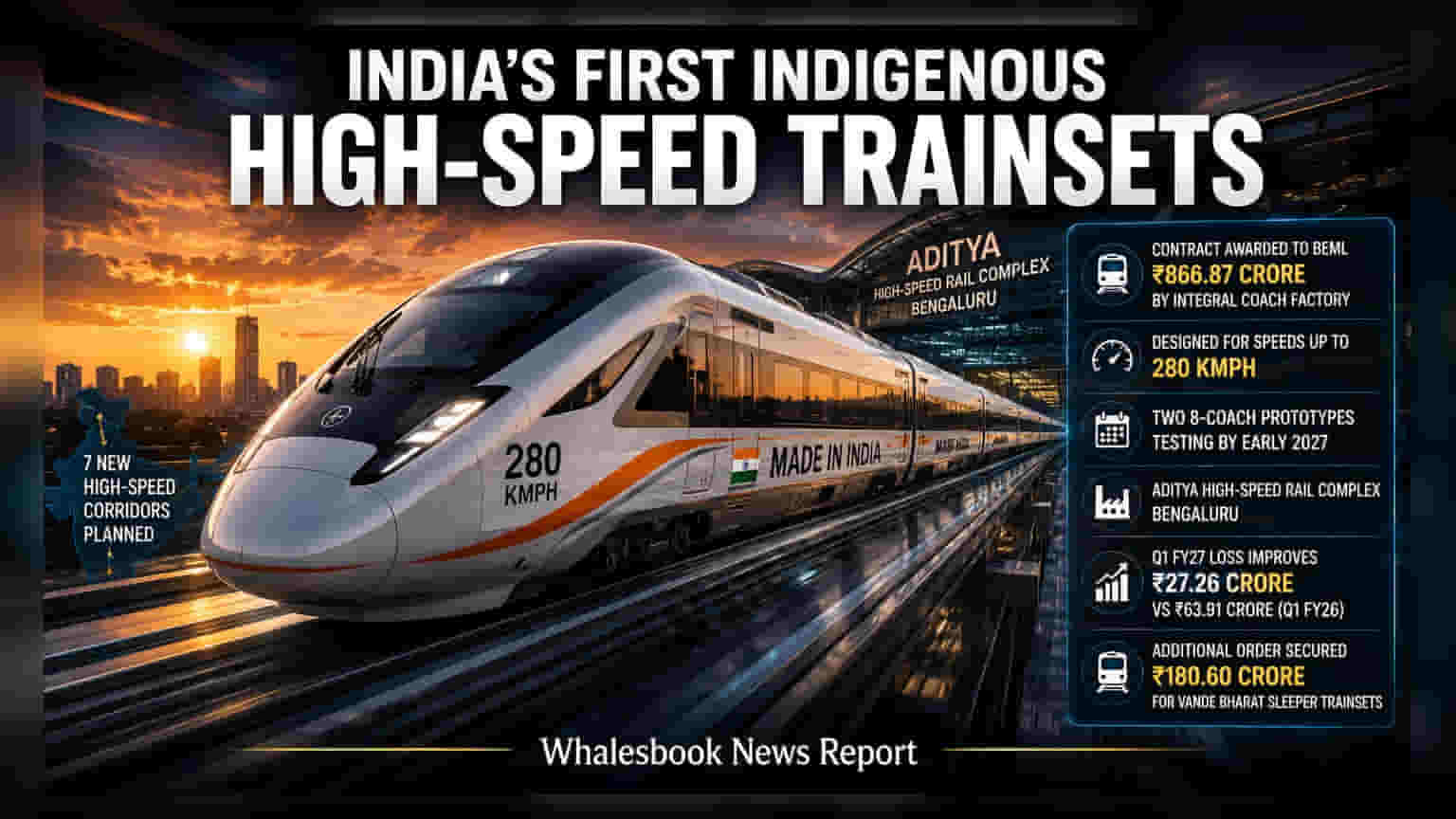
BEML Limited has been awarded an Rs 866.87 crore contract to develop indigenous 280 kmph high-speed trainsets by early 2027. The project, utilizing a new Bengaluru facility, aims to reduce reliance on imports. Investors are tracking the company's execution capabilities and recent financial recovery, marked by narrowing losses in the June 2026 quarter.
BEML Limited is set to manufacture India’s first indigenous high-speed trainsets, a significant step in the nation's efforts to domesticate rail technology. The Integral Coach Factory has awarded a contract worth Rs 866.87 crore to the company for the design and production of two eight-coach prototypes. These trainsets, designed for speeds of up to 280 kmph, are expected to be ready for testing by early 2027.
To support this manufacturing, BEML inaugurated the Aditya High-Speed Rail Complex in Bengaluru earlier this year. The facility is specialized to handle the precision requirements of high-speed rolling stock, which differs significantly from standard coaches. Unlike international models designed for temperate climates, these trainsets must be engineered to operate reliably under India’s extreme heat and high-dust environments. Successful execution will be critical, as these prototypes are expected to form the foundation for the seven new high-speed corridors proposed in the Union Budget.
From a financial perspective, BEML has shown signs of operational improvement. For the first quarter of the 2027 fiscal year, the company reported a standalone net loss of Rs 27.26 crore, an improvement compared to the loss of Rs 63.91 crore reported in the same period last year. This trend of narrowing losses coincides with consistent order flow. On September 2, 2026, the company also secured an additional order worth Rs 180.60 crore from the Integral Coach Factory for the production of Vande Bharat sleeper trainsets, further strengthening its order book.
Despite the positive developments, investors often watch the risks associated with such capital-intensive projects. The rolling stock business typically requires high working capital, with long production cycles and extended timeframes for receiving payments. Additionally, transitioning into high-speed rail involves significant technical execution risks, as the company must meet stringent safety and stability standards while adapting to challenging local operating conditions. Competitive pressure remains a factor as the Indian Railways expands its vendor base to accelerate infrastructure development.
The next major milestone for shareholders will be the progress of the prototype assembly and the subsequent testing phase. Investors will also track how the company manages its working capital requirements and whether the increased order book translates into sustained improvements in profitability and cash flow in upcoming quarters.