
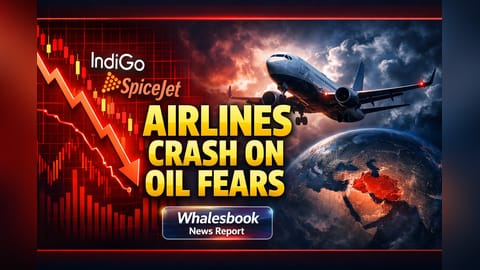
Market Tremors: Geopolitics, Oil Spike Fuel Aviation Sector Drop
Market sentiment soured sharply Thursday, pulling aviation stocks down as global geopolitical fears intensified. Concerns over continued aggressive military action in Iran, following signals from U.S. President Donald Trump, fueled further escalation fears and sent broader market indices tumbling over 2%. In this environment, InterGlobe Aviation, the parent company of IndiGo, saw its shares drop as much as 5% to ₹3,970.05 on the BSE. Competitor SpiceJet faced a similar downturn, falling 4% to ₹9.53.
The sector's sharp decline is immediately linked to soaring global oil prices, with Brent crude surpassing $107 per barrel. This volatility directly drives up Aviation Turbine Fuel (ATF) costs, which make up a significant 30-40% of airlines' operating expenses in India. Domestic ATF prices have reportedly surged over 130% month-on-month, with jet fuel costs in some markets crossing ₹2 lakh per kilolitre – more than double the previous day's price. To buffer these costs, IndiGo introduced revised fuel charges effective April 2. These surcharges range from ₹275 for shorter domestic routes to ₹950 for flights over 2,000 km. International surcharges on long-haul routes to Europe have been raised up to ₹10,000. While necessary for margin protection, these charges pass costs directly to passengers, following government approval for only a 25% staggered pass-through of ATF hikes for domestic operations.
Leadership Amid Turbulence: Walsh Takes Helm at IndiGo
Amid these turbulent conditions, IndiGo's recent appointment of aviation veteran Willie Walsh as CEO, effective August 2026, brings a wealth of experience. Walsh, who previously served as Director General of IATA and CEO of British Airways and International Airlines Group (IAG), has a proven record of navigating complex crises, including the 2008/09 financial crisis and the COVID-19 pandemic. During his time at IAG, he oversaw the successful merger of British Airways and Iberia, forming a strong entity that consistently achieved profitability. Walsh's direct approach and expertise in cost-cutting and restructuring at Aer Lingus and British Airways will be vital as IndiGo grapples with rising fuel costs and potential softening in demand. Despite this leadership appointment, previously viewed as a significant positive, today's market reaction underscores the severity of the external shocks.
Industry Headwinds and Valuation Concerns
IndiGo holds a dominant 50% share of India's domestic seat capacity and a history of strong long-term returns. However, its current valuation and the overall sector outlook present significant challenges. IndiGo's Price-to-Earnings (P/E) ratio was approximately 47.55 as of March 31, 2026, trading at a premium to its 10-year median of 24.91 and slightly above the industry average of 33.56. This premium valuation suggests high growth expectations, which could be strained by the current operating environment. Additionally, about 13-14% of IndiGo's capacity serves routes to the conflict-affected Gulf region.
In contrast, SpiceJet operates with a negative P/E ratio, signaling ongoing losses and a more fragile financial position. While its capacity increased by 14% year-on-year in March 2026, its technical indicators remain largely bearish. The Indian aviation industry is navigating a difficult period overall. Ratings agency ICRA has revised its outlook to 'negative' from 'stable,' forecasting industry-wide losses of ₹17,000–18,000 crore for FY2026, with only a partial recovery expected in FY2027. Domestic passenger traffic growth is projected to be subdued, between 0-3% for FY2026. Operational efficiency is also affected by capacity constraints, with roughly 13-15% of fleets grounded due to supply chain issues.
Analysts Weigh In: Mixed Views Amidst Cost Pressures
Analysts face conflicting signals in assessing the sector. Emkay Global Financial Services, despite reiterating a 'Buy' rating, has significantly reduced its FY26/27/28 earnings estimates by 13%, 28%, and 7% respectively. They also lowered IndiGo's target price to ₹5,500 from ₹6,300. Emkay projects a 20% increase in IndiGo's base fares (RASK) against a steeper 50% rise in blended fuel costs, yet anticipates pre-tax margins will remain better than pre-conflict levels. Morgan Stanley holds an 'Overweight' call with a higher target of ₹6,498. They note that the limited domestic ATF hike alleviates some cost pressures, although international prices have spiked and domestic traffic is weak, down 1% year-on-year. Today's market reaction, with IndiGo's stock trading near its 52-week low of ₹3,894.80 recorded in March 2026, indicates that immediate risks are heavily influencing sentiment, overshadowing prior optimism.
Outlook: Long-Term Growth vs. Immediate Headaches
The Indian aviation sector is at a crucial point. While long-term forecasts predict strong growth, with India expected to become the world's third-largest domestic aviation market and an 11.72% compound annual growth rate projected through 2034, the immediate future is obscured by escalating geopolitical risks, volatile fuel prices, and currency depreciation. The updated fuel surcharges are an essential step to offset soaring costs, but their effect on passenger demand will be closely watched. Willie Walsh's extensive crisis management experience will be vital as he takes leadership of IndiGo. He faces the task of guiding the airline and the wider sector through this period of intense cost pressure and uncertain demand, against ICRA's projection of significant industry-wide losses.