

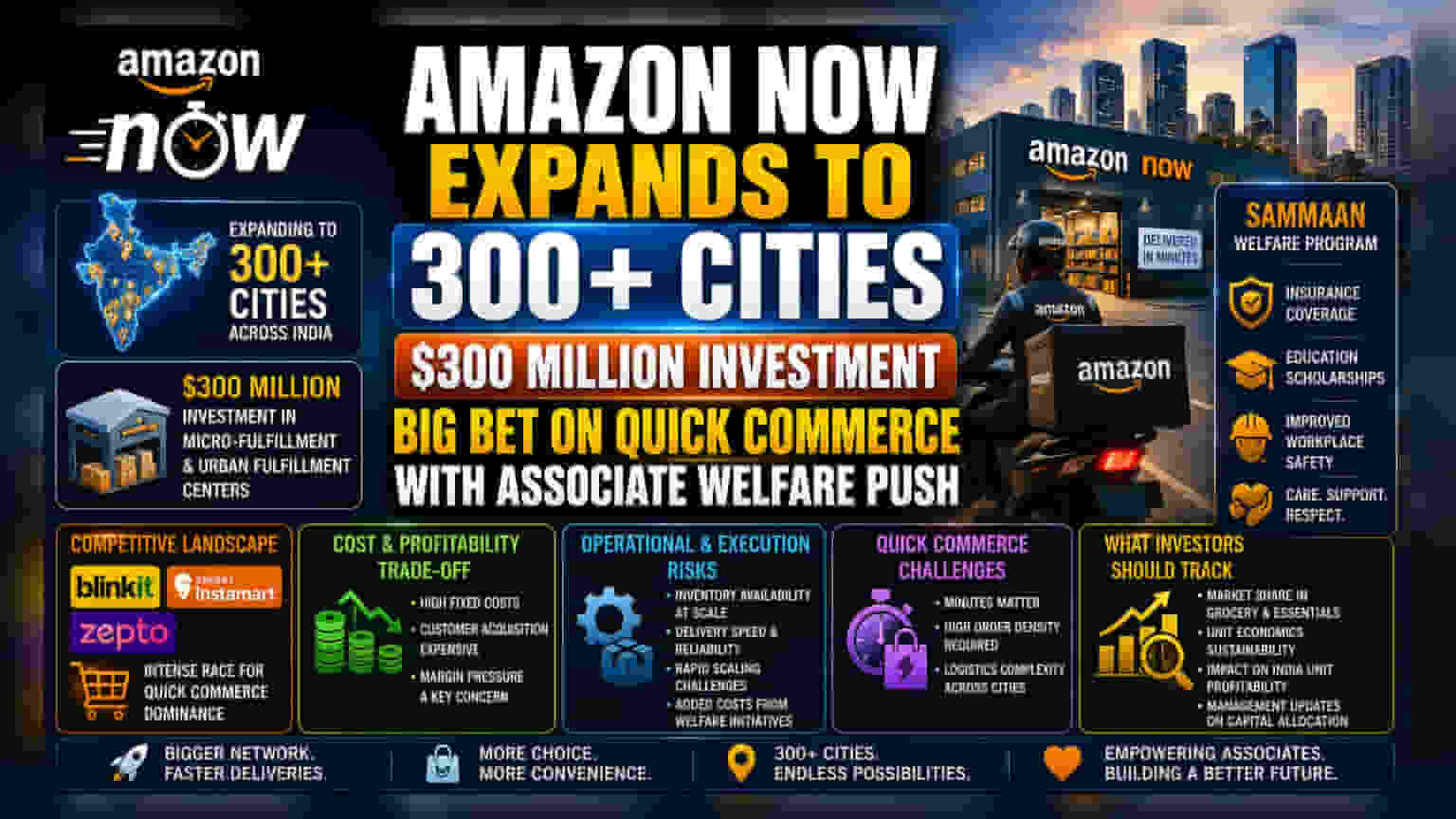
Amazon CEO Andy Jassy has announced a major expansion of its 'Amazon Now' quick commerce service to 300 Indian cities. Supported by a $300 million investment, the move aims to capture market share in India's competitive ultra-fast delivery sector. Investors will track whether this rapid scaling impacts profitability amidst stiff competition from incumbents like Blinkit, Swiggy Instamart, and Zepto.
What Happened
Amazon CEO Andy Jassy announced an aggressive expansion plan for the company's ultra-fast delivery service, Amazon Now, aiming to reach over 300 cities across India. This strategic move is supported by a $300 million investment, which is being directed toward expanding a network of micro-fulfillment and urban fulfillment centers. Alongside this expansion, the company has introduced 'Sammaan,' a welfare program for delivery associates that includes insurance, education scholarships, and improved workplace safety measures. The initiative highlights a significant shift in Amazon's India strategy, focusing heavily on the quick commerce model.
The Competitive Landscape
India’s quick commerce market has been largely defined by established players including Zomato-owned Blinkit, Swiggy Instamart, and Zepto. These companies have conditioned urban consumers to expect deliveries in minutes, forcing traditional e-commerce giants to adapt. Amazon, which has historically relied on a standard delivery model, is now pivoting to defend and grow its market share in the high-frequency grocery and essentials category. This 300-city push is a clear attempt to challenge the dominance of specialized quick commerce platforms and leverage Amazon's existing logistics footprint.
The Cost And Profitability Trade-Off
Entering the quick commerce space requires significant capital investment. The model operates on the principle of micro-fulfillment—small warehouses located closer to the customer to enable rapid delivery. Maintaining these centers across 300 cities involves high fixed costs, including real estate, inventory management, and last-mile logistics. While the scale can lead to higher order volumes, the cost of acquiring customers and maintaining delivery speed is high. Investors may monitor whether this heavy spending puts pressure on Amazon's operational margins in the India unit, as the company balances market share growth against the high operational costs of ultra-fast delivery.
Operational And Execution Risks
The quick commerce business model is sensitive to operational inefficiencies. Success depends on maintaining high inventory availability at every micro-fulfillment center and ensuring consistent delivery times regardless of urban traffic conditions or local logistical hurdles. The company faces the challenge of scaling its workforce and infrastructure rapidly without compromising on quality. Additionally, the 'Sammaan' program, while beneficial for employee retention and welfare, adds to the ongoing operational expenses. If the company cannot convert the expanded reach into sustained order density, the cost structure could become a burden.
What Investors Should Track
The primary monitorable for this expansion is how effectively Amazon can integrate its existing e-commerce infrastructure with the specific requirements of quick commerce. Stakeholders will likely look for updates on market share capture in the grocery and essentials segment, and whether the company can maintain unit economics as it moves beyond major metro cities. Management commentary on the impact of this capital allocation on the India unit's path to profitability will also be important to watch in upcoming quarters.