

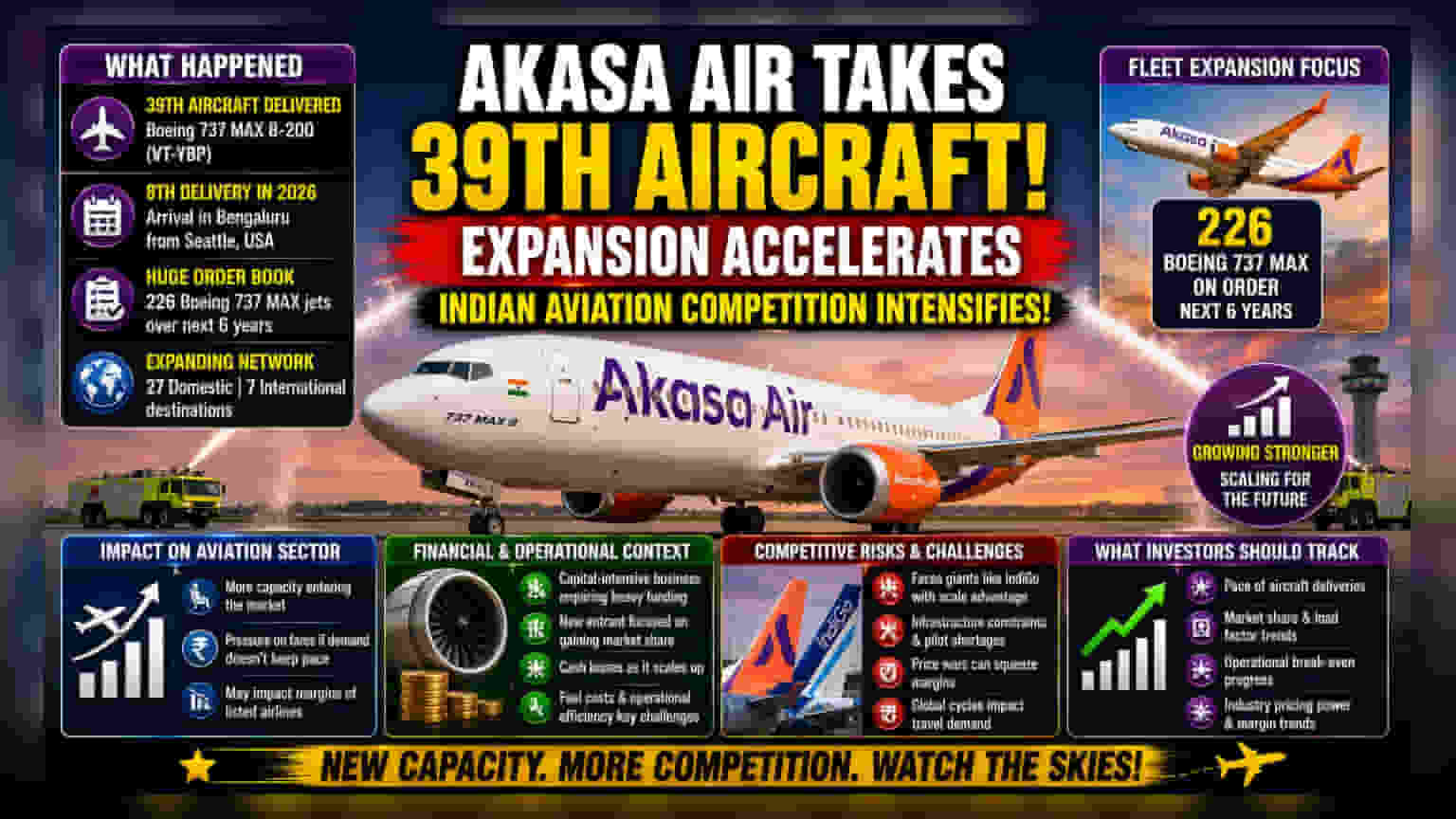
Akasa Air has expanded its fleet with the delivery of its 39th Boeing 737 MAX aircraft. As the private carrier continues its rapid growth, its expansion impacts the competitive dynamics of the Indian aviation sector. Investors in listed airline stocks should track how this capacity addition affects market share and pricing pressures in a sector dominated by major players like IndiGo.
What Happened
Akasa Air has taken delivery of its 39th aircraft, a Boeing 737 MAX 8-200. This addition marks the eighth plane inducted into the airline's fleet in 2026. The new aircraft, registered as VT-YBP, arrived in Bengaluru after a delivery flight from Seattle, USA. The airline is aggressively building its capacity, with a firm order book of 226 Boeing 737 MAX jets expected to be delivered over the next six years. This expansion is part of a strategy to serve both domestic and international markets, having already established a network across 27 domestic and 7 international destinations.
Impact on the Aviation Sector
While Akasa Air is a privately held company, its rapid fleet expansion has significant implications for the broader Indian aviation market. The industry is currently characterized by high competition and dominance by a few established players, most notably InterGlobe Aviation (IndiGo). As Akasa Air increases its fleet size, it challenges the market share of larger, listed airlines. For investors in the aviation sector, this means monitoring potential shifts in seat capacity, passenger load factors, and pricing power. When new capacity enters the market, it often puts pressure on ticket prices if demand does not grow at the same pace, which can affect the margins of all airlines operating on these routes.
Financial and Operational Context
Akasa Air is operating in a capital-intensive sector that requires continuous funding for aircraft acquisition, maintenance, and expansion. Being a relatively new entrant, the airline has reported cash losses as it focuses on gaining market share. The company has secured support from investors to fund this growth, but like many airlines, it faces the constant pressure of rising fuel costs and the need for high operational efficiency. The reliance on a single aircraft type—the Boeing 737 MAX—also creates specific operational risks, such as supply chain delays or potential safety-related issues that could impact fleet availability.
Competitive Risks and Challenges
The Indian aviation industry is known for its high-stakes environment where airlines must balance aggressive expansion with strict cost control. Established competitors like IndiGo benefit from massive economies of scale and extensive route networks, allowing them to absorb price wars better than newer entrants. For Akasa Air, the challenge lies in scaling its operations to a level where it can achieve consistent profitability while competing against incumbents with much larger balance sheets and deeper brand penetration. Additionally, the sector faces structural risks, including infrastructure constraints at major airports, a shortage of trained pilots, and the potential impact of global economic cycles on air travel demand.
What Investors Should Track
For those watching the aviation sector, the key monitorables include the pace of aircraft deliveries, changes in domestic and international market share, and the operational break-even status of emerging carriers. While Akasa Air itself is not listed, its ability to successfully scale its fleet and network serves as a proxy for the intensity of competition in the Indian skies. Investors should watch for any shifts in industry-wide pricing power, as these indicators often signal whether the aviation sector is heading towards sustainable profitability or a period of intensified competition that may squeeze margins for all carriers.