 Whalesbook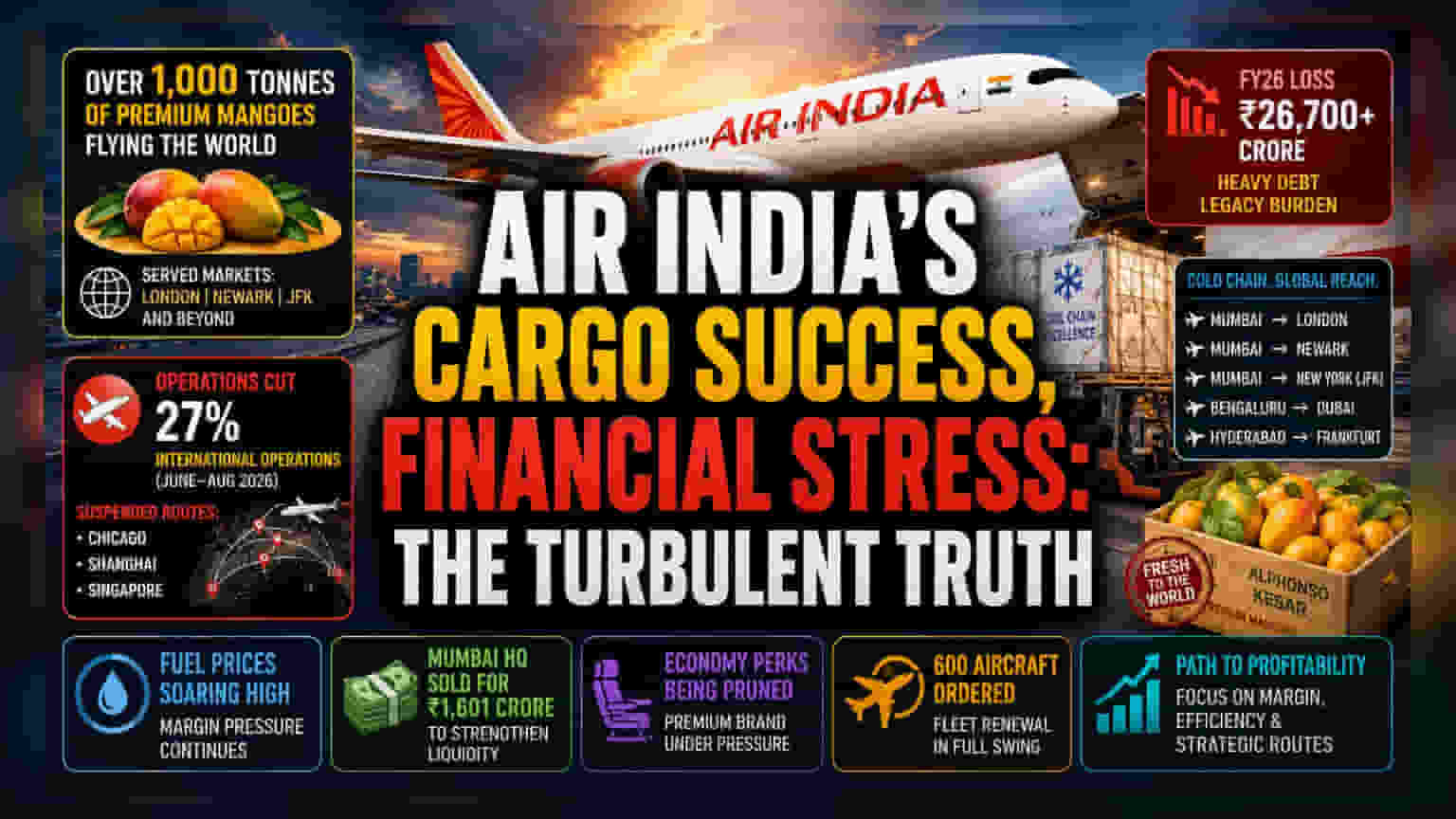


The Operational Paradox
While Air India’s recent achievement of transporting over 1,000 tonnes of premium mangoes—primarily Alphonso and Kesar varieties—across international routes underscores a successful scaling of cold-chain logistics, the broader financial picture remains grim. The airline’s ability to move high-value, temperature-sensitive perishables to markets like London, Newark, and JFK demonstrates operational sophistication, but these niche cargo victories are currently insufficient to offset the structural financial pressures weighing on the company’s parent entity.
The Reality of Margin Compression
Despite the operational growth in fresh produce handling, which rose significantly in recent years, the carrier is struggling with the high cost of fuel and significant debt-related legacy burdens. Recent disclosures indicate that Air India reported losses surpassing ₹26,700 crore for the fiscal year ending March 2026. This performance has negatively impacted its shareholder, Singapore Airlines, which holds a 25.1% stake in the private airline. The reliance on premium cargo is a classic attempt to boost yield, yet it represents a small fraction of the total revenue required to stabilize a balance sheet currently reeling from the capital-intensive merger of its subsidiary airlines.
The Forensic Bear Case: Structural Weakness
Management’s focus on high-margin cargo is a necessary strategy, but it cannot mask the immediate operational volatility. As of June 2026, Air India has been forced to initiate a 27% reduction in international operations between June and August, including the suspension of key routes to Chicago, Shanghai, and Singapore. These cuts are a direct consequence of soaring aviation turbine fuel prices and a volatile geopolitical environment that has made long-haul, high-volume travel increasingly expensive. Unlike low-cost competitors that maintain leaner operational footprints, Air India is trapped in a capital-intensive integration phase, exacerbated by the recent divestment of its iconic Mumbai headquarters, which was sold to the Maharashtra government for ₹1,601 crore to free up liquid capital. The airline’s premium branding is currently being tested by efforts to prune economy-class perks, a move that critics suggest could dilute its market position against aggressive, cost-efficient rivals like IndiGo.
Strategic Outlook
Moving forward, the airline's success hinges on whether it can harmonize its expansive new fleet—following an order for 600 aircraft—with a profitable route structure. While the cold-chain logistics platform is now robust, the path to solvency requires a transition from volume-based growth to margin-focused efficiency. Analysts are closely watching whether the integration of Vistara and the aggressive fleet renewal will provide the necessary economies of scale, or if the current fiscal turbulence will force further cuts to both domestic and international service capacity.