 Whalesbook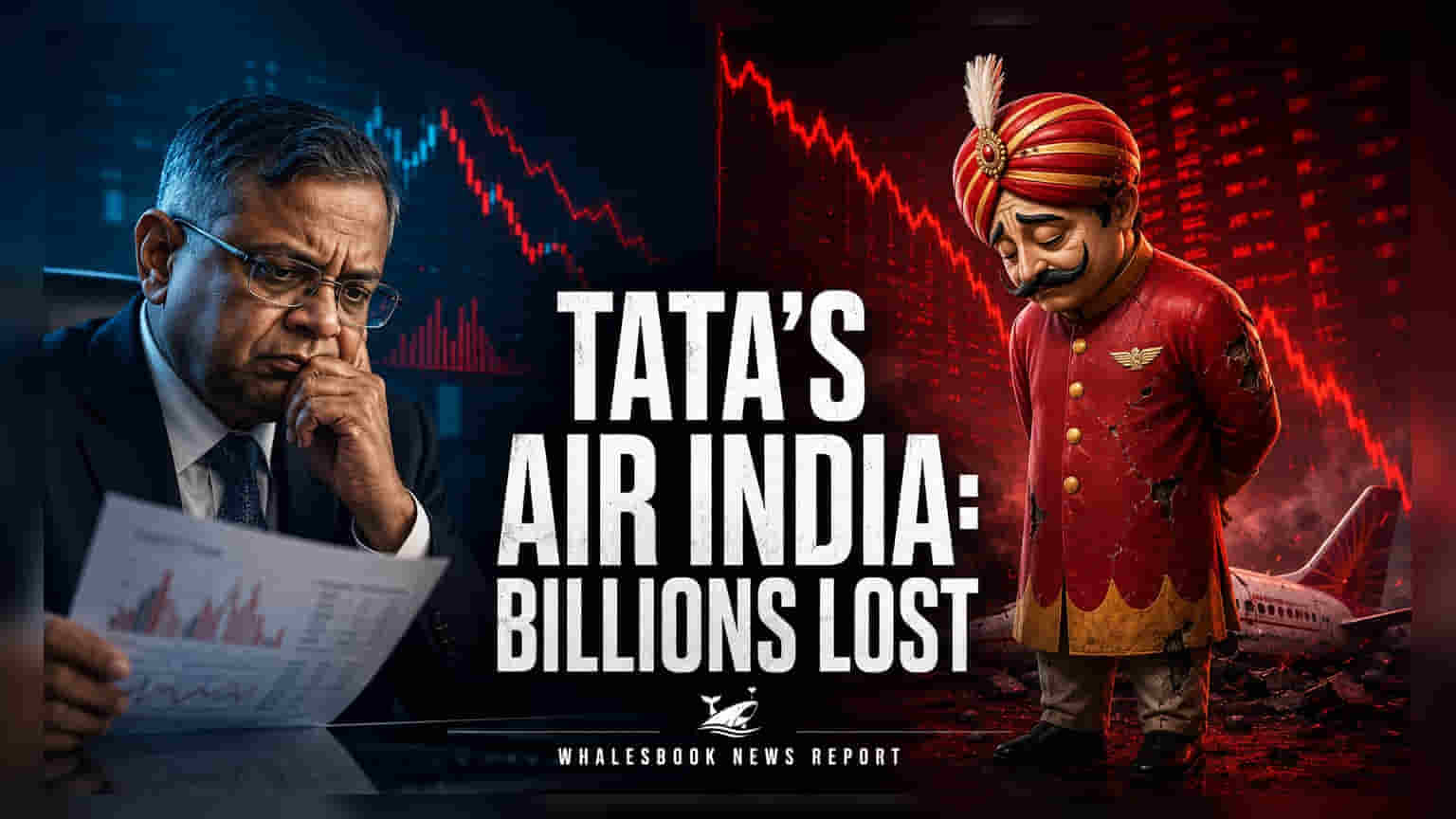


Air India Faces Massive Financial Setback Amidst Turnaround Push
The unprecedented financial losses at Air India signal a critical juncture for the Tata Group's ambitious revival strategy. The airline's FY26 deficit of INR27,000 crore, the largest in its 94-year history, highlights the deep-seated challenges that continue to plague the carrier. These figures cast a shadow over the projected turnaround timeline and the significant capital infusion required to stabilize operations.
Financial Sinkhole Deepens
Air India's FY26 results reveal a devastating financial performance. The airline reported a cash burn of INR18,000 crore against revenues of INR80,000 crore, equating to a daily loss of approximately INR70 crore. Air India Express alone contributed over INR4,000 crore to this deficit. External factors compounded these losses, including the AI171 Boeing 787 incident costing over INR5,000 crore, the Pakistan airspace ban an additional INR5,000 crore, and new labor codes adding INR1,000-INR1,500 crore. Projections indicate losses could persist at INR2,000 crore per month, potentially pushing the total since the Tata takeover to INR80,000 crore (approximately $9.6 billion) over five years.
Funding and Debt Concerns
The mounting cumulative losses have necessitated a push for further financial support, with reports suggesting the Tata Group and Singapore Airlines are seeking an additional INR15,000-INR20,000 crore infusion. Concurrently, Air India's aggressive borrowing to sustain operations has driven its debt levels to INR40,000-INR50,000 crore, nearing its pre-privatization debt. This leveraged financial structure makes the airline vulnerable to extended periods of losses, with a reported net debt-to-equity ratio of 30%.
Leadership and Operational Hurdles
The turnaround effort is further complicated by leadership flux and persistent operational challenges. CEO Campbell Wilson's reported desire to return to Singapore after a four-year tenure suggests mounting pressure. Internally, cultural clashes arising from the integration of various airline entities and external officials are creating friction. Critically, the absence of a core engineering department, retained by the government post-privatization, leads to frequent aircraft-on-ground (AOG) situations, disrupting schedules and escalating costs. Even newer aircraft have experienced unexpected issues, and the airline's on-time performance lags behind rivals like IndiGo. Recent regulatory scrutiny has also highlighted maintenance lapses and record-keeping deficiencies within Air India's engineering processes.
Competitive Landscape and Strategic Ambiguity
Air India's strategic direction remains a point of contention, with the airline reportedly torn between becoming a scaled-up full-service carrier or a niche premium global airline. This ambiguity is particularly stark as competitor IndiGo, which holds a dominant 64.2% domestic market share as of August 2025, rapidly expands its offerings to challenge Air India's international ambitions. While the Tata Group has implemented visible improvements, such as fleet upgrades and enhanced digital platforms under the 'Vihaan.AI' initiative, the fundamental financial and operational issues present a significant long-term challenge.
A History of Debt and Operational Weakness
Air India's history is replete with financial distress and operational inefficiencies, predating the Tata takeover. The airline accumulated significant debt over decades due to losses, ill-timed mergers, and aircraft purchases, with debt reaching approximately $8.4 billion by January 2020. The privatization process itself involved the assumption of substantial debt, with Tata Sons taking on INR153 billion (US$2.07 billion) of Air India Limited's debt in 2021. The retention of the engineering division by the government, along with issues in data migration following the merger of multiple airlines, contributes to ongoing technical snags and safety concerns. Singapore Airlines, a 25.1% stakeholder, has acknowledged the long-term nature of the venture, but Air India's losses are significantly impacting its own profitability, causing a 57.4% year-to-year drop in SIA's net profit for FY26. While Singapore Airlines has seconded executives to bolster operations, these areas have historically been Air India's weak points.
Future Outlook
Despite the current financial turmoil, the Tata Group and Singapore Airlines remain committed to Air India's transformation, viewing it as a long-term strategic investment. Singapore Airlines CEO Goh Choon Phong has reiterated this commitment, describing the turnaround as a "long game." The airline group has announced plans to temporarily reduce and suspend international flights between June and August 2026 to improve network stability amidst rising costs and airspace restrictions. The success of this ambitious turnaround hinges on addressing the deep-rooted operational and financial challenges, alongside navigating a competitive domestic and international aviation market.