 Whalesbook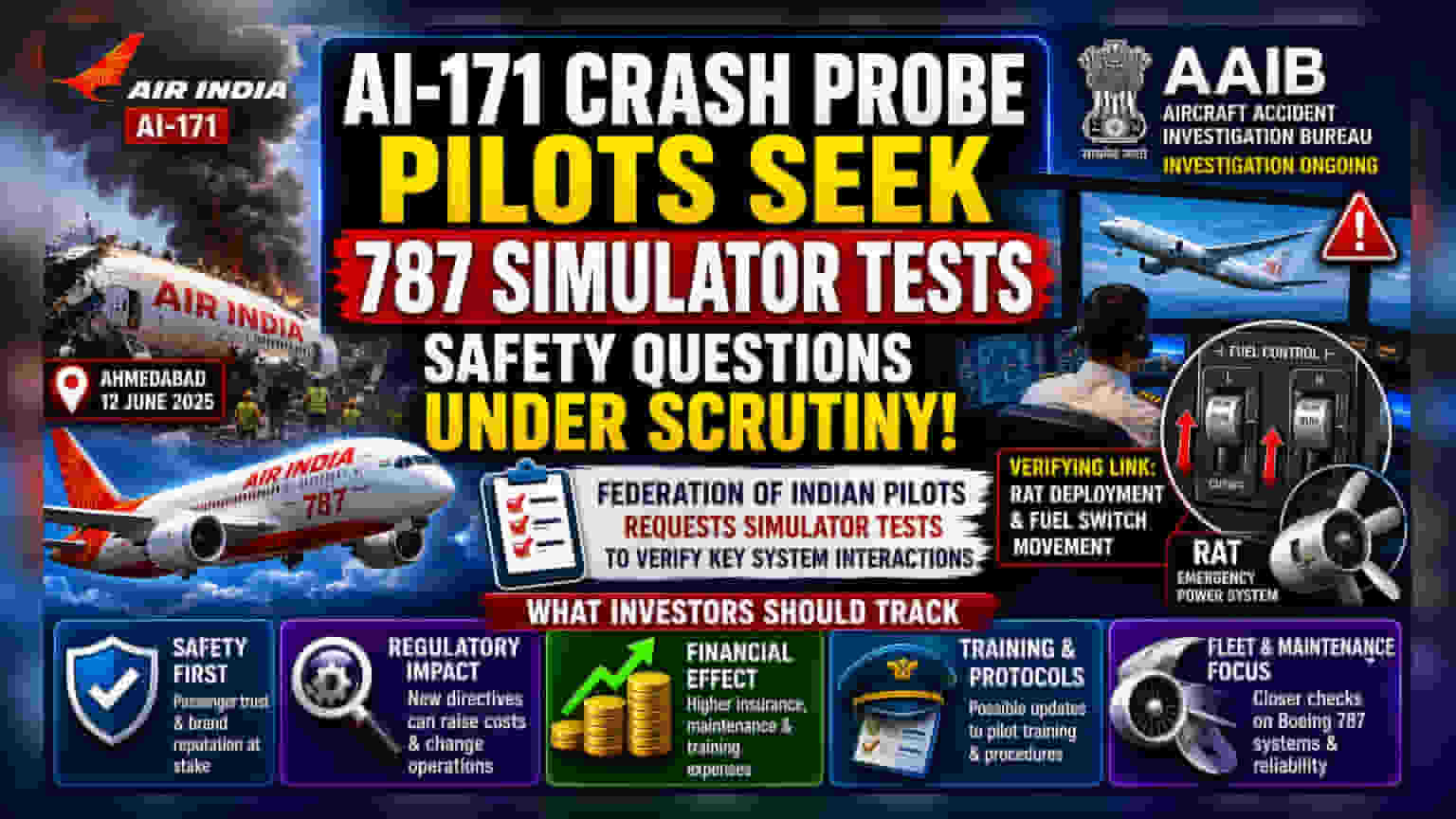


The Federation of Indian Pilots has urged authorities to conduct Boeing 787 simulator tests related to the June 2025 Air India Flight AI-171 crash. For investors, this development highlights the ongoing regulatory focus on aviation safety and technical reliability, factors that can influence operational trust, insurance costs, and regulatory scrutiny for the airline sector and the Tata Group's aviation portfolio.
What Happened
The Federation of Indian Pilots (FIP) has formally requested the Aircraft Accident Investigation Bureau (AAIB) to perform specific simulator tests on Boeing 787 aircraft. This request is part of the ongoing investigation into the tragic crash of Air India Flight AI-171, which occurred on June 12, 2025, near Ahmedabad. The crash resulted in 260 fatalities. The pilots' organization aims to use these simulator tests to independently verify the relationship between the deployment of the Ram Air Turbine (RAT)—a device used to provide emergency power—and the movement of fuel control switches. The FIP believes these tests are necessary to clarify system interactions and data reported in the preliminary investigation.
Why This Matters for Investors
For those observing the aviation industry and the Tata Group's expansion into the sector, safety investigations are significant events. Any major accident involving a commercial airline leads to intensive regulatory scrutiny, which can impact operational costs, insurance premiums, and brand reputation. While Air India is not a publicly traded entity, it is a central pillar of the Tata Group’s airline business, which includes other carriers. Continued focus on technical anomalies or potential design interactions in widely used aircraft, such as the Boeing 787, often leads to regulatory directives that can influence maintenance, training protocols, and fleet operations across the aviation industry.
The Technical Context
At the heart of the pilots' request is the need to correlate survivor accounts and technical data. The FIP has pointed toward cabin anomalies and maintenance messages transmitted by the aircraft shortly before the incident. By simulating these specific conditions, the investigation aims to determine if there were electrical or software-related anomalies that could have affected the flight's systems. The request emphasizes the importance of verifying acceleration data and system behavior under emergency scenarios to build a complete sequence of events leading to the accident.
Regulatory and Operational Scrutiny
Safety investigations are a standard part of the aviation sector, but they can be time-consuming and often result in significant changes to operating procedures. When a professional body like the FIP actively engages with the investigation regulator, it signals that there are unresolved questions regarding the aircraft's technical performance or the sequence of events. For the aviation sector, this often means that operators and manufacturers may face pressure to enhance pilot training, update maintenance schedules, or even implement hardware modifications if technical flaws are identified.
What Investors Should Track
The most important development to follow will be the final findings released by the AAIB. Investors and sector observers should monitor for any regulatory directives issued to airlines operating the Boeing 787 fleet, as these can carry direct financial implications. Additionally, any updates regarding changes to pilot training protocols or airworthiness standards will be relevant to gauging the long-term operational stability and cost structure of the affected airlines. Management commentary from the parent group regarding safety investments and fleet maintenance will also be a key indicator of how the company is managing its operational reputation following the incident.