

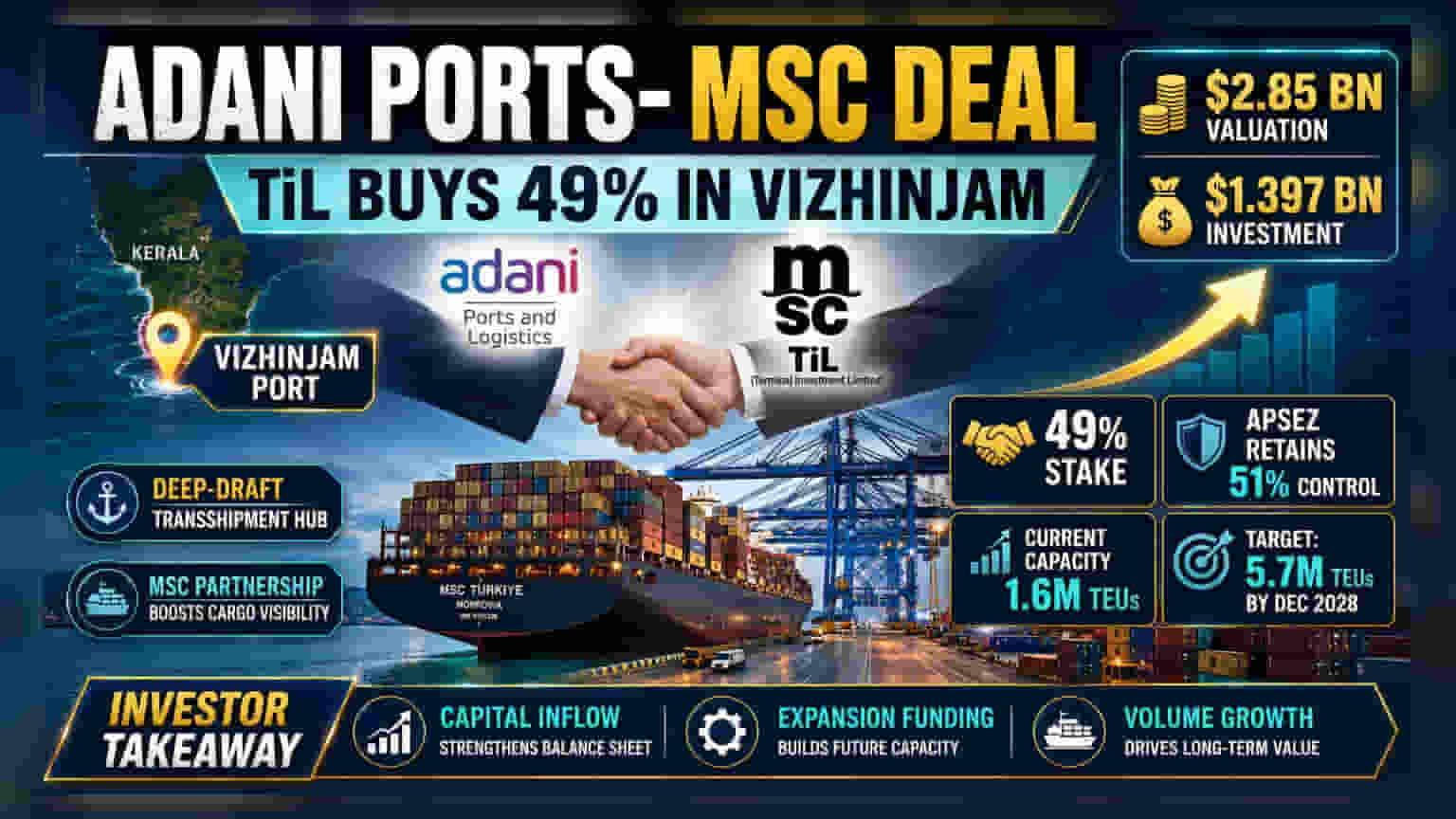
Adani Ports has signed an agreement with Terminal Investment Limited (TiL), an arm of the MSC Group, to sell a 49% stake in the Vizhinjam transshipment port for $1.397 billion. This strategic partnership values the asset at $2.85 billion and is expected to accelerate the port's expansion to 5.7 million TEUs by 2028, while reducing the company's reliance on debt for infrastructure spending.
What Happened
Adani Ports and Special Economic Zone Limited (APSEZ) has entered into a definitive agreement with Terminal Investment Limited (TiL), the port operating arm of the Mediterranean Shipping Company (MSC) Group. Under this deal, TiL will acquire a 49% stake in Adani Vizhinjam Port Private Limited (AVPPL), the operator of the Vizhinjam International Seaport in Kerala. The transaction values the port asset at approximately $2.85 billion. TiL's total investment amounts to $1.397 billion, with an initial upfront payment of $539 million and a remaining $858 million allocated for the port's ongoing expansion phases.
Why This Matters for Investors
This partnership is strategically significant for APSEZ as it aligns the company with MSC, one of the world's largest container shipping lines. Vizhinjam Port is India's first deep-draft transshipment facility, meaning it can handle massive container vessels that other Indian ports cannot accommodate. By bringing in MSC as a partner, APSEZ secures long-term cargo volume commitments. This move is expected to cement Vizhinjam's status as a key transshipment gateway in the Indian Ocean, effectively competing with international hubs like Colombo and Dubai. The agreement marks the third major collaboration between APSEZ and the MSC Group, following their successful ventures at Mundra and Ennore.
The Financial and Growth Impact
The deal provides a substantial capital inflow of nearly $1.4 billion for APSEZ. This is important for the company’s financial health, as it allows APSEZ to fund a significant portion of the massive capital expenditure required for the Vizhinjam project without relying heavily on fresh debt. By monetizing a stake in a high-value asset, the company aims to optimize its balance sheet while maintaining control over operations, as APSEZ will retain the remaining 51% ownership and board control.
Capacity Expansion Targets
Vizhinjam Port, which was commissioned in late 2024, has already shown strong performance, becoming the first Indian port to cross 2 million TEUs (Twenty-foot Equivalent Units) of cargo throughput within 18 months of operations. The current capacity stands at 1.6 million TEUs. Under the agreed-upon expansion plan, APSEZ aims to increase this capacity 3.5 times, reaching 5.7 million TEUs by December 2028. This rapid scale-up is a core part of APSEZ's goal to become an integrated global transport utility.
What Investors Should Track
While the deal is a positive signal for volume visibility and capital allocation, investors should track a few key areas going forward. First, the transaction is subject to customary regulatory and government approvals, which remain a standard procedural step. Second, the execution of the Phase 2 expansion is critical; hitting the 5.7 million TEU target by 2028 will determine how effectively the company can capture market share from regional competitors. Finally, investors will continue to monitor the company’s net debt-to-EBITDA ratio to ensure that even with aggressive infrastructure spending, the balance sheet remains comfortable.