

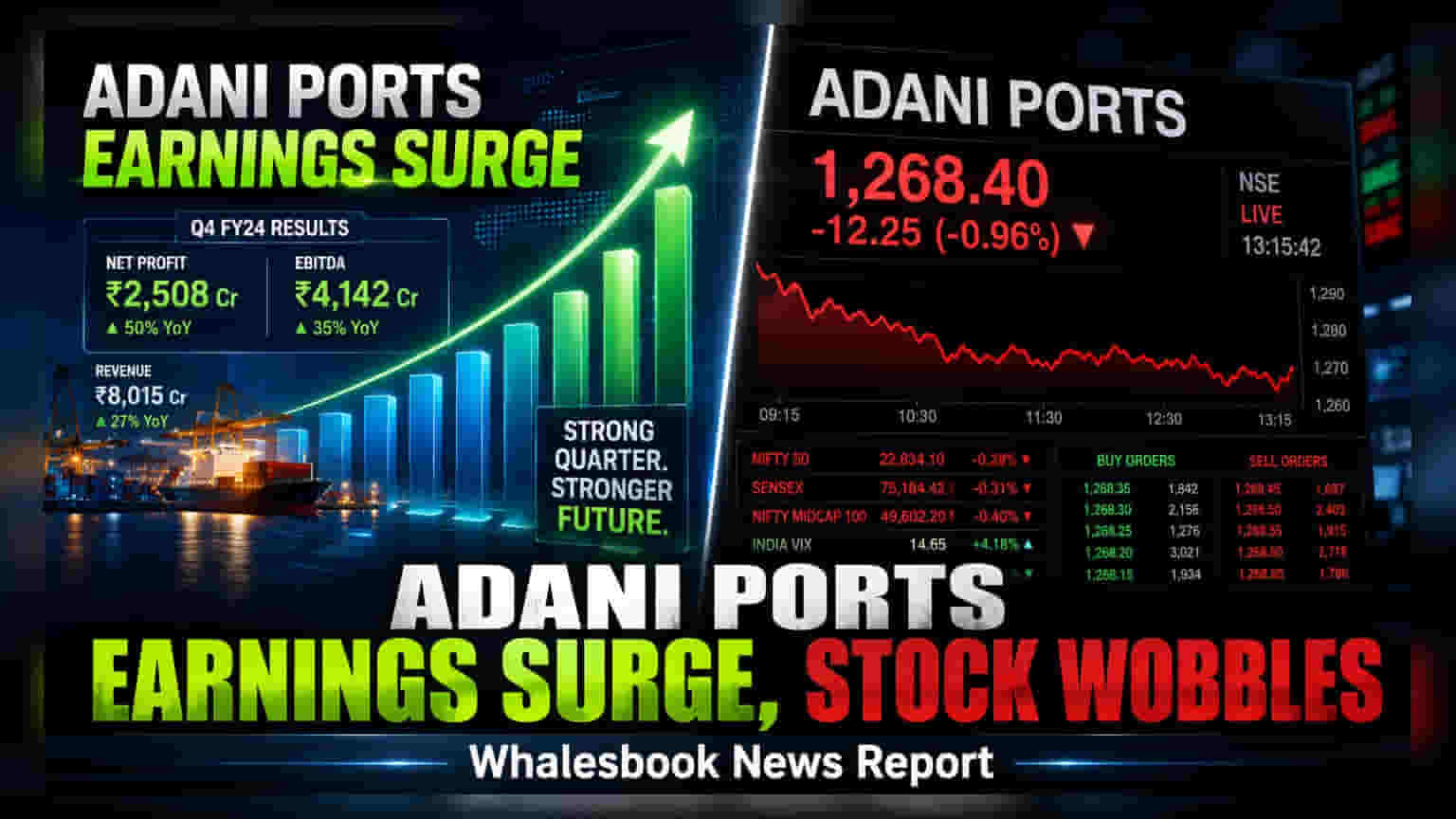
Adani Ports reported a 9.2% rise in net profit to ₹3,620 crore for the first quarter of FY27, backed by an 18.6% revenue growth. Despite the strong financial performance, the company's stock fell 2.25% in trade on Wednesday. Investors are assessing this decline against the backdrop of the company's operational expansion and broader debt management strategies.
Adani Ports and Special Economic Zone Limited (APSEZ) has released its financial results for the first quarter ending June 2026, showing a steady growth in its core business. The company recorded a consolidated net profit of ₹3,620 crore, marking a 9.2% increase compared to the same period last year. Revenue from operations also rose significantly by 18.6%, reaching ₹10,821 crore.
Operational Efficiency and Margins
The company’s operational performance was supported by strong cargo volumes across its various ports. Earnings Before Interest, Taxes, Depreciation, and Amortization (EBITDA), which reflects the core operating profit before accounting for financing costs and taxes, grew by 19% to ₹6,540 crore. The EBITDA margin stood at 60.4%, a slight improvement from 60.2% in the previous year. This suggests that the company maintained tight control over its operating expenses even as it scaled its business activities during the quarter.
Market Movement and Investor Context
Despite the positive financial figures, investors reacted with caution, leading to a 2.25% decline in the stock price to ₹1,734.70 during trading on July 29, 2026. This downward movement in a generally positive market environment highlights that investors may be weighing the company's growth against specific risks. As one of India’s largest port operators, APSEZ relies heavily on consistent global trade demand and internal infrastructure execution. Investors typically monitor the company’s debt levels and the capital spending required for its large-scale port expansions, as high borrowing costs or project delays can impact free cash flow.
When comparing APSEZ with peers in the logistics and infrastructure sector, the company holds a significant market share, which provides a competitive advantage. However, like many capital-intensive businesses, it remains sensitive to interest rate cycles and global economic shifts that affect cargo movement. Historical data shows that while the company has consistently expanded its capacity, the market often scrutinizes the impact of such aggressive expansion on the balance sheet. Future performance will depend on the company's ability to sustain these margin levels while managing its debt obligations. Investors may track upcoming management commentary regarding volume guidance, future capital spending plans, and updates on its debt reduction roadmap to better understand the sustainability of its growth trajectory.