

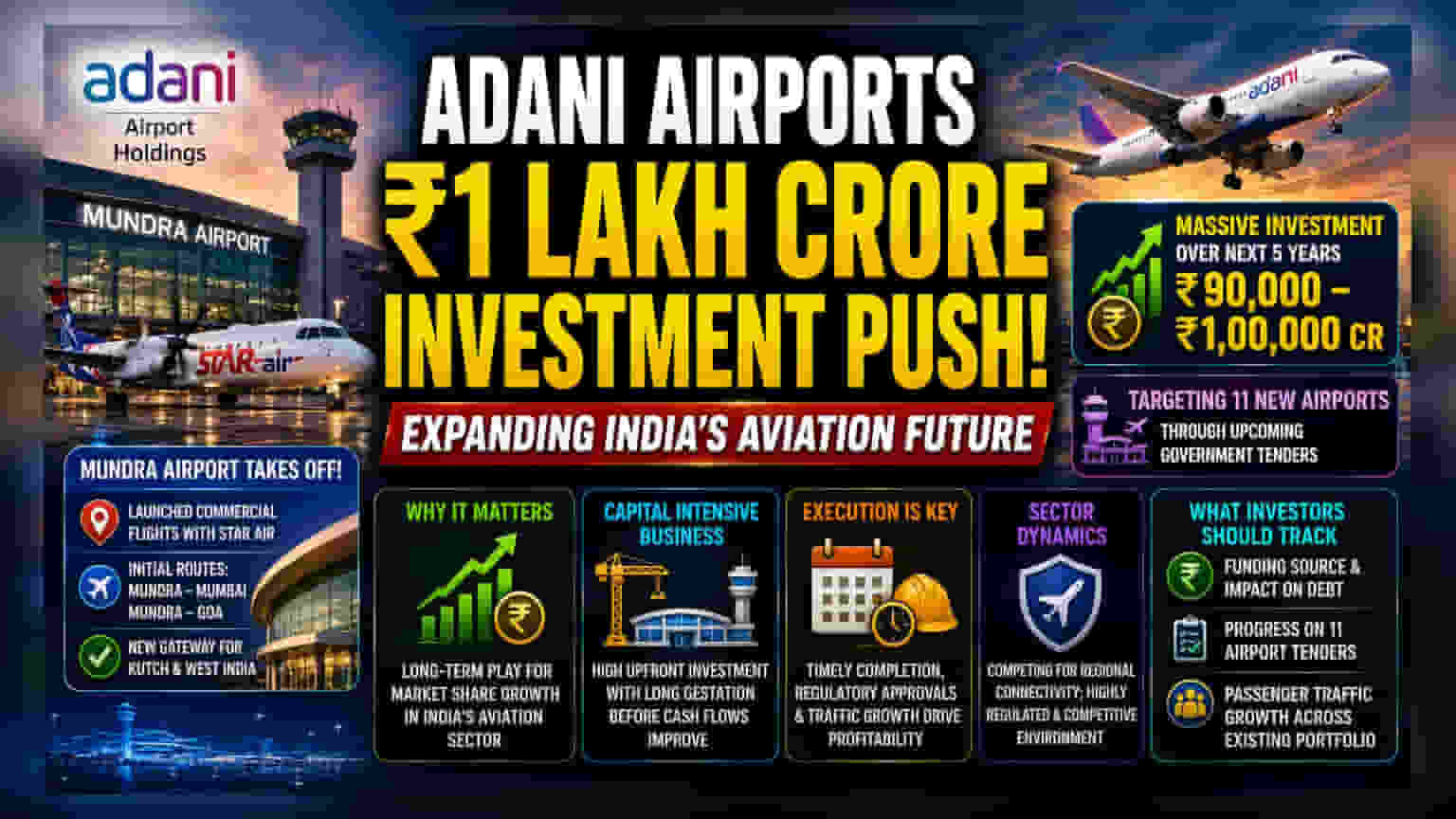
Adani Airport Holdings has announced an investment plan of up to ₹1 lakh crore over the next five years to expand its aviation infrastructure. The group also commenced commercial flight operations at the Mundra Airport in Gujarat. This strategy signals an aggressive expansion, with the company aiming to participate in upcoming government airport tenders.
What Happened
Adani Airport Holdings, a subsidiary of Adani Enterprises, has announced plans to invest between ₹90,000 crore and ₹1 lakh crore into its aviation business over the next five years. The announcement coincided with the start of commercial flight operations at the newly developed Mundra Airport in Gujarat. The airport successfully launched services with Star Air, initially connecting the region to Mumbai and Goa. The management has indicated that this capital spending is intended to upgrade current airport assets and support the acquisition of new sites as the group participates in upcoming government tenders for 11 new airports.
Why This Matters For Investors
For investors in Adani Enterprises, the group's flagship incubator for new businesses, this announcement highlights the company's long-term capital allocation strategy. Airports are highly capital-intensive, meaning they require massive upfront spending before they generate consistent cash flow. While this expansion positions the company to potentially increase its market share in India’s aviation sector, it also involves significant financial commitment. Investors generally watch how such large-scale spending is funded—whether through internal cash flow, new debt, or equity—as it impacts the company's leverage and interest burden over the project lifecycle.
The Financial And Execution Context
Infrastructure projects often face a long 'gestation period,' meaning it takes years for revenues to catch up with the initial construction costs. Adani Airport Holdings has been aggressively expanding its presence, moving beyond just operating major metro airports to developing regional hubs like Mundra. The success of this strategy relies on two key factors: increasing passenger traffic at its current airports and ensuring that new projects are completed without significant cost overruns. History in the infrastructure sector shows that timely execution is the primary driver of profitability; any delays in construction or regulatory approvals can pressure margins and increase debt costs.
Sector Dynamics And Competition
India's aviation sector has seen increased consolidation, with private players like Adani and GMR Airports becoming dominant operators. By bidding for new government tenders, the Adani Group is positioning itself to compete for a larger share of regional connectivity. However, the airport business is heavily regulated. Changes in government policy, airport tariff structures, or passenger demand shifts can directly affect the profitability of these assets. The ability to manage this regulatory relationship while maintaining operational efficiency remains a key point of difference between airport operators.
What Investors Should Track
Investors may monitor several key areas following this announcement. First, the source of funding for this ₹1 lakh crore investment will be critical to understand how the company's debt levels move. Second, progress on the 11 government tenders mentioned by the company will indicate the speed of this expansion. Finally, passenger volume growth across the existing portfolio will be the main revenue driver, as high fixed costs in airports require sustained traffic to achieve break-even and eventually, consistent profit.