

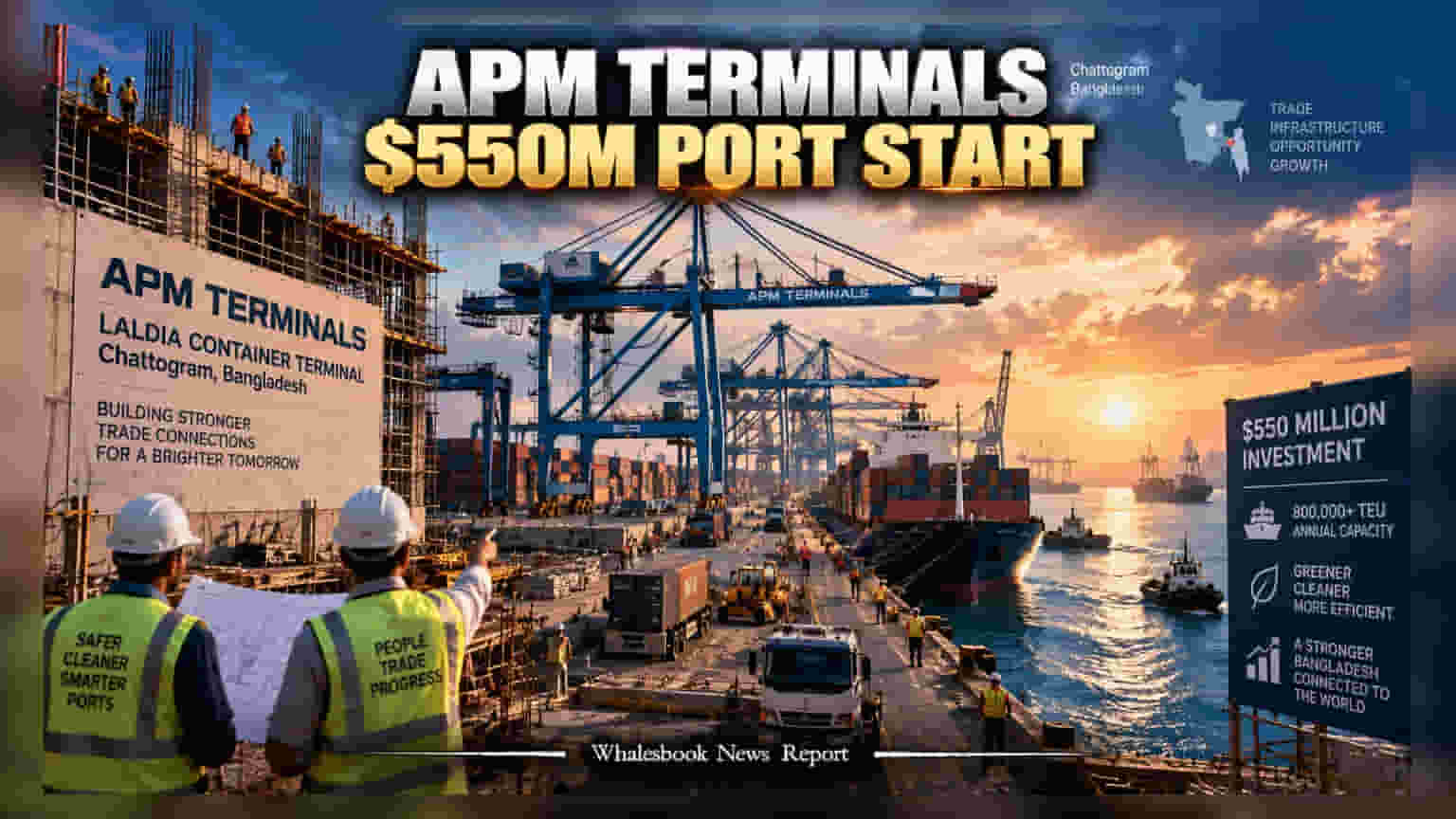
APM Terminals has officially begun construction on the $550 million Laldia Container Terminal in Chattogram, Bangladesh. The project, slated for completion by 2030, is a major infrastructure development designed to increase trade capacity. Investors should monitor the project's long-term execution timeline and the regional demand for shipping services as key factors for this investment.
APM Terminals has moved into the construction phase for the Laldia Container Terminal located in Chattogram, Bangladesh. The company held a groundbreaking ceremony on August 30, 2026, for the project, which involves a total investment of $550 million. This facility is a significant infrastructure development for the region, aimed at modernizing trade links and increasing maritime cargo handling capacity.
Project Scope and Design
The terminal is being developed as a greenfield facility, meaning it is being built from the ground up rather than expanding an existing structure. It is designed to handle more than 800,000 twenty-foot equivalent units (TEU) of cargo annually. Once operational, the terminal will allow the port to accommodate larger vessels, with a capacity to handle ships of up to 6,000 TEU. This is expected to improve logistics efficiency in the region, which has faced bottlenecks in handling high volumes of container traffic.
The project is a joint effort involving APM Terminals, the Chittagong Port Authority, and local partner QNS Container Services. APM Terminals, a subsidiary of the global shipping giant A.P. Møller–Maersk, is leading the project under a 30-year concession.
The Business Model
This development follows a design-build-finance-operate-transfer (DBFOT) model. Under this agreement, APM Terminals takes on the responsibility of designing, financing, and building the terminal, and will subsequently operate the facility for the 30-year concession period. While the private consortium manages the operations and generates revenue from the terminal's services, the Bangladesh government retains ownership of the underlying port asset. This structure allows the state to upgrade its infrastructure without the immediate burden of full capital expenditure, while the operator takes on the commercial risk in exchange for long-term usage rights.
Risks and Investor Monitorables
For investors and stakeholders, this project represents a long-term capital commitment with a 2030 target for commissioning. As with any large-scale infrastructure project, there are inherent risks. The primary challenge is execution; construction delays or technical hurdles could impact the project’s timeline and the expected return on investment.
Furthermore, the project’s success depends on the long-term health of Bangladesh’s export-driven economy. Regional geopolitical stability and potential fluctuations in global trade policy are factors that could influence cargo volumes in the coming years. APM Terminals will bear the commercial risk, meaning that the profitability of the terminal will be tied closely to actual demand for shipping capacity in Chattogram.
Moving forward, the key updates for the market will involve construction milestones and updates on the project’s timeline as it approaches the 2030 commissioning date. Investors will also look for management commentary on how this project fits into the company’s broader global strategy for network expansion and operational efficiency.