

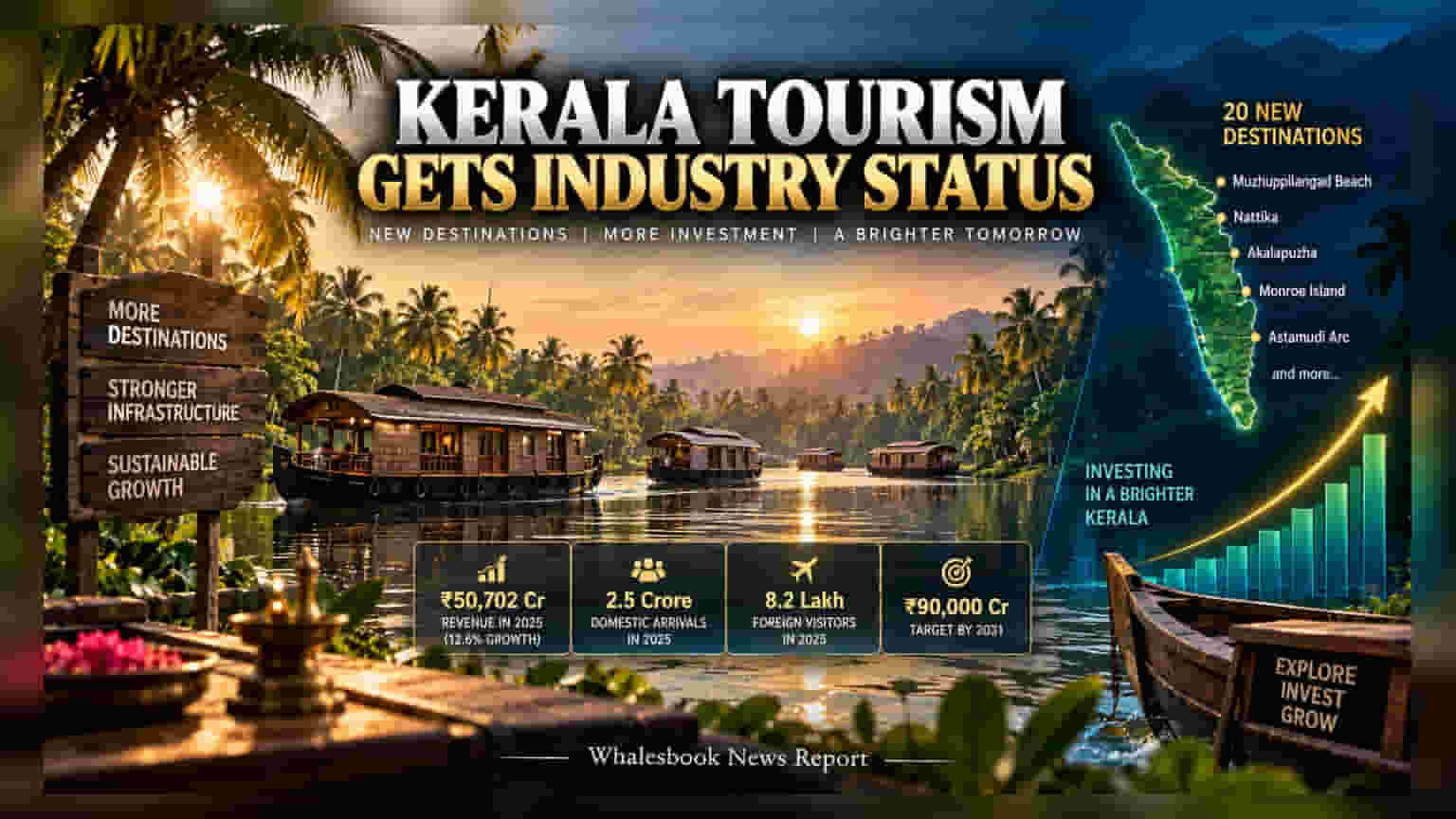
Kerala is granting formal industry status to its tourism sector to ease operations and lower utility costs. With ₹325.36 crore allocated, the state plans to develop 100 new destinations to manage overtourism at major sites. The government aims to nearly double tourism revenue to ₹90,000 crore by 2031, a move that could encourage private investment in the state’s hospitality infrastructure.
The Kerala government is set to grant formal industry status to its tourism sector by October 2026. This move is designed to simplify project approvals through a single-window clearance system and provide subsidies on electricity and water tariffs. By elevating the sector to industry status, the state aims to lower operating costs for hotel chains, resorts, and tourism service providers, potentially making the state a more attractive destination for private capital investment.
The policy shift is a core part of a five-year development strategy backed by an allocation of ₹325.36 crore in the 2026–27 budget. The government’s primary objective is to decentralize tourist traffic, which is currently concentrated in well-known hotspots like Munnar, Varkala, and Kovalam. These locations have faced immense pressure due to high footfall, leading to concerns regarding environmental sustainability and infrastructure strain. To address this, the state is prioritizing the development of 20 new locations for immediate infrastructure work, including Monroe Island, Akalapuzha, Nattika, and Muzhuppilangad Beach. The 'Astamudi Arc,' a project to connect the Ashtamudi and Kollam backwaters, is another key initiative to attract visitors to less-crowded, biodiversity-rich regions.
Financial performance in the state’s tourism sector has been strong, providing a foundation for these expansion plans. In 2025, Kerala recorded 2.5 crore domestic arrivals and 8.2 lakh foreign visitors, representing a 12.6 percent growth compared to the previous year. Total revenue for the sector reached ₹50,702.34 crore during this period. The government has set an ambitious target to scale this revenue to ₹90,000 crore by 2031. To support this growth, the state is also diversifying its visitor base, with a new strategic focus on markets in the Middle East, particularly Oman, following recent roadshows at the Arabian Travel Market.
Despite the growth potential, the execution of this strategy faces several challenges. Scaling infrastructure in 100 new destinations involves complex logistical and environmental hurdles. Large-scale development projects in sensitive regions often face regulatory risks and may require extensive environmental clearances, which can cause delays or cost overruns. Furthermore, the success of these new destinations depends on whether they can generate sufficient interest to meaningfully reduce the load on existing hubs. If the infrastructure development does not match the pace of demand, or if connectivity to these new locations remains poor, the expected economic impact could be delayed.
Investors and stakeholders should monitor the progress of the single-window clearance implementation, as it will directly impact the cost structure for private hospitality companies operating in the state. Tracking the commissioning of infrastructure projects in the identified 20 priority locations will also be critical, as these will serve as the first test of the government's decentralization plan.