 Whalesbook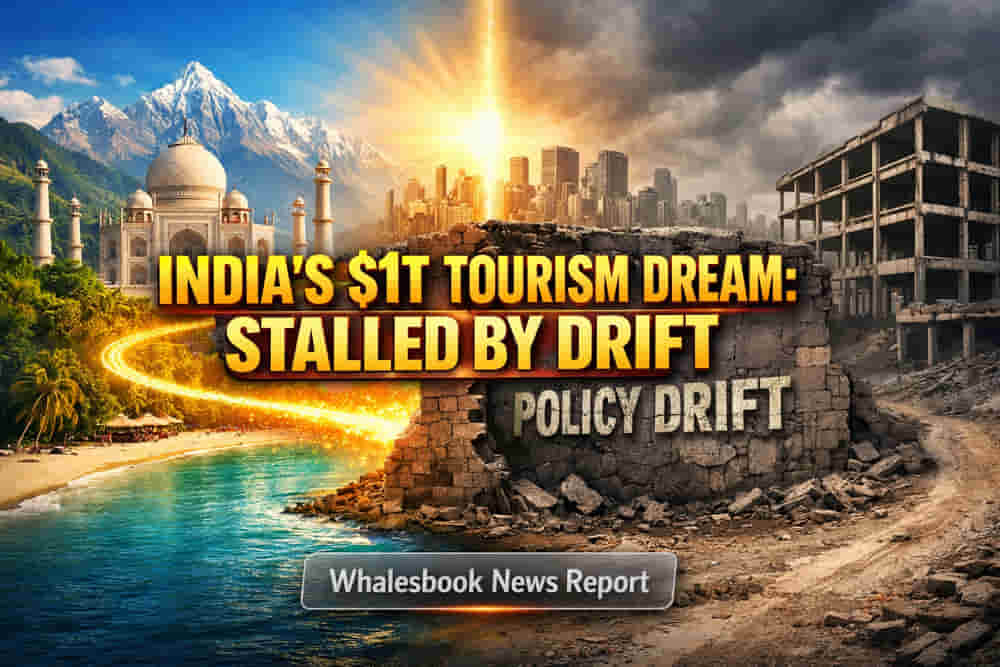
The Missed Trillion-Dollar Opportunity
India's tourism sector stands as a stark illustration of potential vastly outstripping realized value. Projections suggest the sector could contribute $1 trillion to GDP and employ 100 million people by 2035. However, current performance paints a different picture. In 2024, tourism contributed an estimated 6.6% to India's GDP, a figure significantly lower than peers like the UAE (15%) or Thailand (20%). This underperformance translates directly into forgone economic growth and employment opportunities for a nation hungry for development.
The gap between potential and reality is most evident in the outflow of foreign exchange. While India welcomed approximately 9.95 million foreign tourists in 2024, a substantial 30.8 million Indians traveled abroad during the same period. This imbalance highlights a critical failure to attract and retain international visitors, while also indicating a growing outbound travel market driven by rising disposable incomes among its burgeoning middle class. International visitor spending in 2024 reached a record ₹3.1 trillion, a significant recovery but still a fraction of what could be achieved.
The Capacity and Infrastructure Deficit
A foundational issue is the chronic undersupply of critical infrastructure, particularly accommodation. India possesses approximately 196,000 branded hotel rooms, a figure drastically insufficient against an estimated daily demand of five million beds. This contrasts sharply with global tourism powerhouses; for instance, Japan has two million hotel rooms, and China boasts seven million. Analysts predict India's branded hotel inventory might surpass 300,000 rooms by 2029, yet even this projected growth may struggle to meet escalating demand. This scarcity inflates prices, as seen during major events where hotel rates in Delhi surged to ₹4-5 lakh per night, alienating potential visitors and damaging the country's image. The limited inventory also means demand consistently outpaces supply, supporting elevated pricing but restricting overall volume.
Policy Drift and Regulatory Hurdles
Decades of tourism policy have been characterized by a 'policy drift' and 'patchy execution,' hindering progress. While the government has made pronouncements and launched initiatives—such as promises of infrastructure status for tourism and upgrading destinations—meaningful implementation has lagged. The source text notes a mere 0.05% allocation of the Union Budget to tourism, a figure that starves the sector of necessary investment. While specific budget figures are fluid, the overall sentiment of underfunding persists.
Regulatory density is another significant impediment. Entrepreneurs face a labyrinth of permissions, high charges, and lengthy approval cycles, with hotel projects sometimes taking three times longer in India than in Southeast Asia due to compliance hurdles. The call for deregulation, moving tourism to the Concurrent List for better Centre-State coordination, and digitizing approvals is loud. This complexity deters investment, particularly when compared to more streamlined approaches in competing destinations. Foreign Direct Investment (FDI) in the sector, while showing growth and receiving 100% automatic route approval, has not reached its full potential, partly due to these systemic issues.
The Competitive Disadvantage
India's struggle is amplified when compared to its peers. Despite boasting 44 UNESCO World Heritage Sites—more than many nations—it attracts far fewer international visitors. In 2024, India welcomed around 9.95 million foreign tourists, while Vietnam attracted 18 million, the UAE 19 million, and Thailand 36 million. This disparity stems from a range of factors, including a lack of accessible and quality accommodation, underdeveloped last-mile tourist experiences (cleanliness, safety, efficient services), and often-cited issues with hygiene and sanitation. Reports indicate that India's ranking in global safety and security indices remains low, acting as a deterrent for potential visitors.
The Bear Case: Neglect and Mismanagement
The recurring theme is a significant disconnect between ambition and execution. Numerous flagship schemes have seen stalled implementation, and iconic destinations often suffer from mismanagement and neglect. A 2025 report highlights India's low scores in human resource development, with an underutilized labor force lacking sufficient hospitality training. This contrasts with the vast, youthful population that could power the sector if adequately skilled and deployed. Furthermore, environmental sustainability remains a concern, with poor scores in pollution control and nature preservation, risking the degradation of the very assets that attract tourists. The historical trend shows a persistent gap between policy pronouncements and tangible on-the-ground improvements, a cycle that continues to hamper India's global competitiveness.
Path to Potential: Reform and Investment
Unlocking India's tourism potential hinges on decisive reforms. Key proposals include: 1) Moving tourism to the Concurrent List to resolve Centre-State coordination issues. 2) Rapidly scaling supply, with targets for one million branded hotel rooms and 500,000 homestays by 2035. 3) Fixing the last-mile experience through initiatives like 'Mission Cleanest Cities' and deploying trained personnel. A $10 billion India Tourism Fund, structured as a sovereign-private InvIT, could anchor this expansion. Standardizing state-level incentives and promoting homestays with modest grants are also crucial steps. Analyst projections anticipate strong growth, with the sector aiming for a 10% GDP contribution by 2030, but this requires a radical reform agenda that prioritizes deregulation, infrastructure development, and robust public-private partnerships. Sustained high-level attention, possibly via a Prime Minister-chaired committee, is essential to enforce delivery and bridge the gap between policy and performance.