

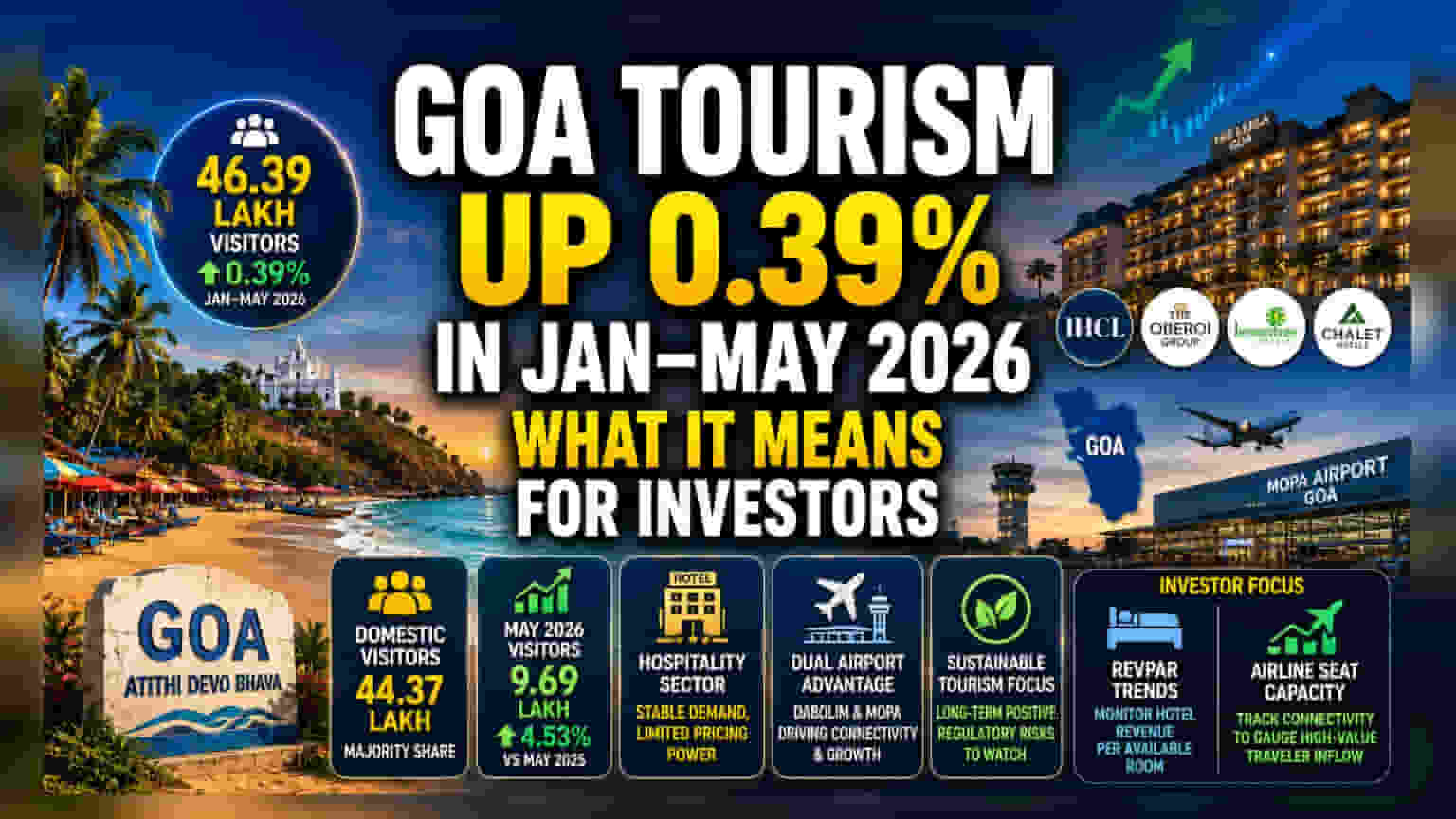
Goa recorded over 46.39 lakh tourist arrivals from January to May 2026, a marginal 0.39% year-on-year increase. While domestic demand remains steady, the slow growth pace is a key factor for hospitality and airline companies with exposure to the region. Investors are now looking at how this moderate demand affects room rates and occupancy for hotel operators.
What Happened
Goa’s tourism sector saw a modest uptick in visitor numbers during the first five months of 2026. Data from the state tourism department shows that 46.39 lakh tourists visited the state between January and May, reflecting a 0.39% growth compared to the same period last year. Domestic travelers continue to form the vast majority of arrivals, accounting for 44.37 lakh visitors. May showed a stronger performance, with 9.69 lakh visitors, marking a 4.53% increase compared to May 2025.
Impact on Hospitality and Travel Stocks
For investors, Goa is a critical market for many listed hospitality chains like Indian Hotels Company (IHCL), EIH (Oberoi), Lemon Tree Hotels, and Chalet Hotels. These companies often look to Goa for high-margin, premium leisure revenue. A marginal growth in total footfall suggests a stable demand environment, but it may also limit the 'pricing power' of these hotel chains. If demand does not rise sharply, hotels may find it harder to significantly increase their average room rates compared to previous years.
Infrastructure and Connectivity
The state’s focus on leveraging its dual-airport infrastructure—Dabolim Airport and the newer Manohar International Airport at Mopa—is central to the state's growth strategy. Improved air connectivity is vital for these hotel chains as it directly influences occupancy levels and accessibility for high-spending tourists. Investors should note that while the infrastructure is in place to handle more traffic, the actual footfall growth is currently proceeding at a measured, single-digit pace.
Sustainability and Regulatory Risks
State authorities have emphasized a move toward 'sustainable tourism' and diversifying experiences beyond the traditional beach model, including wellness and heritage tourism. For investors, this creates a dual scenario. While it may help keep the destination attractive for the long term, any new regulatory restrictions or environmental compliance requirements linked to sustainable tourism policies could impact the operating costs or expansion plans of hotel projects in the region.
What Investors Should Track
The key monitorable for the upcoming quarters will be the 'Revenue Per Available Room' (RevPAR) figures reported by hotel chains with significant Goa exposure. Investors should look for commentary on whether these chains are managing to sustain their premium room rates despite the flat-to-modest growth in overall tourist numbers. Additionally, tracking airline seat capacity and frequency data to Goa will provide clues on whether the connectivity improvements are successfully translating into a higher influx of high-value travelers in the second half of the year.