 Whalesbook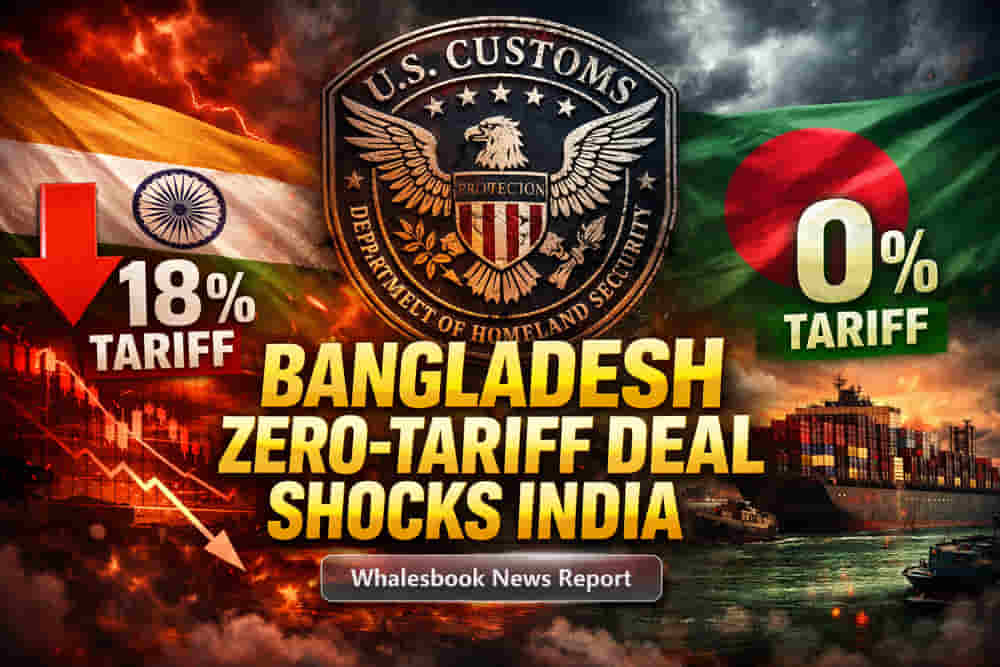
### The Core Catalyst: Immediate Reaction to Tariff Shifts
Indian textile stocks experienced a sharp sell-off on February 10, 2026, with the sector index plunging up to 9% amidst profit-taking and reassessment of global trade dynamics. Major players, including Gokaldas Exports, KPR Mill, Arvind, and Pearl Global Industries, saw their share prices decline significantly, with some dropping over 5% during intraday trading. This market reaction followed the announcement of a reciprocal trade agreement between the United States and Bangladesh. Under this pact, the US reduced its overall tariff rate on Bangladeshi goods to 19% and committed to a mechanism allowing certain textile and apparel imports from Bangladesh to enter the US duty-free, provided they utilize US-produced cotton and man-made fiber inputs. This development directly contrasted with the earlier optimism surrounding the India-US trade framework, which had set a reciprocal tariff rate of 18% for Indian textile exports to the US. The immediate investor response focused on the perceived competitive threat posed by Bangladesh's preferential access, leading to a reversal in stocks that had previously rallied on expectations of improved market conditions.
### The Analytical Deep Dive: Strategic Advantages Emerge
While the US-Bangladesh agreement has introduced short-term volatility, a deeper analysis reveals that India's competitive position in the global textile market remains robust, primarily due to broader strategic trade agreements. The US-India trade framework, which lowered tariffs on Indian exports to 18%, effectively opened up America's $118 billion textile and apparel import market, aiming to place Indian exporters in a favorable position against rivals like Bangladesh (19% overall tariff, with specific zero-tariff provisions), Vietnam (previously facing 20% tariffs), and China (subject to higher tariffs). More significantly, the recently finalized EU-India Free Trade Agreement (FTA), operational from early 2026, promises substantial long-term benefits for India's textile sector. This landmark agreement eliminates nearly all tariffs on Indian textile products entering the European Union, a market valued at $263 billion. This provides Indian exporters with duty-free access, putting them on par with competitors like Bangladesh and Vietnam who previously held preferential status in the EU. Furthermore, global textile market trends for 2026 emphasize growth in technical and sustainable textiles, areas where India is increasingly investing. The ongoing 'China Plus One' sourcing strategy adopted by global buyers also continues to benefit Indian manufacturers, who are seen as a resilient alternative in diversified supply chains. India's strength in specialized products like home textiles, carpets, and niche apparel segments further differentiates it from Bangladesh's primary reliance on garment exports.
### The Forensic Bear Case: Nuances of the US-Bangladesh Pact
The market's sharp reaction to the US-Bangladesh trade deal may prove to be an oversimplification. The zero-tariff access for Bangladeshi textiles is not universal; it is contingent on specific volumes and, crucially, requires the use of US-produced raw materials. This conditionality could limit Bangladesh's cost advantage and may increase manufacturing costs for Bangladeshi producers, potentially diminishing the true benefit derived from the zero-tariff provision. Analysts suggest that the margin leverage gained by Bangladesh from this specific exemption may be limited, and the overall tariff of 19% still presents a slight disadvantage compared to India's 18% in the US market. The market appears to be reacting to a potentially constrained and conditional benefit for a competitor, rather than assessing the broader, more certain advantages India is securing through comprehensive FTAs. Moreover, recent rallies in Indian textile stocks have led to some valuations being stretched, with KPR Mill noted as particularly highly valued and Arvind exhibiting slower revenue growth relative to its industry. This suggests that underlying company fundamentals and valuations warrant careful consideration beyond immediate trade news.
### The Future Outlook: FTAs Set the Long-Term Trajectory
Despite the short-term volatility triggered by the US-Bangladesh trade agreement, the outlook for the Indian textile sector remains underpinned by significant long-term strategic advantages. The India-EU FTA is expected to be a major catalyst, providing Indian exporters with enhanced competitiveness and stable market access across Europe. Similarly, the ongoing framework with the US, combined with the global shift towards diversified sourcing, provides a foundation for sustained export growth. While competition remains intense, India's focus on value-added products, technical textiles, and sustainability, coupled with preferential access to major global markets, positions the industry for resilience and expansion. The immediate concerns stemming from a competitor's niche tariff advantage are likely to be outweighed by the broader, more impactful trade agreements shaping India's global textile footprint.