 Whalesbook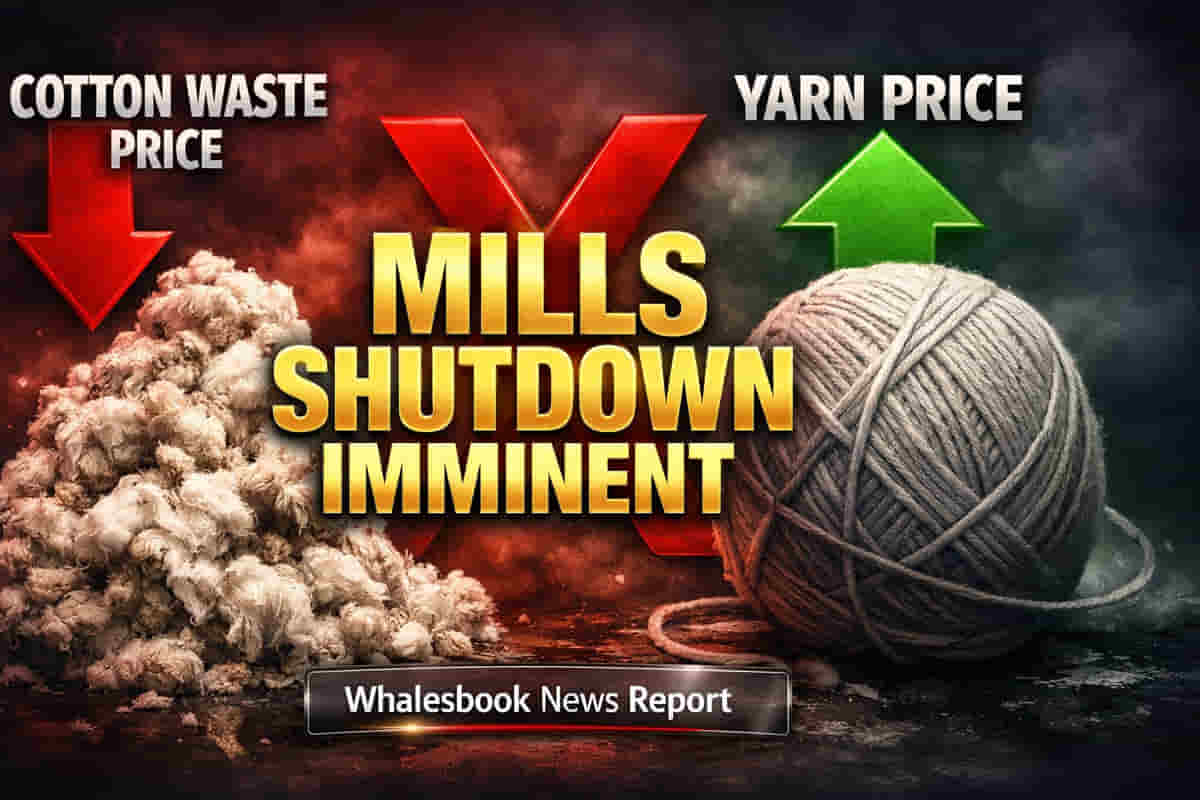
Tamil Nadu Mills Halve Output Amid Profitability Woes
Over 600 open-end spinning mills in Tamil Nadu, a crucial segment of India's textile industry, have been forced to slash their production by a significant 50 percent. This drastic measure is being implemented as a strategy to mitigate mounting losses and navigate challenging market conditions, according to industry representatives.
The Core Issue
The primary driver behind this production cut is a severe squeeze on profit margins. Mills are contending with a sharp increase in the price of cotton waste, their principal raw material, while simultaneously experiencing a decline in the prices of both raw cotton and finished yarn. This unfavorable price dynamic has rendered operations increasingly unsustainable.
Financial Squeeze
According to G Arulmozhi, president of the Open-End Spinning Mills Association (OSMA), the price of cotton waste, specifically comber noil, has surged from ₹100 per kilogram to ₹113 per kilogram. This increase persists despite a notable drop in the price of raw cotton, which fell from ₹60,000 per candy (approximately 356 kg) in October to ₹53,500 in December.
Simultaneously, the selling prices for open-end yarn have also declined. Prices for 20s weft yarn have fallen from ₹150 per kilogram to ₹140 per kilogram, and 20s warp yarn has seen a decrease from ₹165 per kilogram to ₹158 per kilogram. This combination of rising input costs and falling output prices is crippling the mills' profitability.
Impact on Operations
The hike in cotton waste prices, by ₹15 per kilogram, has significantly eroded the margins for mills producing grey yarn, which relies heavily on this byproduct. To avoid deeper financial distress, these units are now compelled to operate at half their usual capacity or, in some cases, cease operations entirely.
OSMA estimates that a complete halt in production could lead to daily output losses exceeding ₹10 crore. This situation not only impacts the mills directly but also has ripple effects on their associated supply chains.
Industry Demands
The Open-End Spinning Mills Association has put forth several demands to the government to address the crisis. They are calling for measures to control the price of cotton waste and a reduction in electricity tariffs by the state government. Furthermore, OSMA urges the central government to impose restrictions on the export of cotton waste.
Opportunities in Value Addition
Arulmozhi highlighted that curbing cotton waste exports could provide a crucial boost to the domestic market. If this material remains available locally, it can be used to manufacture higher-value "made-up" products. Cities like Karur in Tamil Nadu and Panipat in Haryana stand to benefit significantly from this shift, potentially transforming exports from low-value raw material to high-value finished goods, thereby increasing foreign exchange earnings substantially.
Broader Economic Repercussions
The scaling back of production by open-end mills directly affects suppliers for the powerloom and handloom sectors, potentially disrupting their operations. The current crisis underscores the sector's sensitivity to raw material price volatility and the impact of export policies on domestic industry.
Impact
This news has a significant impact on the Indian textile sector, affecting profitability, supply chains, and potentially employment. It highlights critical issues related to raw material management, export policies, and energy costs for a key manufacturing industry. Impact Rating: 7/10
Difficult Terms Explained
- Open-end spinning mills: Factories that produce yarn using a specific spinning technique, often utilizing shorter fibers and waste materials. They produce a different type of yarn compared to ring spinning mills.
- Cotton waste: Residual fibers and materials generated during the process of spinning yarn and manufacturing textiles.
- Comber noil: A specific type of cotton waste, a byproduct obtained during the cotton combing process, which refines and aligns cotton fibers.
- Candy: A unit of weight used for cotton. In this context, it is stated as approximately 356 kg.
- Grey yarn: Yarn that has not undergone dyeing or any other coloring process; it is in its natural state.
- Colored yarn: Yarn that has been dyed to a specific color before being used for weaving or knitting fabrics.
- Powerloom: Mechanized looms used for the mass production of textiles.
- Handloom: Looms operated manually, typically used for smaller-scale or artisanal fabric production.