

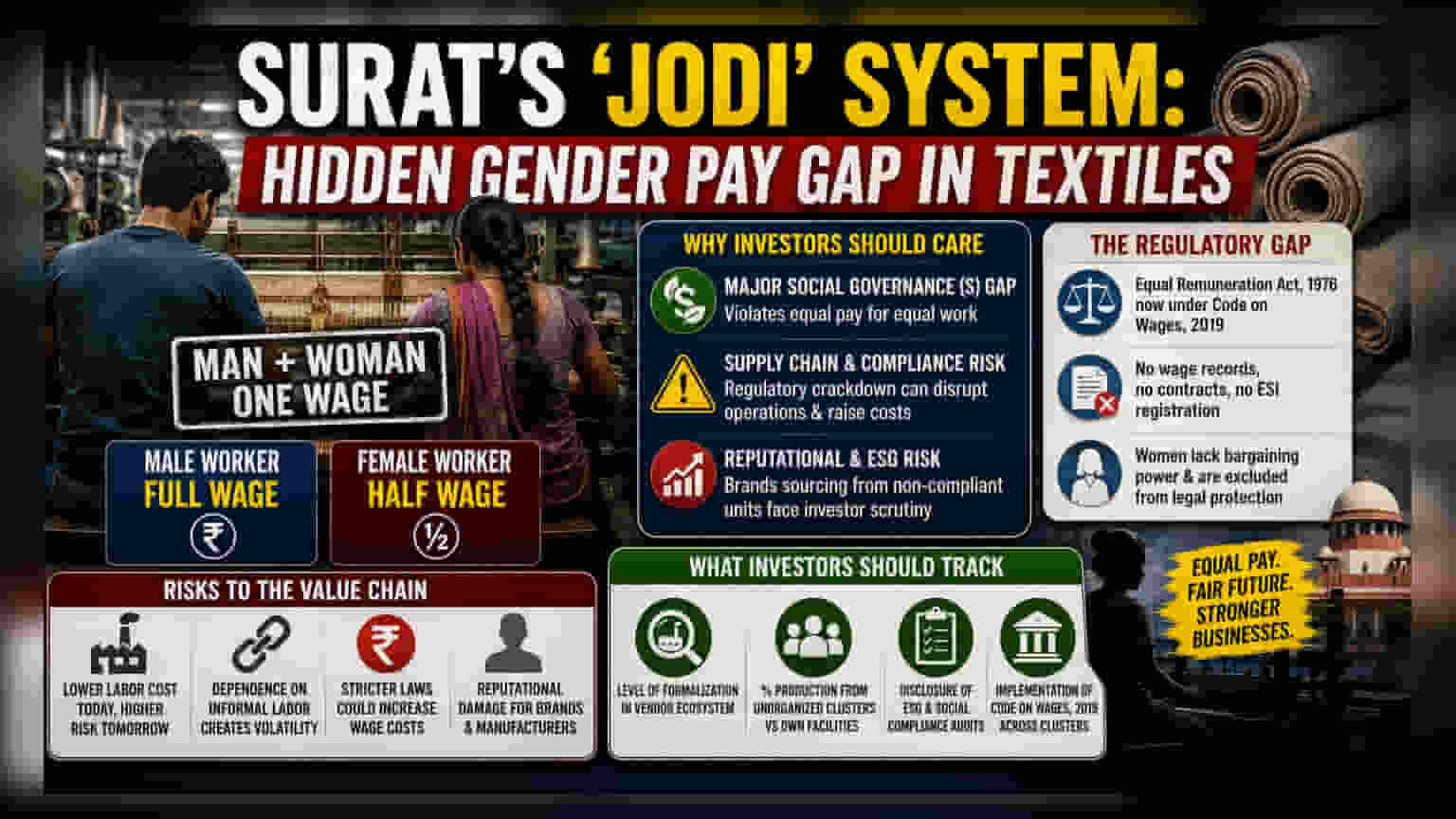
The 'jodi' system in Surat’s textile hub treats couples as a single employment unit, often paying women half the wages of their male counterparts. This informal structure evades labor law compliance, posing a material social risk for companies and supply chains as India moves toward formalizing its workforce.
What Happened
In Surat's textile powerloom industry, a long-standing practice known as the 'jodi' (pair) system persists. Under this arrangement, a man and a woman are recruited together to operate machinery. While they perform labor under identical conditions, they are paid as a single unit. In practice, the male worker receives a full wage, while the female worker receives only half, effectively creating a significant gender wage gap. Because this arrangement operates in the informal sector, women are often left without independent wage records, social security registrations like ESI, or formal employment contracts.
Why This Matters for Investors
For investors, the 'jodi' system represents a significant gap in labor compliance and social governance (the 'S' in ESG). The textile industry in India is highly fragmented, with many smaller units operating in the informal economy. Large, listed textile manufacturers often rely on these clusters for yarn, fabric, and processing.
When labor laws are bypassed, companies face latent risks. As India integrates the Equal Remuneration Act of 1976 into the new Code on Wages, 2019, the government is placing higher importance on transparency and formal employment. Any sudden regulatory crackdown on these clusters could disrupt supply chains, increase labor costs, or lead to operational stoppages. Furthermore, institutional investors are increasingly screening for such practices when evaluating the sustainability of textile supply chains.
The Regulatory Gap
Legislators have long attempted to mandate equal pay for equal work, but the 'jodi' system thrives by staying below the radar of formal oversight. The law typically requires clear employer-employee relationships and wage registers to enforce compliance. Because 'jodi' workers are often considered part of an informal arrangement—frequently tied to migrant housing provided for men—they fall outside the traditional framework of labor courts and inspectors.
This creates a mismatch between the intent of the law and the reality on the ground. Women in these arrangements lack the bargaining power to demand independent pay or benefits, and the lack of documentation makes it difficult for regulators to prove violations, even if they choose to investigate.
Risks to the Value Chain
While this system currently lowers direct labor costs for informal units, it carries long-term risks. Dependence on informal, unorganized labor creates high volatility in production capacity. If the sector faces stricter labor enforcement, businesses that rely on the cost-efficiency of the 'jodi' system may see their profit margins come under pressure due to rising wage bills or the need to transition to formal payrolls. Additionally, reputational risk exists for larger brands that may be indirectly sourcing from units failing to meet basic labor standards.
What Investors Should Track
Investors analyzing companies in the textile space should look beyond top-line revenue and consider supply chain transparency. Key monitorables include the level of formalization within a company’s vendor ecosystem, how much of their production is sourced from unorganized clusters versus owned, compliant facilities, and whether the company discloses its ESG or social compliance audits. The transition toward the Code on Wages, 2019, and its implementation status across different industrial clusters will remain a critical factor to watch for the long-term stability of the sector.