 Whalesbook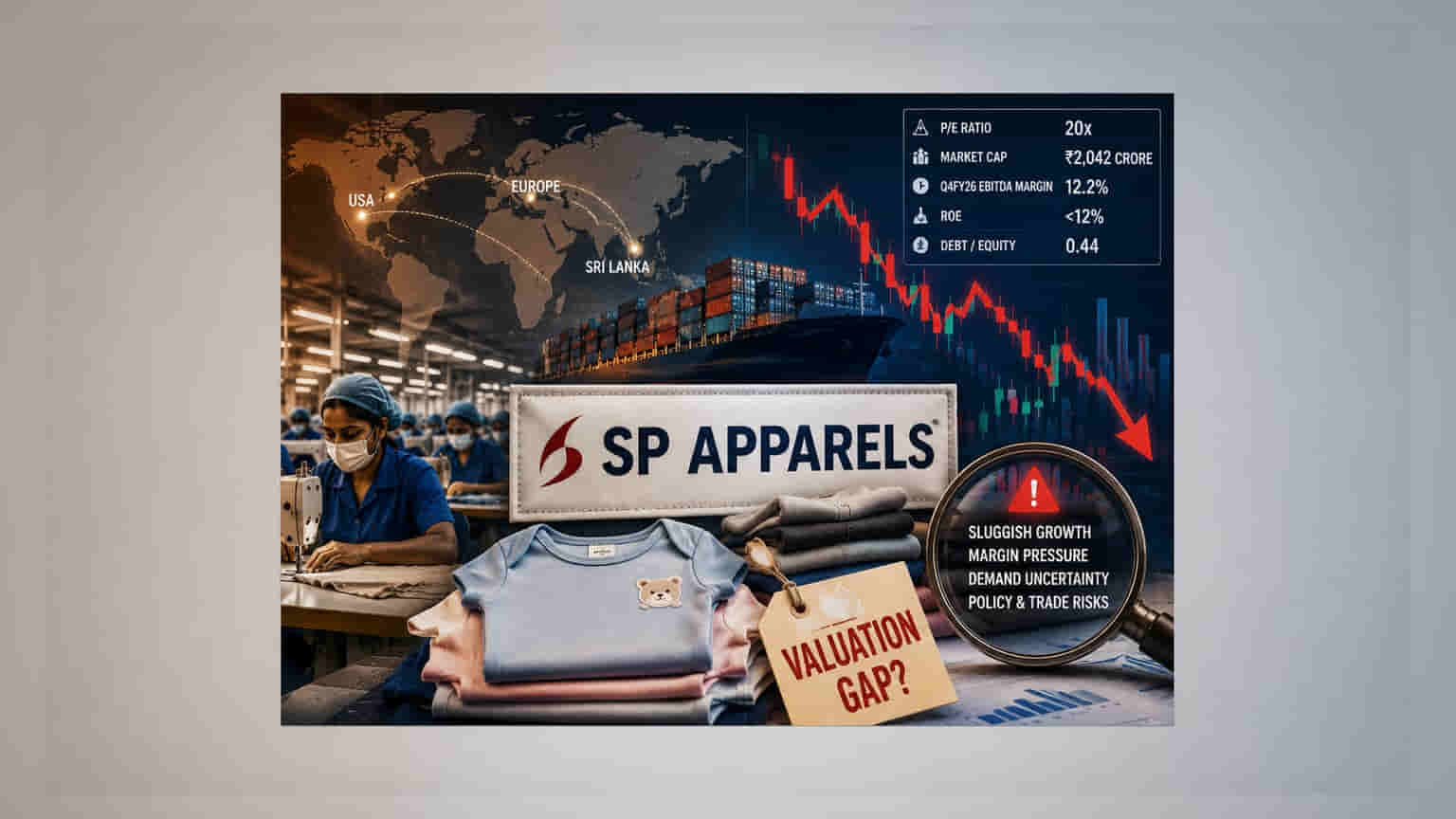


The Valuation Gap
SP Apparels currently trades at a price-to-earnings (P/E) multiple of approximately 20x, a valuation that assumes a rapid stabilization of order flows and successful execution of international expansion plans. However, the stock's recent performance reflects broader skepticism; despite a moderate recovery in the last month, the share price has lagged behind its sector peers. With a market capitalization near ₹2,042 crore, the company remains highly sensitive to demand shifts from Western retailers, where inventory management issues continue to dictate the pace of new order cycles. The gap between management’s ambitious growth projections and the realities of a 12.2% EBITDA margin in Q4FY26 highlights the disconnect between strategic intent and operational output.
The Analytical Deep Dive
When benchmarked against diversified textile manufacturers, the firm’s reliance on the infant and children’s wear segment—while providing a niche moat—limits its flexibility during cycles of discretionary consumption slowdowns. The ongoing expansion into Sri Lanka represents a critical pivot, intended to leverage lingerie production capabilities and diversify the manufacturing footprint away from India’s primary hubs. Yet, this capital-intensive move arrives at a time when capacity utilization across the sector is under pressure. Historically, the firm has faced volatility in realizations, and the 3% decline witnessed over recent quarters suggests that pricing power remains constrained by the highly competitive global export environment. Unlike larger, more integrated players that benefit from greater scale and deeper vertical integration, the firm’s reliance on favorable trade agreements and duty-drawback schemes leaves its profitability susceptible to regulatory changes and government policy shifts.
The Forensic Bear Case
Investors should view the current optimism with caution, as several structural weaknesses persist. The firm’s return on equity (ROE) has struggled to cross the 12% threshold, a figure that appears underwhelming when compared to top-tier apparel manufacturers. Debt levels, while currently manageable at an equity ratio of approximately 0.44, warrant close monitoring as the company pursues aggressive expansionary capital expenditure. Furthermore, the management’s reliance on cyclical US demand for its 'Young Brand' division exposes the firm to geopolitical risks and potential trade-related shocks. Past instances of sluggish profit growth, coupled with institutional DIIs reducing their stake in recent quarters, suggest that the 'smart money' is not yet convinced of a sustained fundamental turnaround. Any failure to hit the FY27 revenue targets or further margin erosion due to commodity price fluctuations could lead to a significant downward correction in the stock price.
The Future Outlook
Guidance remains focused on hitting the ₹2,000 crore revenue mark, with operating margins projected to scale toward the 14-15% range. For this to materialize, the firm must successfully navigate the 90-120 day lead times inherent in its export contracts. Market participants should monitor the order book velocity in the upcoming quarters as the primary indicator of whether the recent uptick in client interaction converts into high-margin, long-term revenue streams.