 Whalesbook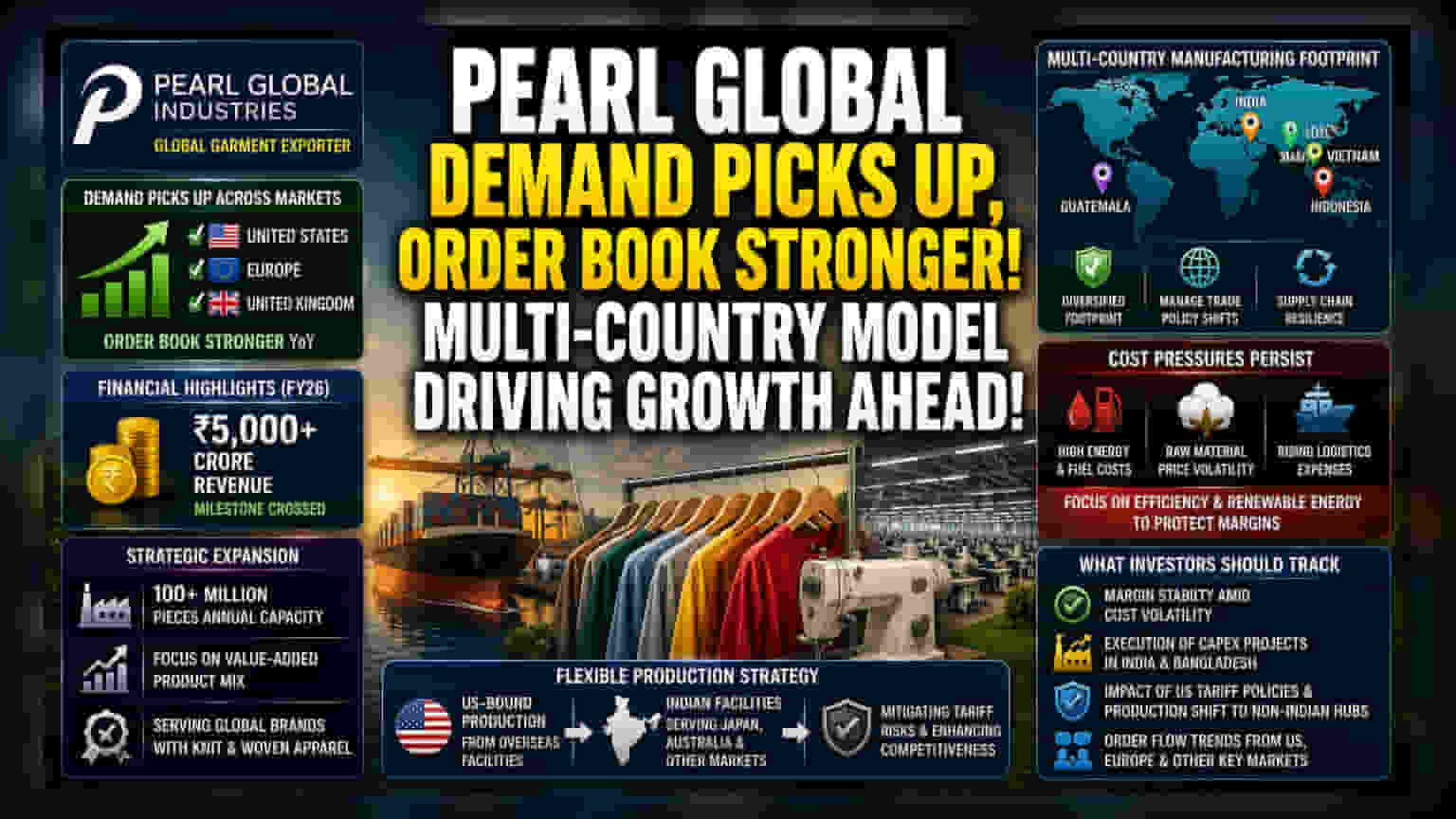


Pearl Global Industries is seeing strong export demand from the US and Europe, supporting a healthy order book. The company plans to leverage its multi-country manufacturing model to meet this demand, though investors are keeping a close watch on rising raw material and energy costs as well as global trade tariff dynamics.
What Happened
Pearl Global Industries, a prominent Indian garment exporter, has reported a positive shift in demand across its key international markets, including the United States, Europe, and the UK. The company, which operates an expansive network of manufacturing facilities across India, Bangladesh, Vietnam, Indonesia, and Guatemala, stated that its current order book is notably stronger compared to the previous year. This improvement in order volume comes as global retail confidence begins to stabilize after a period of caution.
Strategic Expansion and Multi-Country Model
Pearl Global continues to pursue an aggressive capacity expansion strategy, supported by its existing annual production capacity of over 100 million garment pieces. A key aspect of the company’s business model is its diversified manufacturing footprint. By spreading operations across various countries, the firm aims to navigate geopolitical challenges and trade policy shifts—such as potential US tariff changes—more effectively than single-country exporters. The management has indicated a strategy to pivot US-bound production to its overseas facilities where it is more efficient, while utilizing Indian facilities to serve other markets like Japan and Australia. This flexibility is central to the company’s goal of maintaining supply chain resilience.
Financial and Operational Context
For the financial year ended March 2026, Pearl Global surpassed the Rs 5,000 crore revenue milestone, reflecting steady growth in volumes and the benefits of its value-added product mix. The company has focused on scaling operations to compete with larger global vendors, emphasizing operational excellence and cost-efficiency. Its ability to offer multi-product solutions, including both knit and woven apparel, has helped it maintain relationships with marquee global brands and retailers. However, the company’s performance remains sensitive to its operating margins, which are influenced by the effective utilization of its expanded capacity.
Why Investors Are Watching Costs
While demand is recovering, the industry faces persistent headwinds regarding input costs. Management has highlighted that increased energy and fuel prices, partly driven by global geopolitical tensions, are impacting the cost of logistics and manufacturing. Additionally, raw material prices, particularly for cotton and synthetic fabrics, remain volatile. For investors, the key test will be whether the company can pass on these cost increases or manage them through operational efficiencies to protect its profitability. While the company has implemented measures like investments in renewable energy and sustainable facilities to save costs, these factors remain critical monitorables.
Risks and Market Pressures
Investors should be aware that the textile sector is currently navigating a fragile global recovery. The risk of tariff adjustments in the US remains a point of concern for Indian exporters, as it can directly impact the competitive pricing of goods. Furthermore, the company’s performance is tied to the purchasing power of consumers in the US and Europe; any sudden economic slowdown in these regions could impact order flows. Competition from other garment-exporting hubs also necessitates continuous investment in product quality and compliance standards, which adds to the operational cost base.
What Investors Should Track
Moving forward, the primary monitorables for Pearl Global will be the stability of its profit margins amid fluctuating energy and raw material prices. Investors should also track the successful execution of planned capital spending (capex) projects in India and Bangladesh, as delays in scaling up could hinder volume growth. Finally, management commentary regarding the impact of US trade policies and the company's ability to shift production to its non-Indian hubs to mitigate tariff risks will be essential to understanding the company's long-term competitive position.