

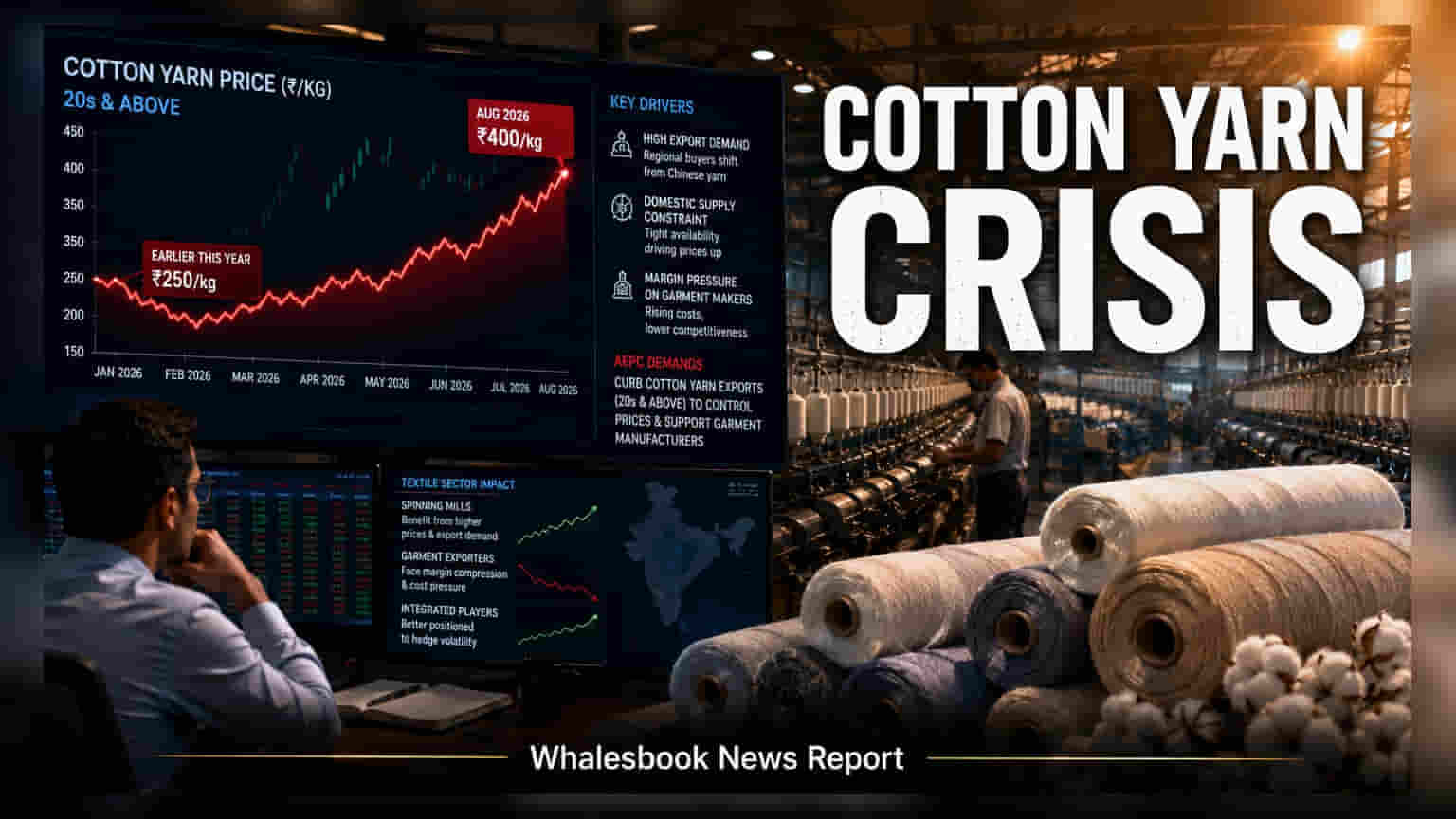
The Apparel Export Promotion Council has requested the government to restrict cotton yarn exports, citing a sharp price rise to ₹400 per kg. The move highlights deepening margin pressure on Indian garment manufacturers, who are struggling with raw material costs as global demand drains domestic supply.
The Apparel Export Promotion Council (AEPC) has formally approached the Union Ministry of Commerce and Industry and the Ministry of Textiles to seek urgent intervention regarding cotton yarn exports. The council is advocating for regulatory measures to curb outward shipments of yarn, specifically targeting counts of 20s and above, as domestic prices have surged to approximately ₹400 per kg, compared to ₹250 per kg earlier this year.
The industry body argues that this significant increase in raw material costs is threatening the survival of many Indian garment manufacturers. The core of the complaint is that high external demand—driven by regional players seeking alternatives to restricted Chinese inputs—is draining the domestic market. Consequently, value-added garment exporters are finding it increasingly difficult to maintain their profit margins, as they cannot pass these rapid cost increases on to international buyers immediately.
This development brings the structural divide in the Indian textile industry back into focus. Spinning mills, which produce the yarn, typically benefit from higher global prices and increased export demand. Conversely, downstream garment manufacturers, who purchase this yarn to produce finished apparel, face severe margin compression when prices spike. For investors, this creates a distinct split in operational performance. Integrated textile companies, which possess the capability to both spin yarn and manufacture garments, are generally better positioned to hedge against these price swings. In contrast, standalone garment manufacturers remain highly vulnerable to volatile raw material procurement costs.
The government has previously attempted to manage this supply-demand balance through fiscal policy. Currently, an 11% import duty waiver on raw cotton is in effect, which is scheduled to expire in October 2026. This measure was introduced to improve domestic availability and cool prices. However, the AEPC's latest request suggests that the market remains tight and that the industry is looking for more direct regulatory control over the outflow of yarn.
Moving forward, the key investor monitorable will be whether the government chooses to intervene in the export market. Any move to restrict yarn exports would likely support domestic garment margins by easing supply constraints, but it would conversely place downward pressure on the export realizations of spinning companies. Market participants will also track the sustainability of yarn prices beyond the current peak, as global demand patterns and inventory levels play a major role in pricing.
Investors should closely watch for any official announcements from the Ministry of Commerce and Industry regarding export quotas or restrictions, as well as any updates regarding the extension of the cotton import duty waiver as the October deadline approaches. Understanding how a company manages its inventory and raw material hedging will be crucial for assessing performance in this volatile pricing environment.