

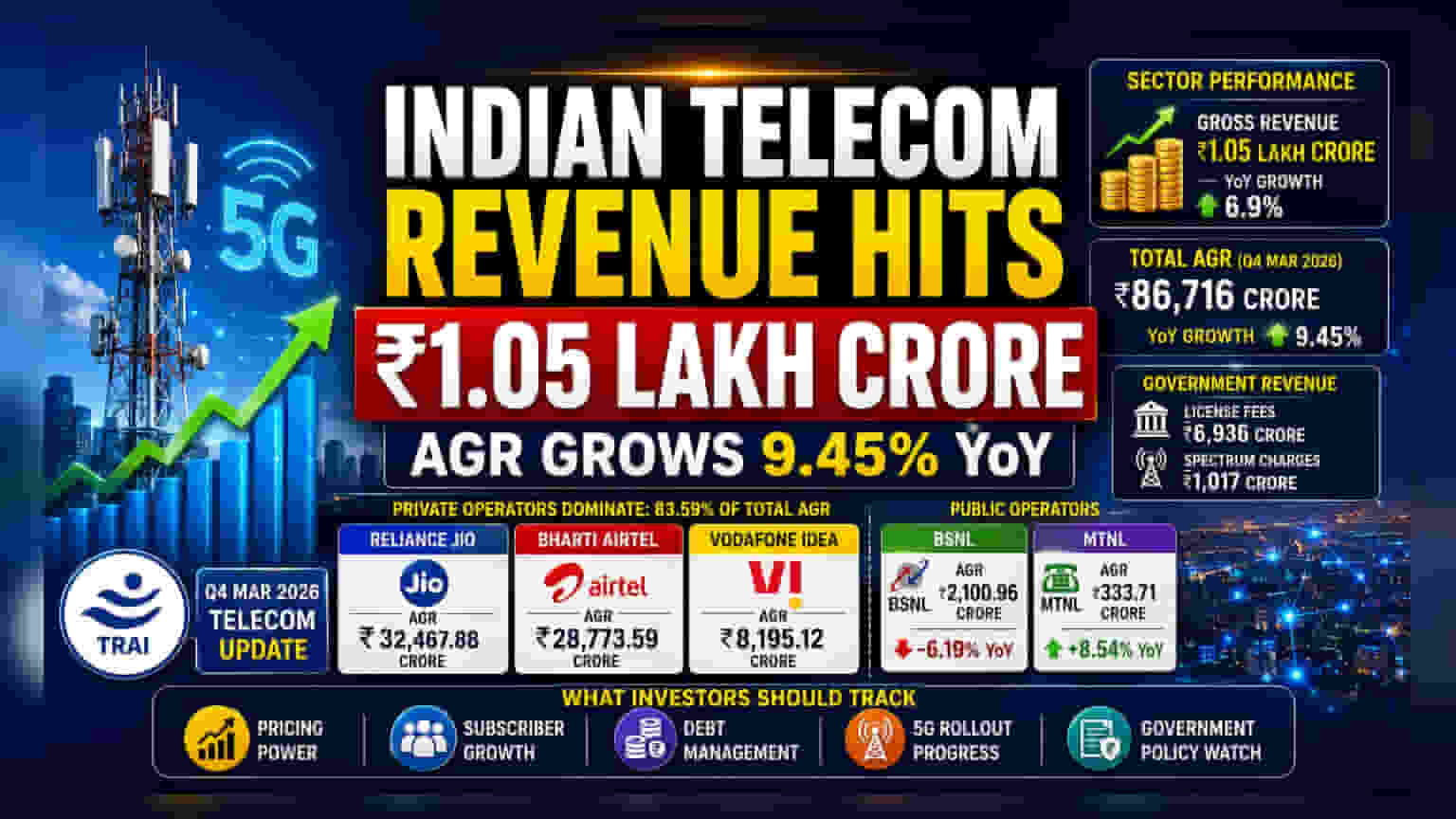
India’s telecom sector recorded a 6.9% revenue growth to ₹1.05 lakh crore in the March 2026 quarter. Adjusted Gross Revenue (AGR) rose by 9.45%, reflecting stable demand for data and voice services. Investors are watching how this revenue trend helps telecom companies manage their heavy debt loads and fund network expansion.
What Happened
The Indian telecom sector reported a total gross revenue of ₹1.05 lakh crore for the quarter ending March 2026. This is a 6.9% increase compared to the ₹98,250 crore recorded in the same period last year. According to data released by the Telecom Regulatory Authority of India (TRAI), the sector continues to show steady financial growth, driven by consistent demand for telecom services across the country.
Revenue Trends and AGR
Investors often look at Adjusted Gross Revenue (AGR) to understand the actual health of the sector, as this is the figure used to calculate government levies like license fees and spectrum usage charges. In the March 2026 quarter, the sector's total AGR stood at ₹86,716 crore. This marks a 9.45% growth compared to the ₹79,226 crore reported in the same quarter last year. The growth in AGR is a positive sign for the sector’s cash flow, as it indicates the money companies are generating from core telecom operations.
How Major Players Stack Up
Private telecom operators continue to capture the vast majority of the market, accounting for 83.59% of the total AGR in the quarter. Reliance Jio remains the market leader, reporting an AGR of ₹32,467.88 crore. Bharti Airtel followed with an AGR of ₹28,773.59 crore. Vodafone Idea, which operates with a different capital structure and debt profile compared to the two market leaders, reported an AGR of ₹8,195.12 crore. These figures reflect the ongoing competitive intensity in the market, as companies vie for market share in both data and voice segments.
Public Sector Operator Performance
Performance among state-run operators was mixed. Bharat Sanchar Nigam Limited (BSNL) reported a 6.19% decline in its AGR year-over-year, totaling ₹2,100.96 crore, despite recent reports of profitability in some operational areas. Meanwhile, Mahanagar Telephone Nigam Limited (MTNL) showed a different trend, with its AGR growing by 8.54% to reach ₹333.71 crore.
What Investors Should Track
The telecom sector remains capital-intensive, requiring constant spending on infrastructure like 5G rollouts. While the 9.45% growth in AGR provides a clearer picture of operational cash generation, investors should closely watch for a few key factors. These include the ability of companies to maintain pricing power, the pace of subscriber growth, and the management of high debt levels, particularly for players with lower market shares. Additionally, changes in government policy regarding license fees and spectrum charges, which contributed ₹6,936 crore and ₹1,017 crore respectively to government revenue this quarter, will remain an important area for long-term financial planning.