

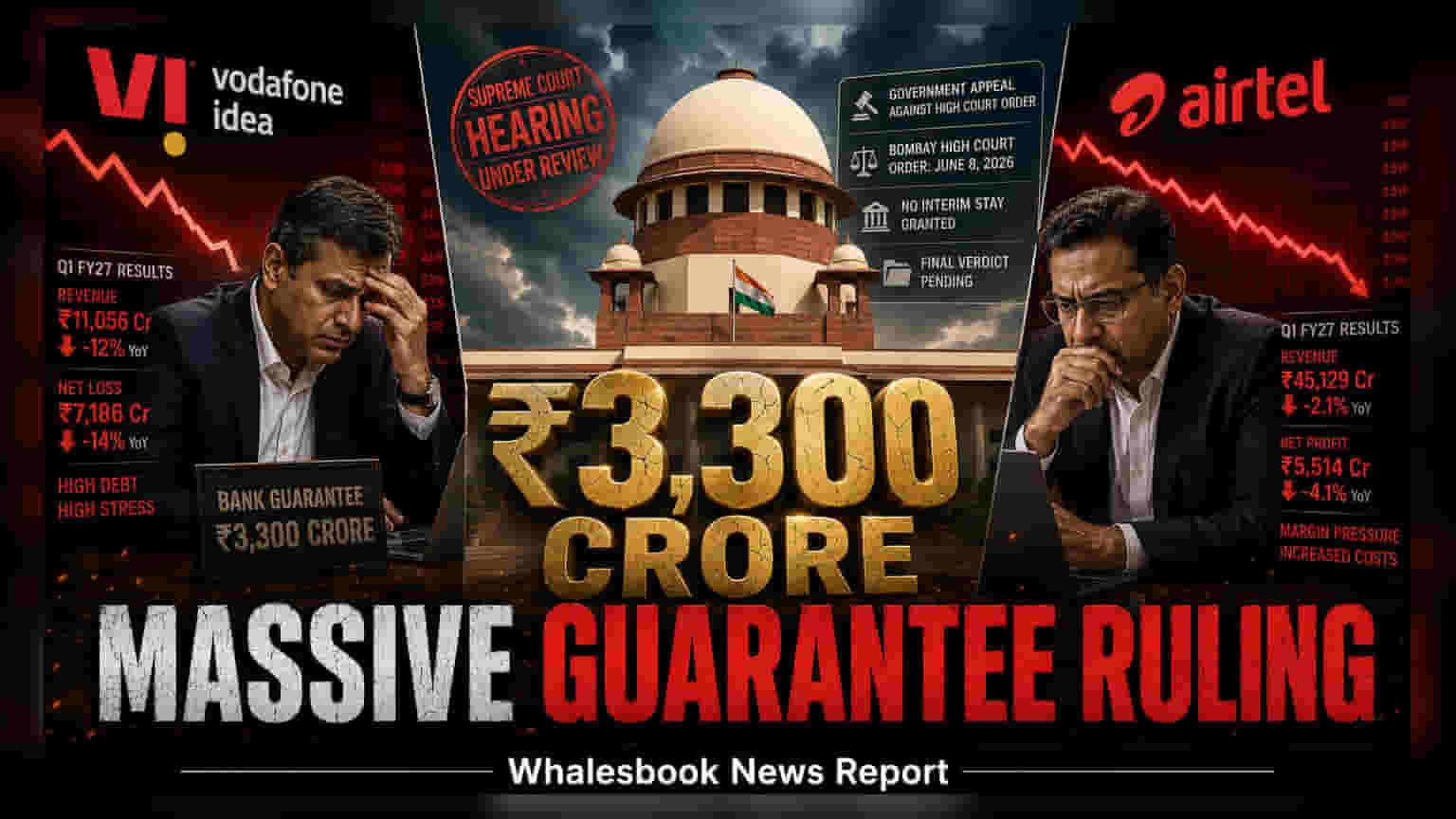
The Supreme Court is hearing the government's appeal against a Bombay High Court ruling that ordered the release of ₹3,300 crore in bank guarantees to telecom companies. The apex court has declined to issue an interim stay, though the final legal dispute regarding retrospective spectrum charges remains pending. This situation impacts the financial liquidity of major operators like Bharti Airtel and Vodafone Idea.
The Supreme Court is currently reviewing an appeal filed by the Union of India regarding a significant financial dispute with major telecom operators. A bench led by Justice BV Nagarathna and Justice R. Mahadevan is examining a June 8, 2026, Bombay High Court judgment that ruled in favor of telecom firms, including Bharti Airtel and Vodafone Idea. The High Court order had directed the release of approximately ₹3,300 crore in bank guarantees held by the government.
While the Supreme Court has agreed to hear the government’s challenge, it refused to grant an interim stay on the High Court’s ruling. This means that, for now, the path remains open for the return of these guarantees, though the legal case is far from closed. The outcome is being closely followed by investors as it relates to a larger, long-standing regulatory disagreement over spectrum pricing.
Origins of the Spectrum Charge Dispute
The root of this legal conflict lies in the government's 2012 decision to impose a One-Time Spectrum Charge (OTSC) on telecom operators. The government sought to levy this charge retrospectively on spectrum holdings that exceeded 6.2 MHz, covering the period from July 2008 to 2012. Telecom companies have consistently challenged these demands, arguing that the government does not have the legal or contractual authority to change license terms retroactively.
The Bombay High Court’s decision earlier this year validated this view, stating that the government had not provided sufficient justification for such a retrospective levy. For companies like Vodafone Idea and Bharti Airtel, this was a significant development, as the total financial impact of the disputed charges across the industry is estimated to exceed ₹20,000 crore.
Financial Implication for Telecom Players
For investors, the immediate focus is on liquidity and balance sheet flexibility. Vodafone Idea, which has historically operated under high financial stress and significant debt, stands to benefit if the ₹3,300 crore in bank guarantees is returned to its cash reserves. Access to these funds could provide a temporary cushion for its operational expenses or debt-servicing requirements.
However, the situation remains fluid. Because the Supreme Court has only refused an interim stay and the final judgment is pending, the risk of a potential reversal in the future persists. If the Supreme Court ultimately rules in favor of the government, the telecom companies could be required to settle these liabilities, which would impact their financial standing. The final verdict will set a critical precedent for how retrospective spectrum pricing disputes are handled in the Indian telecom sector. The next phase will involve detailed hearings, and market participants will likely track any further developments regarding the status of these bank guarantees during court proceedings.