

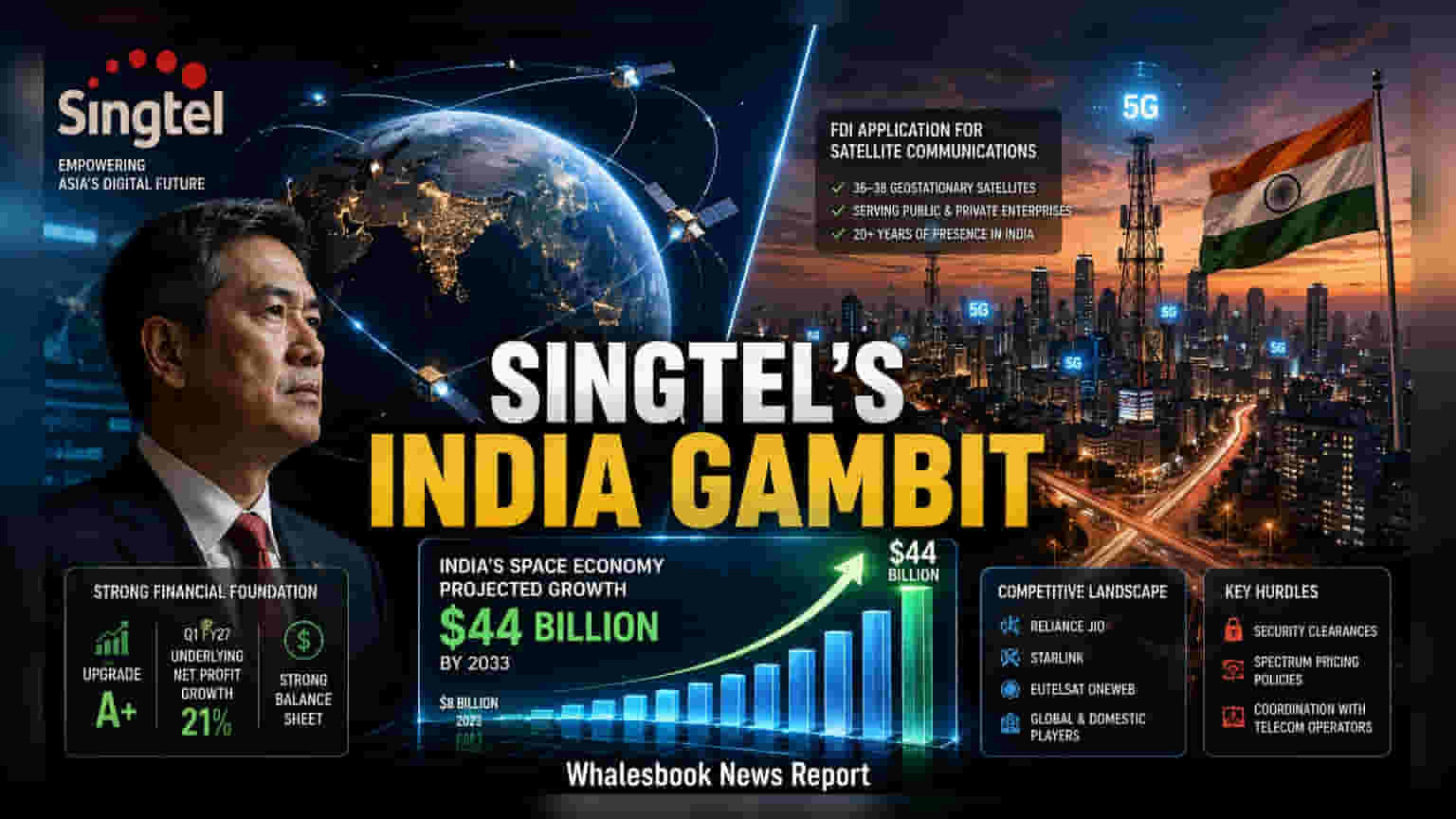
Singtel has applied for foreign direct investment approval to launch satellite communication services in India through its subsidiary, Singapore Telecom India. The move comes as the company seeks to expand its footprint in the country's growing space sector. Investors will likely monitor how the company handles regulatory hurdles, spectrum pricing, and intense competition from existing global and domestic players.
Singapore Telecommunications (Singtel) has formally requested foreign direct investment (FDI) approval from the Indian government to expand its local operations into the satellite communications (satcom) market. The application, filed by its subsidiary Singapore Telecom India (STIPL), signals a strategic effort to broaden the company's service offerings in the country, where it has already maintained a presence for more than 20 years.
This application follows the Indian Space Policy introduced in December 2023, which was designed to encourage private sector participation in the space economy. Singtel, which is already a significant stakeholder in Bharti Airtel with a 26.85% interest, is now looking to establish a more direct operational role in the satellite segment. The company aims to provide services to both public and private enterprises by utilizing its global network, which includes approximately 36 to 38 geostationary satellites.
Financial Context and Strategic Strength
Singtel’s move into the Indian satcom space is supported by a stable financial position. In August 2026, S&P Global Ratings upgraded the company's credit rating to 'A+', highlighting its strong balance sheet and successful asset monetization program. Additionally, the company reported a 21% growth in underlying net profit for the first quarter of fiscal year 2027, demonstrating its ability to generate capital for expansion. This financial discipline is expected to be a factor as the company navigates the high costs often associated with setting up satellite infrastructure and terrestrial network integration.
Competition and Regulatory Hurdles
While Singtel has the financial backing to pursue this expansion, the Indian satcom landscape is becoming increasingly crowded. The company will face competition from well-capitalized global and domestic players, including Reliance Jio, Starlink, and Eutelsat OneWeb. These firms are also vying for market share in a sector projected to see significant growth over the next decade.
Investors should note that the regulatory environment remains the most critical factor for all participants. No foreign entity has yet commenced commercial satcom services in India, largely due to pending security clearances, unresolved spectrum pricing policies, and the complexities of coordinating with established telecom operators. The Indian National Space Promotion and Authorisation Centre (IN-SPACe) is acting as the single-window authority for these approvals, and the timeline for Singtel’s entry will depend on these government processes.
Execution will also be a test for the company. Successfully integrating satellite capabilities with existing terrestrial networks like 4G and 5G is a technical challenge that will determine the service quality and commercial viability of the offering. The next important update for shareholders will be the government’s decision on the FDI application and any subsequent clarity on spectrum allocation rules, which will define the competitive playing field for all satcom providers in India.