 Whalesbook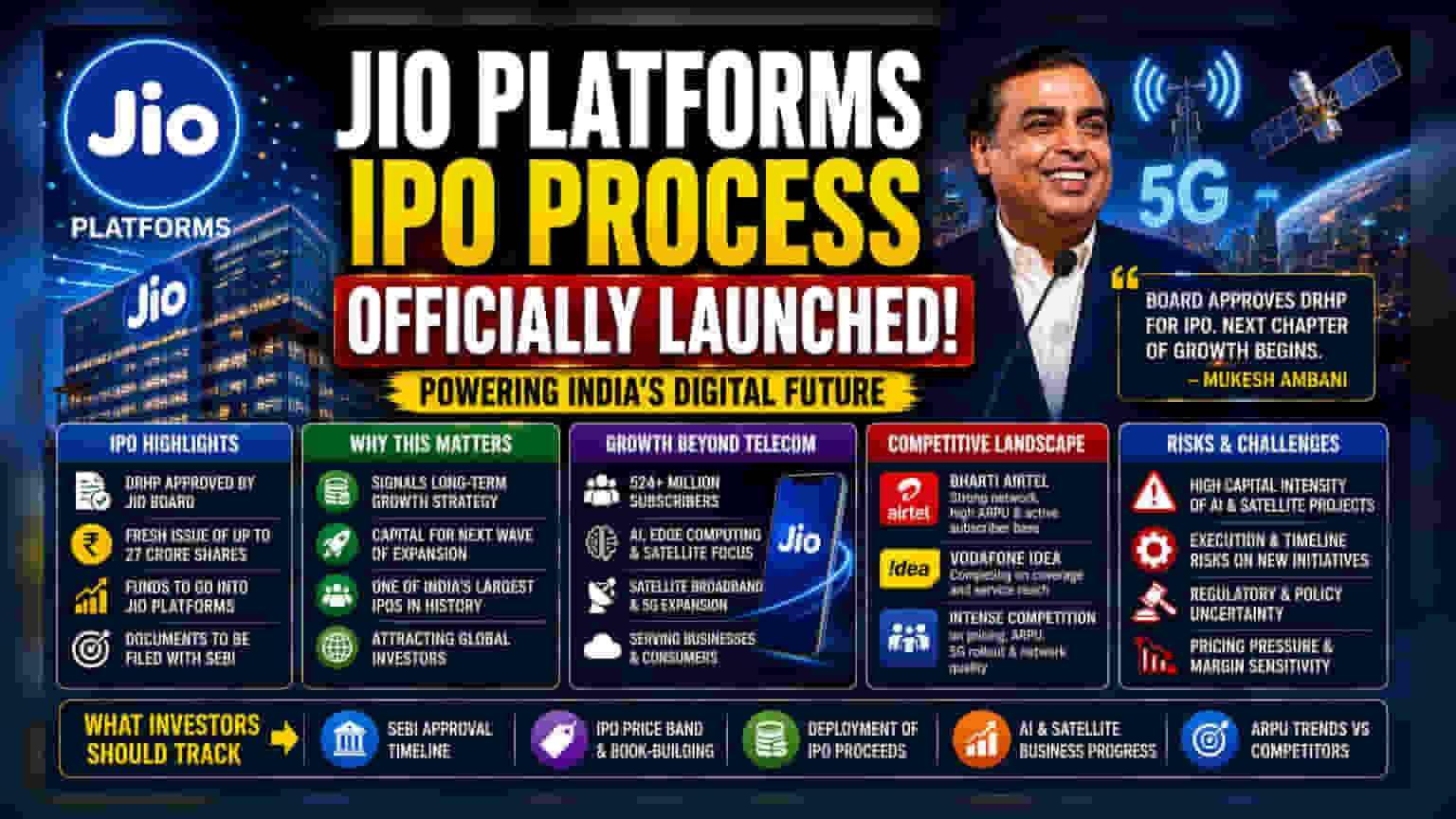
Reliance Jio Platforms has taken the first step toward a massive stock market debut, filing draft papers for an IPO. The company plans a fresh issue of up to 27 crore shares, signaling its intent to raise significant capital for AI, 5G, and satellite broadband projects. This move marks a major shift in India’s tech sector, aiming to unlock value for Reliance Industries shareholders while positioning Jio for its next phase of growth amid fierce telecom competition.
What Happened
Reliance Jio Platforms, the digital and telecom powerhouse of the Reliance Industries group, has officially initiated the process for its highly anticipated stock market debut. During the company’s 49th Annual General Meeting held on June 19, 2026, Chairman Mukesh Ambani announced that the board has approved the Draft Red Herring Prospectus (DRHP) for an Initial Public Offering (IPO). The company plans to file these documents with the Securities and Exchange Board of India (SEBI). The IPO is structured as a fresh issue of up to 27 crore equity shares, meaning the funds raised will go directly into the company’s coffers to support its business operations rather than providing an exit for existing shareholders.
Why This Matters For Investors
For investors, this filing is a significant indicator of Reliance Industries' long-term strategy. By choosing to launch a fresh issue instead of selling existing stakes, Jio is signaling that it needs substantial capital to fund its next wave of expansion. The company is pivoting from being primarily a telecom provider to becoming a technology-first entity. The funds are earmarked for building out advanced artificial intelligence infrastructure, accelerating 5G network reach, and developing satellite broadband connectivity. This IPO is expected to be one of the largest in Indian history, aiming to showcase the company's global scale and attract a wider base of institutional and retail investors.
Expanding Beyond Telecom
While the core telecom business remains the primary engine, Jio Platforms is aggressively diversifying. The company reported a subscriber base exceeding 524 million, making it India’s largest telecom operator. However, its future growth narrative is heavily tied to its investments in AI, edge computing, and satellite technology. Management has emphasized that this IPO will provide the necessary resources to transition the business into a developer of global-scale proprietary technology, aiming to serve both small businesses and large enterprises with integrated digital solutions.
Competitive Landscape and Peer Check
The Indian telecom sector remains intensely competitive. While Jio holds the largest market share, it faces consistent pressure from peers like Bharti Airtel, which has maintained strong operational performance and a high percentage of active subscribers. Vodafone Idea continues to operate in the market, adding another layer of complexity. Investors often compare these companies based on metrics like Average Revenue Per User (ARPU) and the pace of 5G rollout. Jio’s ability to sustain its market leadership while competing with Airtel’s infrastructure and Vodafone Idea’s service expansion will be a critical factor for market analysts as they evaluate the company's valuation.
Risks and Execution Challenges
While the growth plans are ambitious, investors should be aware of the inherent risks. The company is embarking on large-scale, high-cost projects such as satellite broadband and sovereign AI infrastructure, which require significant capital and carry execution risk. If these projects face delays or do not generate the expected return on investment, it could pressure the company’s financial margins. Additionally, the telecom industry is highly sensitive to regulatory changes, shifts in pricing power, and the ongoing need to upgrade technology to keep pace with global standards. Maintaining a balance between aggressive expansion and operational efficiency will be the key challenge for the leadership team.
What Investors Should Track
Moving forward, the primary monitorables for investors include the formal SEBI approval timeline and the eventual price band determined through the book-building process. Investors should also pay close attention to management commentary regarding the deployment of IPO funds, as this will clarify how quickly the company plans to scale its AI and satellite broadband divisions. Keeping an eye on the competitive dynamics, particularly ARPU trends compared to peers like Bharti Airtel, will help in assessing the company’s pricing power as it evolves into a broader technology conglomerate.