

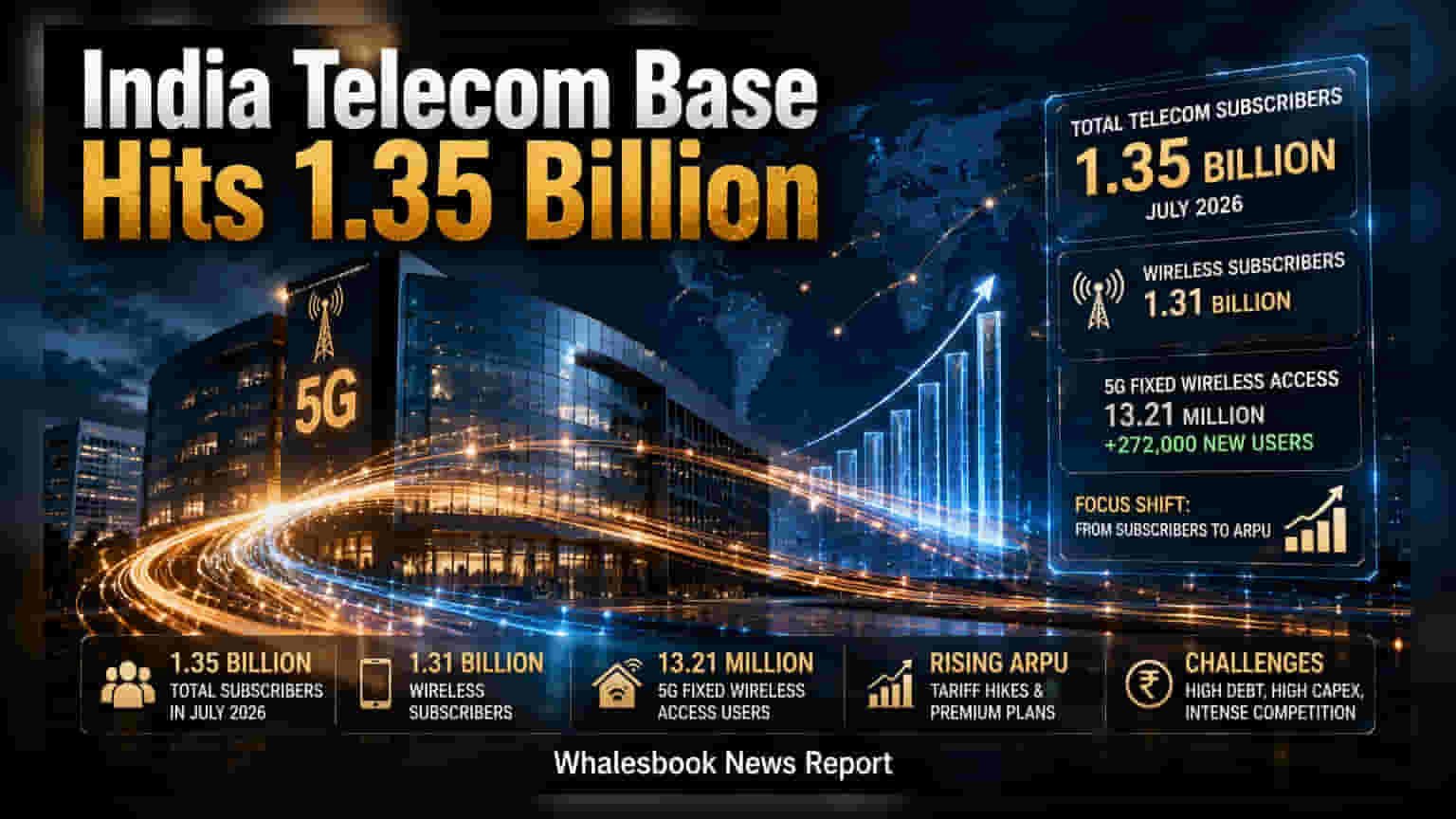
India's telephone subscriber base touched 1.35 billion in July 2026, supported by steady wireless and broadband adoption. For investors, the growth in 5G Fixed Wireless Access signals a shift toward higher-value services, though the industry continues to grapple with high debt and competitive churn.
India’s telecom sector expanded further in July 2026, with the total subscriber base reaching 1.35 billion. According to data from the Telecom Regulatory Authority of India, the industry added millions of new connections, with wireless users accounting for 1.31 billion of the total. This consistent growth highlights the deep penetration of mobile services across the country, but for investors, the focus is shifting away from pure subscriber numbers toward how much revenue each user generates.
The Shift Toward Revenue-Led Growth
While the total number of users continues to climb, the industry is increasingly prioritizing Average Revenue Per User, or ARPU. Recent performance in the sector shows that top-tier operators are looking to boost profitability through tariff adjustments and by pushing customers toward premium data plans. The steady rise in 5G Fixed Wireless Access, which added over 272,000 new users to reach 13.21 million, is a key part of this strategy. This technology allows operators to offer high-speed home internet without needing to lay cables to every house, providing a new way to earn from existing 5G infrastructure.
Competitive Landscape and Financial Risks
The broadband and mobile market remains highly consolidated, with Reliance Jio, Bharti Airtel, and Vodafone Idea controlling the vast majority of the landscape. Intense competition remains a constant factor, as evidenced by millions of mobile number portability requests processed every month. This churn makes customer retention a primary goal for the leading carriers, often leading to increased marketing and promotional spending.
Despite the growth in subscribers and data consumption, financial pressure persists for some operators. Building out 5G networks across a country as large as India requires massive capital spending, which has kept debt levels elevated for several players. While industry-wide repricing efforts, such as Bharti Airtel’s ARPU crossing the ₹200 threshold, aim to improve cash flows, the burden of servicing existing debt remains a critical factor for long-term viability.
Investors will be tracking how these operators balance their heavy capital spending on network upgrades with the need to deleverage their balance sheets. Future updates regarding industry-wide tariff trends, the pace of 5G monetization, and the management of debt obligations will be the primary factors determining financial performance in the coming quarters.